The China Mail - 'Very strong' nuclear verification needed in Iran after war: IAEA head

USD -
AED 3.672502
AFN 64.000263
ALL 82.887148
AMD 366.961185
ANG 1.790403
AOA 916.999974
ARS 1477.282482
AUD 1.451326
AWG 1.8
AZN 1.69974
BAM 1.719513
BBD 2.010673
BDT 122.690487
BGN 1.69088
BHD 0.376397
BIF 2974.792134
BMD 1
BND 1.295148
BOB 6.89258
BRL 5.176601
BSD 0.998341
BTN 94.112631
BWP 13.622705
BYN 2.840941
BYR 19600
BZD 2.007699
CAD 1.419465
CDF 2269.999442
CHF 0.809125
CLF 0.023381
CLP 920.204301
CNY 6.80385
CNH 6.806635
COP 3447.33
CRC 454.351489
CUC 1
CUP 26.5
CVE 97.350115
CZK 21.33975
DJF 177.776214
DKK 6.57171
DOP 59.37498
DZD 133.406996
EGP 49.511101
ERN 15
ETB 157.452947
EUR 0.87917
FJD 2.266102
FKP 0.756718
GBP 0.757645
GEL 2.644983
GGP 0.756718
GHS 11.249719
GIP 0.756718
GMD 73.000293
GNF 8779.999741
GTQ 7.610005
GYD 208.702762
HKD 7.84129
HNL 26.71295
HRK 6.624102
HTG 130.476672
HUF 311.820498
IDR 17932.85
ILS 2.999203
IMP 0.756718
INR 94.688449
IQD 1307.718026
IRR 1375050.000419
ISK 126.597116
JEP 0.756718
JMD 157.33372
JOD 0.709004
JPY 161.625503
KES 129.529701
KGS 87.450007
KHR 4020.149139
KMF 434.00027
KPW 900.00035
KRW 1545.310216
KWD 0.30966
KYD 0.831896
KZT 483.810797
LAK 22188.003203
LBP 89397.304146
LKR 336.454108
LRD 181.540044
LSL 16.531463
LTL 2.95274
LVL 0.60489
LYD 6.410995
MAD 9.415497
MDL 17.719258
MGA 4256.067999
MKD 54.183404
MMK 2099.450161
MNT 3580.242389
MOP 8.062139
MRU 39.651054
MUR 47.710121
MVR 15.449697
MWK 1731.111883
MXN 17.5381
MYR 4.100597
MZN 63.915223
NAD 16.531463
NGN 1376.119947
NIO 36.733491
NOK 9.88535
NPR 150.695297
NZD 1.772125
OMR 0.3845
PAB 0.99749
PEN 3.422005
PGK 4.380744
PHP 61.303503
PKR 277.832264
PLN 3.76694
PYG 6100.388479
QAR 3.645025
RON 4.602102
RSD 103.16901
RUB 75.351681
RWF 1466.964054
SAR 3.748015
SBD 8.051953
SCR 13.241511
SDG 600.000121
SEK 9.73885
SGD 1.296115
SHP 0.746601
SLE 24.796392
SLL 20969.503664
SOS 570.490909
SRD 37.320245
STD 20697.981008
STN 21.55618
SVC 8.735131
SYP 110.532098
SZL 16.530795
THB 33.4385
TJS 9.221714
TMT 3.5
TND 2.937497
TOP 2.40776
TRY 46.616399
TTD 6.780108
TWD 31.864013
TZS 2627.689002
UAH 44.889771
UGX 3690.695456
UYU 40.019342
UZS 11982.22316
VES 620.752985
VND 26309.5
VUV 119.950905
WST 2.785497
XAF 577.139891
XAG 0.017722
XAU 0.000249
XCD 2.70255
XCG 1.799113
XDR 0.717821
XOF 577.180517
XPF 104.849947
YER 238.625001
ZAR 16.52215
ZMK 9001.205413
ZMW 18.019596
ZWL 321.999592
  • RBGPF

    0.0000

    61.3

    0%

  • CMSC

    -0.0190

    22.046

    -0.09%

  • CMSD

    -0.0900

    21.93

    -0.41%

  • BCC

    2.1000

    79.76

    +2.63%

  • BCE

    0.0000

    23.2

    0%

  • AZN

    2.6600

    185.68

    +1.43%

  • NGG

    0.5900

    83.42

    +0.71%

  • JRI

    0.0100

    12.58

    +0.08%

  • RYCEF

    0.7000

    18.7

    +3.74%

  • RELX

    -0.2300

    30.92

    -0.74%

  • BTI

    1.0900

    62.48

    +1.74%

  • GSK

    0.8000

    51.89

    +1.54%

  • VOD

    0.0500

    13.86

    +0.36%

  • BP

    -0.1400

    37.72

    -0.37%

  • RIO

    1.0800

    95.11

    +1.14%

'Very strong' nuclear verification needed in Iran after war: IAEA head
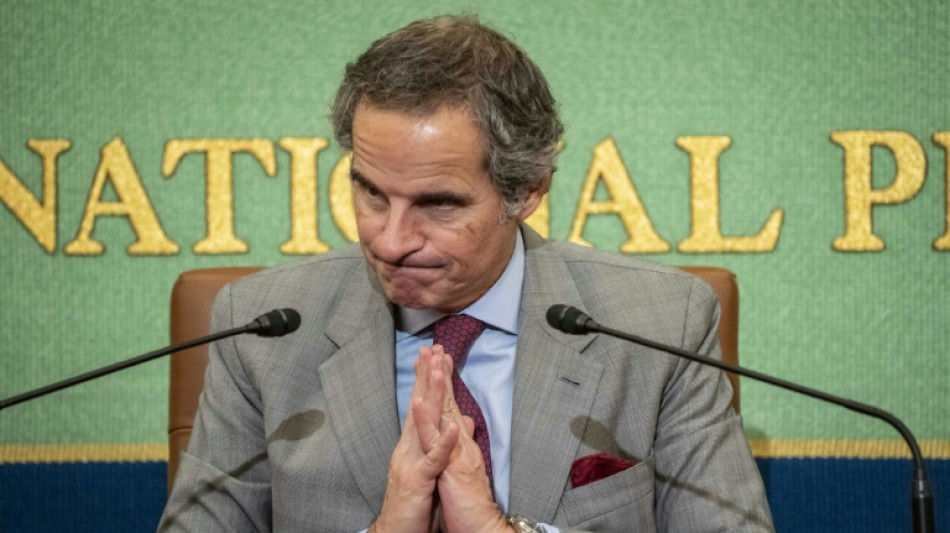
'Very strong' nuclear verification needed in Iran after war: IAEA head / Photo: © AFP

'Very strong' nuclear verification needed in Iran after war: IAEA head

"Very strong" verification is needed in Iran following the Middle East conflict to ensure that it does not develop nuclear weapons, the UN atomic watchdog chief said on Friday.

Text size:

International Atomic Energy Agency (IAEA) head Rafael Grossi's remarks come as the United States and Iran negotiate a broader agreement to end the war, with Tehran's nuclear programme a key sticking point.

"I think the objective of this (recent US-Iran preliminary) agreement is to ensure that there is no development of nuclear weapons in Iran. The government of Iran has declared quite clearly that this is not their intention," Grossi told reporters in Japan.

"But of course intentions are not enough. We have to have a very strong verification system in place... as soon as is practicable," the IAEA chief said.

Grossi said the watchdog had also "barely initiated" talks with Iran following its preliminary agreement with the United States about what to do with Tehran's uranium stockpile.

"Initial conversations have taken place... We expect this work to pick up soon," Grossi said.

Before the conflict, the IAEA estimated that Iran had 440 kilograms (970 pounds) of uranium enriched to 60 percent.

That is close to the 90 percent needed to make a bomb and well above the 3.67-percent limit set by a now-defunct 2015 agreement with Iran.

Iran suspended cooperation with the IAEA after Israel and the United States launched a previous wave of attacks in June 2025, and its inspectors have not seen the material since.

Under the terms of the preliminary agreement between Tehran and Washington, this stockpile is meant to be "downblended" under IAEA supervision.

Grossi said the "widespread impression" was that the stockpile remains where it was before June 2025 near Iran's Isfahan facility.

However, that facility was bombed and Iran said that it does not plan to allow the IAEA to inspect sites that were attacked.

Grossi also said on Friday that an alternative to diluting could be shipping the enriched uranium out of Iran.

"The memorandum of understanding, as you may have noted, includes the possibility of downblending as one alternative," Grossi said.

"It could also be shipped out directly. It would perhaps be more complicated, but there are a few technical alternatives to deal with the material," he said.

Iran has consistently denied seeking to acquire an atomic bomb, while remaining adamant about its right to operate a full-scale civilian nuclear programme.

Before the 12-day war in 2025, Iran as a signatory to the nuclear non-proliferation treaty -- unlike Israel, which is widely assumed to have atomic weapons -- allowed the IAEA to inspect its nuclear sites under its safeguards deal with the Vienna-based body.

Iran agreed a landmark nuclear deal with six big powers in 2015 limiting its nuclear programme in exchange for sanctions relief, but US President Donald Trump walked away from the agreement during his first term.

R.Yeung--ThChM