Women pushed back to Afghanistan pin hopes on rare private sector jobs / Photo: © AFP

Alongside millions of Afghans, 21-year-old Fatima Ibrahimi was forced to return from Iran to a home country in the grips of a humanitarian crisis.
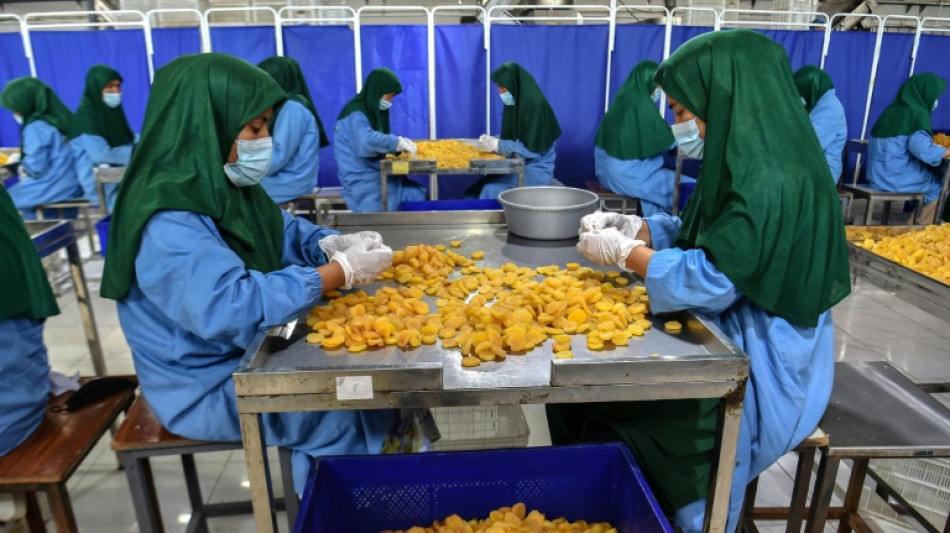
Unlike many, though, she has found a rare glimmer of hope in a stable job at a dried fruit factory in northern Balkh province.
"There are six of us in my family, and I am the only one working," Ibrahimi told AFP as she sorted raisins in the large factory hall in sweltering summer heat.
She lived in Iran for four years, working in greenhouses and as a seamstress, before returning home after Tehran tightened its policies for Afghan migrants.
That, combined with a government repatriation drive in neighbouring Pakistan, has resulted in what the United Nations calls one of the largest population repatriation movements globally.
More than six million Afghans have been pushed back to a country where jobs are few.
The risk of economic destitution is particularly acute for women, with a series of restrictions by Taliban authorities on their movement, work and education leaving many without an income.
However, at the dried fruit factory in the historic city of Mazar-i-Sharif, UN backing has helped ensure around 40 percent of the 400 employees are returnees -- many of them women.
"As girls are not allowed to get an education, it is an opportunity we got to work here, and we are satisfied with our work," Ibrahimi said.
Taliban authorities have closed high schools and universities to women and girls over the age of around 12.
Aid budgets have been slashed since the Taliban government took power, and were exacerbated by Trump administration cuts last year. Another two million Afghans are expected to be pushed back this year, so the need for work opportunities is only growing.
"It's important that we are there to help with settlement and with integration and survival and, beyond survival, for livelihood and sustainable solutions," UN High Commissioner for Refugees Barham Salih told AFP during a visit to UN-backed private sector projects in Mazar-i-Sharif on Monday.
The head of the United Nations Development Programme (UNDP), Alexander De Croo, accompanied him and told AFP that both agencies partnering with businesses could be a launching pad for finding longer term solutions.
"The approach we have here is really... going immediately into the logic of a longer-term perspective and going outside of the immediate short-term."
- Challenges remain -
A few kilometres (miles) away in the district of Nahr-e-Shahi, returnee women sat at a large loom where they wove a carpet with bright multicoloured thread, taking part in one of Afghanistan's oldest and most famous artisanal sectors at another project backed by the UN refugee agency and UNDP.
The centre offered an economic lifeline for around 40 women employed there, but challenges remain for those pushed back from neighbouring countries where many had migrated seeking more lucrative opportunities.
"Compared to living in Iran, our situation has worsened because I could work there, but working here for just $25 (per month) is like nothing," said 20-year-old Mursal Sadat.
Saliha Ahmadzai, the head of the centre, acknowledged the uphill battle.
"Currently, we have many problems, specifically, the restrictions (on women) itself is a challenge," she said. "Poverty is getting more intense day by day in Afghanistan's society."
Still, the centre offered hope in a country where the majority of people live below the poverty line and where UNDP figures suggest a formal employment rate of only 3 percent among returnees.
Aydin Sadat, who returned from Iran months ago, first lost her "morale and was crying a lot, saying that we had to go back to Iran because we could not live here", she told AFP during a short break from weaving a green and red carpet.
"I have found friends; our trainers help us," 18-year-old Sadat said. "Now that I have come here, my morale has improved."
J.Liv--ThChM