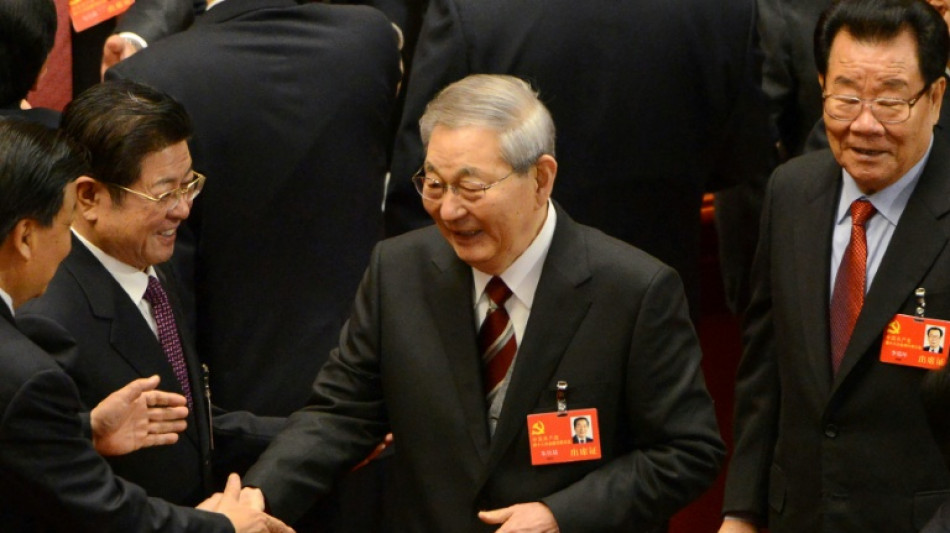
Zhu Rongji, trailblazing ex-premier who transformed China's economy / Photo: © AFP/File

Zhu Rongji, China's former premier who died on Wednesday aged 97, championed free-market policies and delivered far-reaching economic reforms during his five years at the helm.
Rumoured to be descended from Zhu Yuanzhang, the founding emperor of the Ming dynasty, Zhu was born in the central city of Changsha in 1928 into a China riven by civil war.
Zhu studied electrical engineering at Beijing's elite Tsinghua University and joined the Communist Party in 1949, the same year leader Mao Zedong declared the creation of the "New China".
An economic planner and later an engineer at the State Planning Commission, Zhu was purged twice during the tumultuous early decades of the People's Republic.
He was first cast out during the "Hundred Flowers Campaign" in the 1950s, when his criticism of Mao's "irrational" economic policies saw him labelled a "rightist".
He was pardoned but purged again during the chaos and bloodshed of the Cultural Revolution, when he was sent into exile in rural China.
The party rehabilitated him in the wake of Mao's death, tapping him for jobs at the Ministry of Petroleum and State Economic Commission.
His talents caught the eye of then-paramount leader Deng Xiaoping and in 1988 he was appointed mayor of China's economic powerhouse city Shanghai, where he developed a reputation as a stalwart supporter of market reform.
In a speech that year, he called for state-owned enterprises to be allowed to "swim by themselves in the markets".
- Steady hand -
Appointed vice premier under then-leader Jiang Zemin in 1991, he found himself nicknamed China's Mikhail Gorbachev after the reformist former president of the Soviet Union.
He was seen as largely responsible for China's "soft landing" -- reducing inflation without causing a recession -- after it experienced runaway growth following Deng's renewed push to open up in the 1990s.
But it was his radical reforms as premier from 1998 that cemented his reputation as a no-compromise free marketeer.
Among those was a broad programme to privatise unprofitable state-owned enterprises -- long a guarantee of lifelong so-called "iron rice bowl" employment for millions but which drained public finances.
Those reforms slashed 30 million jobs over five years, leaving workers at the mercy of cutthroat market forces that spurred massive growth but which massively exacerbated economic inequality.
He also oversaw the privatisation of urban housing, scrapping welfare for millions of urban workers and promoting home ownership.
Those reforms sparked a boom in real estate and construction, which would soar to become a quarter of China's economy before a crippling debt crisis struck in 2020.
His leadership was credited with helping China avoid the worst of the 1997 Asian financial crisis, bucking a global trend.
And he led negotiations for China's accession to the World Trade Organization in 2001 -- a move seen as consolidating the country's transformation from an isolated economy under Mao to the marketplace of the world.
Zhu also developed a reputation as a hard-nosed opponent of corruption, which he once described as one of China's most pressing problems.
During his tenure, a former vice governor of eastern Jiangxi province was executed for taking bribes, the highest-ranking official to be put to death for such charges in five decades.
A fluent English speaker, he formalised the traditional premier's press conference at the end of the yearly "Two Sessions" political meet.
During those meetings he was known for tackling questions head-on, with a sardonic sense of humour.
At his debut press conference, he vowed to face down "multitudinous minefields and 30,000-metre abysses" in reforming China.
- Out of favour? -
In retirement, "Boss Zhu" published a number of books of speeches on economic reform, and was listed as one of the country's top philanthropists.
But his brand of market reformism, which lifted millions out of poverty but unleashed inequality, fell out of vogue with the ascent of Xi Jinping, China's most powerful leader in generations, in 2012.
Xi has since condemned runaway capitalism and sought to move China onto a more balanced development path, as well as cracking down on excessive displays of wealth and private firms seen as monopolistic.
And under Xi, Zhu's style of open, frank talk by officials has been replaced by a much more staid, closed-off approach.
The late former premier notably clashed with the current leadership over Xi's consolidation of power and statist approach in 2022, The Wall Street Journal reported.
In office, Zhu was asked by a Danish reporter what he hoped the Chinese people would remember him for.
"I only hope that after I step down, people across the country will say that 'he was an honest official, not a corrupt one' and I'll be very satisfied with that," he said.
"If they are a bit more generous and say that 'Zhu Rongji did accomplish some practical things', I will thank the heavens."
Zhu is survived by his wife, Lao An and two children.
D.Pan--ThChM