'Trying to bury the science': US climate research under siege / Photo: © AFP

A benchmark US report on the fast-changing state of the Arctic has been canceled. The nation's top research body has removed a chapter on global warming from a reference manual for judges.
After the mass layoffs and budget cuts that characterized the early days of President Donald Trump's second term, the administration is barreling ahead with its war on climate science, at a time when the world's oceans and land masses face record-breaking heat.
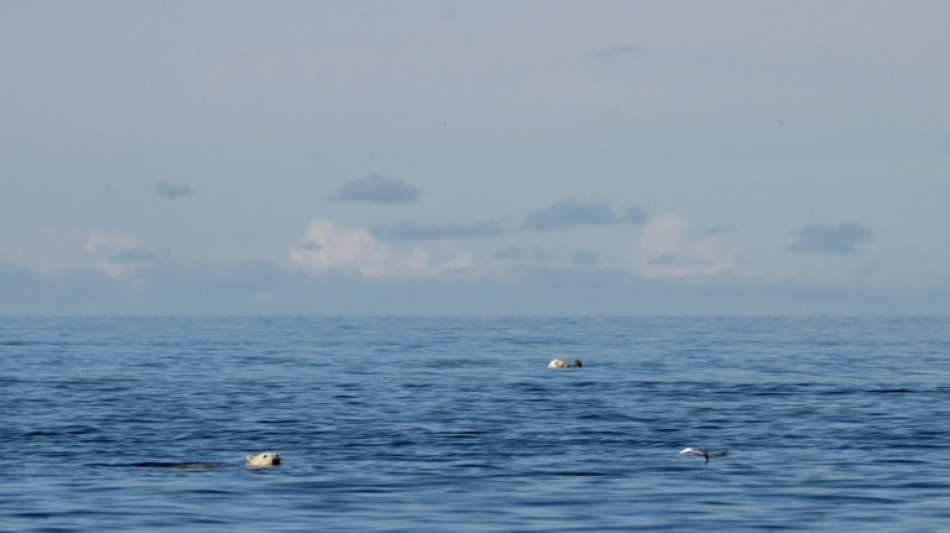
In 2025, the Arctic Report Card found the polar region had experienced its hottest year since records began, with cascading impacts from melting glaciers and sea ice to greening landscapes and disruptions to global weather.
Driven largely by the burning of fossil fuels, the Arctic is warming several times faster than the global average, a phenomenon known as "Arctic amplification."
"They're literally trying to bury the science," University of Pennsylvania climatologist Michael Mann, who co-wrote the recent book "Science Under Siege," told AFP.
"It's a losing effort given the piling up of evidence and the fact that people are seeing and feeling the consequences of climate change so dramatically this summer with the heat domes and wildfires. But that doesn't mean they won't continue to try."
- Global impacts -
What happens in the Arctic doesn't stay in the Arctic.
For example, losing sea ice injects more freshwater into the North Atlantic, making surface waters less dense and salty and hindering their ability to sink and drive the Atlantic Meridional Overturning Circulation, which helps keep Europe's winters milder.
The National Oceanic and Atmospheric Administration, which has published the Report Card annually since 2006, did not explain its demise, saying only that "Coordination of the 2026 Arctic Report Card will not be facilitated through NOAA" and that prior data would remain publicly available.
Its Arctic research program, it added, would continue to support work contributing to national security, weather prediction, safety of navigation and coastal economies.
The end of the Report Card, considered a gold standard in the field, is the latest in a litany of actions by the Trump administration against science documenting the impacts of human-caused climate change.
- Attacks on climate cases -
Days earlier, the National Academy of Sciences, a congressionally chartered yet independent body tasked with supplying the best science to policymakers, removed from its website a chapter on climate science from a manual for judges.
It came after Trump took to Truth Social to blast the chapter as "fraudulent, biased and misleading" and accuse the NAS of being run by "Radical Left Democrats."
A statement by the NAS alluded to "considerable scrutiny," adding it had determined "that questions about the processes used to develop the chapter warrant an independent review, and the chapter will not appear on our website while that review is underway."
A spokesperson told AFP: "We expect to complete the review this fall."
The decision attracted attention particularly because the NAS had weeks earlier released a comprehensive review of climate attribution science.
That review examined whether individual extreme weather events can be linked to climate change and found the science robust for many phenomena -- a question pivotal to dozens of cases against oil and gas companies working their way through US courts.
Carly Phillips, a senior scientist with the nonprofit Union of Concerned Scientists, said she saw a "broad attack on attribution science that's been happening for many months," including from Republicans in Congress, who are pushing to outlaw climate accountability lawsuits.
"Judges need reliable scientific information about climate change so that they can evaluate those cases on their merits," she told AFP.
These developments follow the administration's rescission in February of the "endangerment finding," the 2009 determination that greenhouse gas pollution endangers human health and must be regulated.
Its immediate effect was to wipe out federal vehicle emissions standards. But the same framework underpins limits on power plants -- potentially the bigger prize, with the AI boom driving a surge of new natural gas projects.
V.Fan--ThChM