The China Mail - In shadow of abandoned US airbase, Bagram's economy withers

USD -
AED 3.6725
AFN 64.494756
ALL 81.598713
AMD 359.67278
ANG 1.789785
AOA 918.000208
ARS 1538.260398
AUD 1.421858
AWG 1.8025
AZN 1.693911
BAM 1.758181
BBD 2.017808
BDT 124.280834
BGN 1.747831
BHD 0.378105
BIF 3005.600554
BMD 1
BND 1.283543
BOB 11.917476
BRL 5.352201
BSD 1.001892
BTN 95.226537
BWP 13.859348
BYN 2.947424
BYR 19600
BZD 2.014932
CAD 1.406275
CDF 2314.999721
CHF 0.830245
CLF 0.024972
CLP 986.040307
CNY 6.66835
CNH 6.666145
COP 3151.86
CRC 455.595609
CUC 1
CUP 24.044517
CVE 99.123517
CZK 21.881896
DJF 178.40785
DKK 6.722025
DOP 61.444278
DZD 135.369852
EGP 56.14368
ERN 15
ETB 162.972609
EUR 0.899349
FJD 2.243699
FKP 0.75114
GBP 0.75245
GEL 2.570497
GGP 0.75114
GHS 11.676555
GIP 0.75114
GMD 73.999918
GNF 8866.375106
GTQ 7.656419
GYD 209.942467
HKD 7.84472
HNL 26.89794
HRK 6.76901
HTG 131.239943
HUF 330.105013
IDR 18166
ILS 3.098303
IMP 0.75114
INR 95.22695
IQD 1518.788206
IRR 1857000.000207
ISK 122.670033
JEP 0.75114
JMD 159.404525
JOD 0.709014
JPY 157.858024
KES 129.909972
KGS 87.449204
KHR 4090.273689
KMF 441.000077
KPW 899.999961
KRW 1337.48013
KWD 0.31132
KYD 0.834862
KZT 457.910823
LAK 22548.645041
LBP 89716.422674
LKR 333.065143
LRD 170.315667
LSL 16.709083
LTL 2.952739
LVL 0.60489
LYD 6.436563
MAD 9.868303
MDL 18.093068
MGA 4560.450921
MKD 55.35329
MMK 2099.630718
MNT 3601.077836
MOP 8.095253
MRU 40.249373
MUR 47.549701
MVR 15.449945
MWK 1737.250425
MXN 18.681115
MYR 4.079905
MZN 63.910092
NAD 16.709008
NGN 1344.540146
NIO 36.866069
NOK 9.334902
NPR 152.363829
NZD 1.783502
OMR 0.384498
PAB 1.001888
PEN 3.451546
PGK 4.491231
PHP 64.053502
PKR 277.234306
PLN 3.95895
PYG 5828.864747
QAR 3.652104
RON 4.811894
RSD 105.694014
RUB 80.501108
RWF 1482.753351
SAR 3.750764
SBD 8.064647
SCR 13.986932
SDG 601.515787
SEK 9.95784
SGD 1.28196
SHP 0.749344
SLE 22.874977
SLL 20969.504398
SOS 572.550994
SRD 37.6505
STD 20697.981008
STN 22.02465
SVC 8.766631
SYP 13001.999685
SZL 16.701501
THB 33.8175
TJS 9.217057
TMT 3.5
TND 3.000388
TOP 2.40776
TRY 49.837115
TTD 6.800611
TWD 32.414703
TZS 2644.982953
UAH 45.735578
UGX 4393.203883
UYU 40.165228
UZS 11956.976101
VES 886.72915
VND 25842
VUV 118.98361
WST 2.767767
XAF 589.934591
XAG 0.018563
XAU 0.000248143884
XCD 2.70255
XCG 1.805556
XDR 0.707052
XOF 589.934591
XPF 107.209637
YER 236.149824
ZAR 16.663225
ZMK 9001.205413
ZMW 20.204154
ZWL 321.999592
SSP 5745.470209
MXV 2.10654
  • RYCEF

    0.4000

    19.71

    +2.03%

  • CMSC

    0.0000

    20.4

    0%

  • BTI

    0.4200

    56.05

    +0.75%

  • BP

    0.2800

    44.43

    +0.63%

  • RBGPF

    1.6000

    67

    +2.39%

  • RIO

    -0.1500

    94.41

    -0.16%

  • AZN

    -0.4300

    166.15

    -0.26%

  • GSK

    0.4600

    49.7

    +0.93%

  • BCE

    -0.4100

    20.56

    -1.99%

  • NGG

    -0.2500

    75.24

    -0.33%

  • VOD

    -0.0400

    16.58

    -0.24%

  • RELX

    -0.4500

    33.07

    -1.36%

  • BCC

    -0.5500

    76.59

    -0.72%

  • CMSD

    -0.0300

    20.27

    -0.15%

  • JRI

    -0.2500

    10.77

    -2.32%

In shadow of abandoned US airbase, Bagram's economy withers
In shadow of abandoned US airbase, Bagram's economy withers / Photo: © AFP

In shadow of abandoned US airbase, Bagram's economy withers

For years, the sprawling military base at Bagram, just north of Kabul, was a potent symbol of the United States' two decades of war in Afghanistan.

Text size:

The sprawling complex included an air base that was the linchpin of the US invasion; a prison where rights groups allege widespread violations occurred; and a residential area that featured swimming pools, cinemas and spas.

But weeks before Washington officially ended its military presence in Afghanistan last August, US troops left the airbase in the dead of night.

Today, the military base is occupied by the Taliban, who took over the country in a swift offensive as US forces were exiting.

The US departure from Bagram has also seen the collapse of the economy in the nearby town of the same name, an illustration of how Afghanistan's fortunes were so heavily tied to the war and foreign aid.

"Today, I'm jobless. I don't know much about politics, but the exit of US forces from the base is a big economic loss," said Saifulrahman Faizi, one of the town's 80,000 residents.

Faizi earned $30 a day when he was employed at the base, at a time when hundreds would queue for hours outside the compound in the hope of getting work.

"Now, nobody goes there. Everything has just crashed, everybody is struggling", he said.

- Shuttered shops -

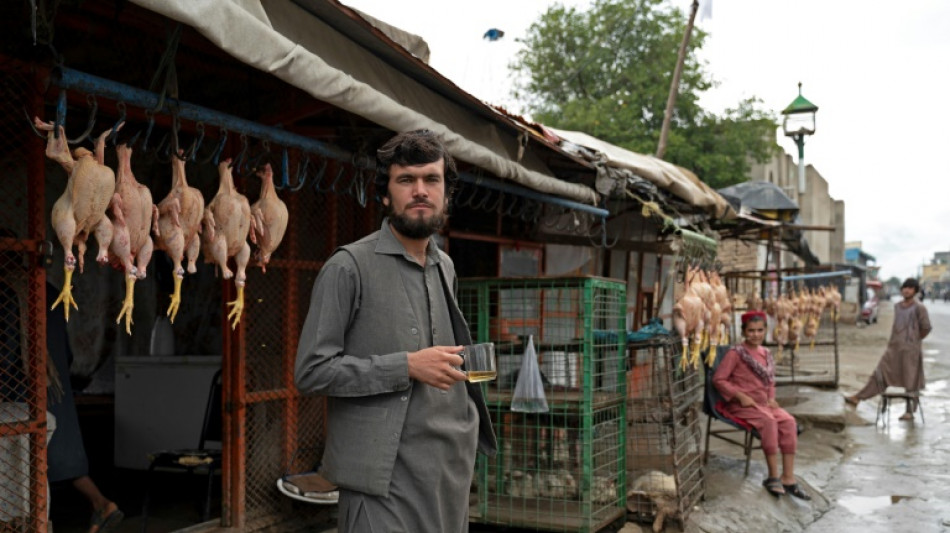
Nowhere is the town's economic collapse more evident than in the main market.

It is marked by rows of shuttered shops and warehouses, and those that remain open have seen sales plummet.

Shah Wali, a 46-year-old grocery store keeper, said he used to earn an income of between 20,000 and 30,000 Afghanis ($230 and $340).

Today, he can barely pay his rent.

"With the Islamic Emirate (Taliban) coming to power, peace has returned but business has gone," Wali told AFP, clutching his prayer beads.

At the peak of the US invasion, Bagram was home to tens of thousands of troops and contractors, with the town serving as a hub for tons of supplies that would service the base.

The airfield was first built by the Americans for their Afghan ally during the Cold War in the 1950s.

The Soviet Union vastly expanded it after the Red Army invaded Afghanistan in 1979.

After their withdrawal, the base was controlled by the Moscow-backed government, and later by the shaky mujahideen administration during the 1990s civil war.

With the Taliban seizing power last year, the airfield is now under their control.

- 'Empty town' -

When the US military pulled out, it took much of its military hardware home, but tons of civilian equipment was left behind.

For several months, the town managed to thrive on a booming scrap business, but residents say that now that, too, is dying.

Shops that sold used gym equipment, generators, air conditioners and spare car parts are either shut or receive few orders.

Several houses are now deserted, their residents having moved to Kabul or elsewhere in search of work.

Many who had worked at the base have also fled the country, fearing reprisals from the Taliban.

"Half the people have gone, the town feels so empty," said Faizi.

G.Tsang--ThChM