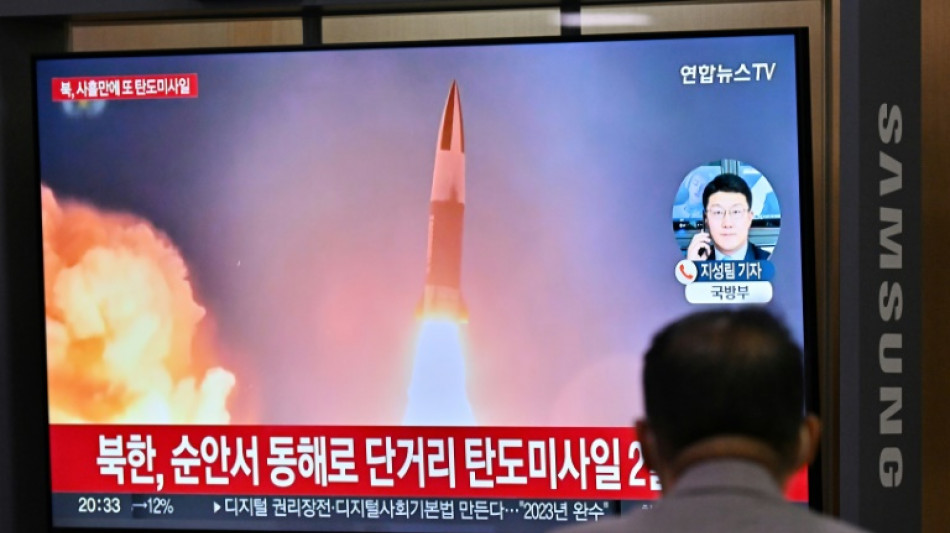
North Korea fires two ballistic missiles on eve of Harris trip / Photo: © AFP

North Korea fired two short-range ballistic missiles on Wednesday, Seoul's military said, just days after Pyongyang's last test and ahead of a visit to South Korea by US Vice President Kamala Harris.
The launches, part of a record-breaking blitz of weapons tests this year by North Korea, came after Seoul's spy agency warned that Pyongyang was close to conducting another nuclear test.
South Korea's military said it had "detected two short-range ballistic missiles fired from the Sunan area in Pyongyang".
The missiles flew "around 360 kilometres (223 miles) at an altitude of 30 kilometres at the speed of Mach 6", Seoul's Joint Chiefs of Staff said in a statement, adding that it was analysing the details of the launches.
"Our military has reinforced monitoring and surveillance and is maintaining utmost readiness in close coordination with the United States," it added.
Japan also confirmed the launches, with deputy defence minister Toshiro Ino saying North Korea's recent spate of missile tests were "unprecedented" in frequency.
"The repeated missile launches cannot be tolerated," he said.
The latest launch comes after North Korea test-fired a short-range ballistic missile on Sunday.
Harris is due to arrive in Seoul on Thursday for a brief visit, during which she will go to the heavily fortified border between North and South Korea.
The White House has said Harris' trip, which follows a visit to Japan, intends to underscore the importance of the alliance with Seoul.
Washington is Seoul's key security ally and stations about 28,500 troops in South Korea to help protect it from the North.
Last week the nuclear-powered USS Ronald Reagan conducted joint drills with South Korea's navy in waters off the Korean peninsula.
Under Seoul's hawkish new President Yoon Suk-yeol, who took office in May, the two countries have boosted joint exercises, which they insist are purely defensive -- but North Korea sees them as rehearsals for an invasion.
- 'Harbinger' -
South Korean and US officials have been warning for months that North Korean leader Kim Jong Un is preparing to conduct another nuclear test.
Earlier Wednesday, Seoul's spy agency said Pyongyang appeared to have completed "a third tunnel at its Punggye-ri nuclear site", MP Yoo Sang-bum told reporters after a briefing from Seoul's National Intelligence Service.
Pyongyang is likely to choose the window between "China's upcoming Communist Party Congress on October 16 and the midterm elections in the United States on November 7" for its next nuclear test, Yoo said.
North Korea, which is under multiple UN sanctions for its weapons programmes, typically seeks to maximise the geopolitical impact of its tests with careful timing.
The isolated regime has tested nuclear weapons six times since 2006. Its last and most powerful one in 2017 -- which Pyongyang claimed was a hydrogen bomb -- had an estimated yield of 250 kilotons.
Seoul has also detected signs the North is preparing to fire a submarine-launched ballistic missile (SLBM), the president's office said Saturday, a weapon Pyongyang last tested in May.
"Today's launch makes it clear the North is attempting to gain an upper hand on the peninsula with a nuclear arsenal at its disposal," Kim Jong-dae of the Yonsei Institute for North Korean Studies told AFP.
The repeated tests are "a harbinger of Pyongyang's aggressive posturing to come next month -- with missile launches and a possible nuclear test", he said.
W.Tam--ThChM