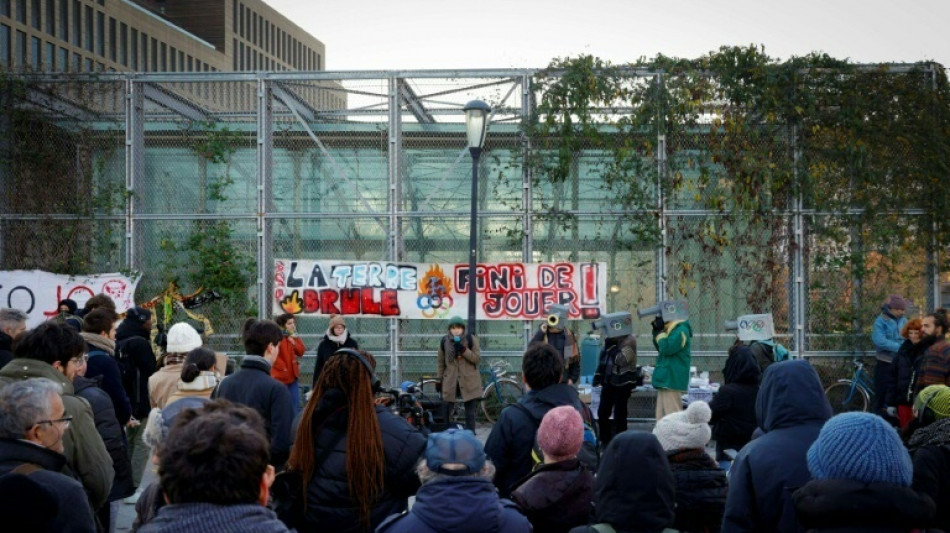
Can Paris 2024 deliver a 'climate positive' Olympics? / Photo: © AFP

Organisers of the 2024 Paris Olympics say they plan to make the Games the world's first 'climate positive' sporting event, a boast experts claim is 'misleading'.
"We want to show that we can do these Games with half the emissions," Georgina Grenon, Paris 2024's director of environmental excellence, said with 500 days to go before the world's biggest sporting extravaganza gets underway in the French capital.
"Within the limit of what is technically feasible in 2024, we will have made every effort to cut, cut, cut."
But for Lindsay Otis Nilles of Carbon Market Watch, "to say that an event has a positive impact on the climate is misleading.
"The event itself generates greenhouse gases which are bad for the climate. The financial support of the organisers for external projects does not change this."
Paris organisers say their calculations are based on reducing greenhouse gases and offsetting residual emissions linked to the event, in addition to financing projects to offset the effects of pollution.
Organisers insist they can halve CO2 emissions from the estimated 3.5 million tonnes generated during the 2012 London and 2016 Rio Games.
The construction footprint is limited thanks to 95 percent reliance on existing venues.
Most of the polluting will be linked to travel, with 25 percent of total emissions from spectator transit alone, and operations, including accommodation, security and catering.
- 'Offsetting emissions' -
Organisers have also favoured the use of electricity from renewable energy sources, with most venues near to public transport, and serving spectators "low-carbon" dishes with less meat at venues.
"By offsetting even more CO2 emissions than those we are going to emit, we will become the first major sporting event with a positive contribution to the climate," organisers said.
Environmental compensation includes financing the planting of trees to absorb carbon dioxide, and projects to conserve and restore forests and oceans.
However, these ventures on five continents including providing more efficient cooking equipment in Africa where kindling is still often used, are hard to verify and have been criticised by UN experts.
Sports ecology expert Madeleine Orr, a professor at Britain's Loughborough University, praised the efforts being made but remains cautious on talk of a "sustainable" games.
"All sport events have an impact. The most sustainable sport event is the one that doesn't happen," she said.
"There's also the challenge of travel - for athletes and spectators - which is really out of the organisers' hands.
"We're waiting on the transport sector, mainly airlines, to sort out electric travel options.
"So, for now, offsetting is an acceptable option. I think the Paris 2024 organisers have the right idea here."
Orr added: "My concern is when absolutist language is used, like 'most sustainable event' or even just 'a sustainable Olympics', because even if they do everything right, a big international event cannot be perfectly sustainable, because certain emissions and waste product is unavoidable, and we know that offsetting programmes are imperfect.
"So, there's always a risk of overstating the accomplishments. That said, I'd always rather they try!"
- 'Smaller Games' -
But the question remains how to go further to reduce the carbon footprint at future Olympic Games with Los Angeles hosting the 2028 edition.
In a study published in US magazine Nature in 2021, experts claim three things could make the Games more environmentally friendly; drastically reducing the size of the event, rotating Games between the same cities and implementing independent sustainability standards.
Orr also backs the idea of smaller Games, with fewer spectators travelling by plane.
"In future, it's possible to reduce the size and scope of the event, which also opens the doors to use smaller facilities and fewer hotels, produce less waste, and so on, without eroding the athlete experience or the media spectacle that can be produced and broadcast to televisions around the world," she said.
"The world loved watching Tokyo and Beijing, even without fans. We can operate a more sustainable Games".
E.Lau--ThChM