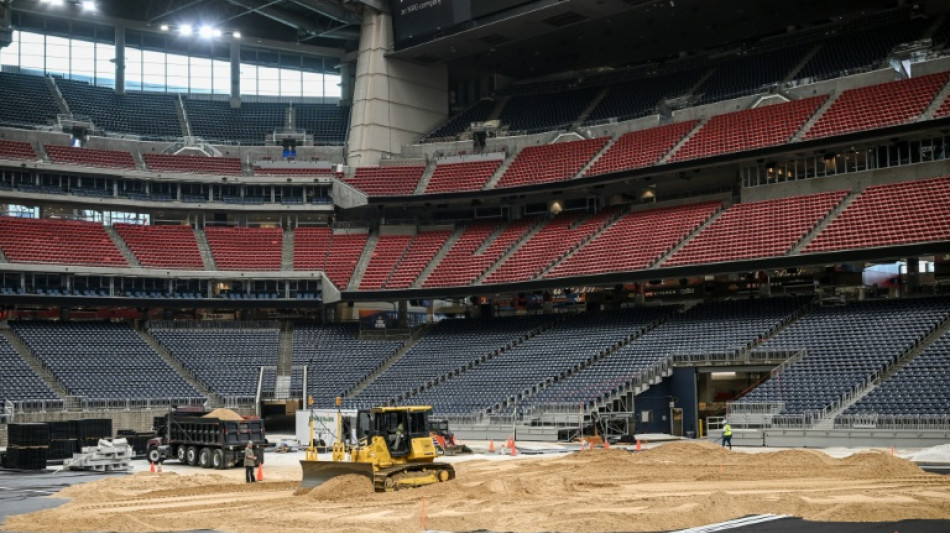
Stadium changes just part of Houston's World Cup transformation / Photo: © AFP/File

Houston is turning the Texans' NFL stadium into a natural-grass pitch, shielding its streets from punishing heat and preparing its transit police force to respond in 50 languages during the World Cup.
The fourth-largest city in the United States, with 2.3 million inhabitants, will host five group-stage matches, featuring teams such as Florian Wirtz’s Germany, Cristiano Ronaldo’s Portugal, and Virgil van Dijk’s Netherlands.
It will also host one round-of-32 match and one round-of-16 match in a tournament that kicks off in less than a month, on June 11.
"As the event approaches and expectations grow, we're here to report that Houston is ready," Chris Canetti, president of the FIFA World Cup Houston host committee told AFP on Monday as the city began the one-month countdown to kickoff.
The Texans' NRG Stadium, renamed Houston Stadium for the World Cup, is one of the NFL venues switching out its synthetic playing surface for the natural grass required by FIFA.
The change is made easier by the fact that the stadium originally featured a natural grass field, according to Hussain Naqi, general manager of the stadium complex NRG Park.
– Pitch perfect –
"We know what we're doing," Naqi said, noting that Houston has hosted Copa America matches and international club friendlies in the past.
Before laying the grass pitch imported from Colorado, officials adjusted the playing surface dimensions from those of American football to allow for corners and throw-ins.
"Equally, we have put in what's called a sub-air system. So that is effectively an aeration system that goes in underneath the surface to help with growing the pitch," Naqi said.
Grolite, a high-performance mineral soil conditioner, is being brought in from the Netherlands to keep the grass healthy and the original irrigation system is being reactivated.
On Monday, the white pipes were still visible while workers with heavy machinery covered parts of the field with soil.
– Heat –
World Cup matches will be played with the stadium's roof closed, but outside the climate-controlled venue, Houston's streets will likely see scorching summer temperatures with a heat index hovering around 40 Celsius.
"We are working on basically adapting our public realm to do a couple of things to help to reduce ambient temperatures," Kit Larson, chief executive of the organization Houston Downtown+, told AFP.
"The biggest elements of this are shade and vegetation," Larson said, and the group, dedicated to revitalizing the sprawling city, began installing what they call “cool corridors” last year, with trees and structures that provide shelter for pedestrians on several downtown streets.
The work must be finished by the time Houston hosts its first match, Germany v Curacao, on June 14, but Larson envisions a project that can be expanded upon in coming years.
– 50 languages –
Meanwhile, Houston transit police will wear a device on their chests that performs simultaneous translations in 50 languages to assist tourists.
It detects the source language and translates it into English for the officer.
The officer responds in English, and the device translates the reply back into the listener's original language.
Ban Tien, chief of police for the Harris County Metropolitan Transit Authority (METRO), said they have already tested the system in German, Dutch, Chinese and Spanish and "they all work so far."
And unlike New Jersey, where the train fare will be multiplied by eight, up to 105 dollars, for those traveling to MetLife Stadium on the outskirts of New York, Houston has joined Philadelphia in keeping its transport prices unchanged.
"Our prices remain the same, and that’s not changing," said Anna Carpenter, communications director of METRO, which charges $1.25 for the bus and urban rail to the stadium and $4.50 for a bus from the airport to downtown.
"We offer affordable transportation for everyone," she said.
A.Kwok--ThChM