The China Mail - Asteroid to come 'extraordinarily close' to Earth: NASA

USD -
AED 3.6725
AFN 64.503248
ALL 81.399259
AMD 360.987939
ANG 1.789785
AOA 917.00013
ARS 1513.277015
AUD 1.439201
AWG 1.8
AZN 1.7023
BAM 1.74671
BBD 2.012735
BDT 123.371781
BGN 1.747831
BHD 0.377596
BIF 2992.404453
BMD 1
BND 1.281553
BOB 11.707653
BRL 5.047698
BSD 0.999357
BTN 95.144703
BWP 13.728493
BYN 3.0198
BYR 19600
BZD 2.010066
CAD 1.42173
CDF 2312.488092
CHF 0.829985
CLF 0.02504
CLP 985.5198
CNY 6.69275
CNH 6.692805
COP 3197.63
CRC 455.473044
CUC 1
CUP 23.983889
CVE 98.47771
CZK 21.726302
DJF 177.955203
DKK 6.667695
DOP 61.203074
DZD 134.447973
EGP 53.051903
ERN 15
ETB 160.875008
EUR 0.89202
FJD 2.263034
FKP 0.76043
GBP 0.755065
GEL 2.590636
GGP 0.76043
GHS 11.657639
GIP 0.76043
GMD 74.000549
GNF 8791.365814
GTQ 7.636833
GYD 209.011214
HKD 7.84756
HNL 26.950258
HRK 6.718902
HTG 130.869501
HUF 324.450231
IDR 17955.45
ILS 3.0992
IMP 0.76043
INR 95.062503
IQD 1515
IRR 1790499.999673
ISK 121.579856
JEP 0.76043
JMD 158.71669
JOD 0.709008
JPY 157.997992
KES 129.750167
KGS 87.450322
KHR 4060.142989
KMF 441.99968
KPW 899.999961
KRW 1347.704981
KWD 0.31184
KYD 0.832883
KZT 451.509766
LAK 22502.497647
LBP 89550.000137
LKR 330.755285
LRD 170.384164
LSL 16.550434
LTL 2.95274
LVL 0.60489
LYD 6.424993
MAD 9.83625
MDL 17.887667
MGA 4544.99989
MKD 54.992163
MMK 2099.444361
MNT 3596.720368
MOP 8.078342
MRU 40.229797
MUR 47.58008
MVR 15.449858
MWK 1740.999842
MXN 18.456755
MYR 4.081799
MZN 63.909855
NAD 16.560335
NGN 1330.129834
NIO 36.845007
NOK 9.496965
NPR 152.229808
NZD 1.78159
OMR 0.384489
PAB 0.999379
PEN 3.440502
PGK 4.44475
PHP 63.078014
PKR 277.050261
PLN 3.896645
PYG 5702.318437
QAR 3.642014
RON 4.759398
RSD 104.742003
RUB 83.626908
RWF 1475
SAR 3.677394
SBD 8.064647
SCR 14.300616
SDG 601.502386
SEK 9.974255
SGD 1.28266
SHP 0.754745
SLE 24.679874
SLL 20969.504398
SOS 571.498457
SRD 37.711969
STD 20697.981008
STN 21.95
SVC 8.745048
SYP 13001.999685
SZL 16.555005
THB 33.569499
TJS 9.223858
TMT 3.51
TND 2.98975
TOP 2.40776
TRY 49.417302
TTD 6.796403
TWD 32.380275
TZS 2636.64505
UAH 44.915626
UGX 4037.706697
UYU 40.172371
UZS 11952.148538
VES 878.023601
VND 25877.5
VUV 119.689611
WST 2.781623
XAF 585.126867
XAG 0.017858
XAU 0.000241960558
XCD 2.70255
XCG 1.80126
XDR 0.707052
XOF 585.126867
XPF 106.45003
YER 236.150039
ZAR 16.56065
ZMK 9001.200107
ZMW 19.863078
ZWL 321.999592
SSP 5773.824733
MXV 2.084074
  • RYCEF

    0.4000

    19.71

    +2.03%

  • CMSC

    0.0000

    20.4

    0%

  • BTI

    0.4200

    56.05

    +0.75%

  • BP

    0.2800

    44.43

    +0.63%

  • RBGPF

    1.6000

    67

    +2.39%

  • RIO

    -0.1500

    94.41

    -0.16%

  • AZN

    -0.4300

    166.15

    -0.26%

  • GSK

    0.4600

    49.7

    +0.93%

  • BCE

    -0.4100

    20.56

    -1.99%

  • NGG

    -0.2500

    75.24

    -0.33%

  • VOD

    -0.0400

    16.58

    -0.24%

  • RELX

    -0.4500

    33.07

    -1.36%

  • BCC

    -0.5500

    76.59

    -0.72%

  • CMSD

    -0.0300

    20.27

    -0.15%

  • JRI

    -0.2500

    10.77

    -2.32%

Asteroid to come 'extraordinarily close' to Earth: NASA
Asteroid to come 'extraordinarily close' to Earth: NASA / Photo: © AFP

Asteroid to come 'extraordinarily close' to Earth: NASA

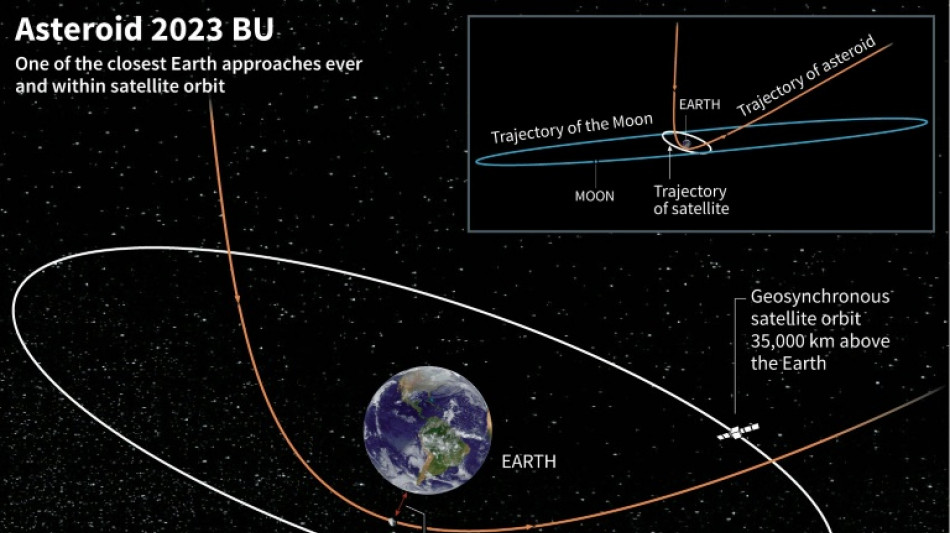
A truck-sized asteroid will pass near Earth on Thursday in one of the closest approaches to our planet ever recorded, NASA said, emphasising that it poses no danger.

Text size:

Asteroid 2023 BU, which was recently discovered by an amateur astronomer, will zoom by the southern tip of South America at around 4:27 pm PST on Thursday (0027 GMT Friday), according to NASA.

It will pass just 2,200 miles (3,600 kilometres) from Earth's surface, much closer than many geostationary satellites orbiting the planet.

But there is no risk that the asteroid will hit Earth, NASA said in a statement on Wednesday.

Even if it did, the asteroid measuring 3.5-8.5 metres (11-28 feet) across would largely disintegrate in the Earth's atmosphere, potentially just resulting in a few small meteorites.

It was discovered on Saturday from an observatory in Crimea by amateur astronomer Gennadiy Borisov, who previously spotted an interstellar comet in 2019.

Dozens of observations were then carried out by observatories across the world.

NASA's Scout impact hazard assessment system quickly determined that the asteroid would miss Earth, the US space agency said.

"Despite the very few observations, it was nonetheless able to predict that the asteroid would make an extraordinarily close approach with Earth," said NASA's Davide Farnocchia who helped develop Scout.

"In fact, this is one of the closest approaches by a known near-Earth object ever recorded."

The asteroid will come so close that its trajectory around the Sun will be significantly altered.

Previously it took the asteroid 359 days to complete its orbit around the Sun, but after this close call with Earth, it will now take 425, NASA said.

W.Tam--ThChM