The China Mail - Our galaxy's black hole not as sleepy as thought: astronomers

USD -
AED 3.672956
AFN 64.496752
ALL 81.174974
AMD 377.570168
ANG 1.79008
AOA 916.999823
ARS 1397.029402
AUD 1.410696
AWG 1.8025
AZN 1.700523
BAM 1.646095
BBD 2.014569
BDT 122.333554
BGN 1.67937
BHD 0.377015
BIF 2955
BMD 1
BND 1.261126
BOB 6.911847
BRL 5.211698
BSD 1.000215
BTN 90.656892
BWP 13.115002
BYN 2.867495
BYR 19600
BZD 2.011792
CAD 1.361295
CDF 2240.000171
CHF 0.76912
CLF 0.021714
CLP 857.380092
CNY 6.90065
CNH 6.897575
COP 3670.33
CRC 487.566753
CUC 1
CUP 26.5
CVE 93.350027
CZK 20.42925
DJF 177.719723
DKK 6.292503
DOP 62.249609
DZD 129.610409
EGP 46.845899
ERN 15
ETB 155.299662
EUR 0.84238
FJD 2.190605
FKP 0.732521
GBP 0.734155
GEL 2.69037
GGP 0.732521
GHS 11.004983
GIP 0.732521
GMD 73.49361
GNF 8775.000271
GTQ 7.671623
GYD 209.274433
HKD 7.81705
HNL 26.497564
HRK 6.348016
HTG 130.97728
HUF 319.315043
IDR 16815.6
ILS 3.063925
IMP 0.732521
INR 90.57735
IQD 1310.5
IRR 42125.000158
ISK 122.339743
JEP 0.732521
JMD 156.251973
JOD 0.70898
JPY 152.736996
KES 128.999926
KGS 87.449907
KHR 4022.000238
KMF 416.000384
KPW 899.988812
KRW 1440.769852
KWD 0.306703
KYD 0.833596
KZT 494.926752
LAK 21450.000054
LBP 85549.999911
LKR 309.456576
LRD 186.393986
LSL 15.940218
LTL 2.95274
LVL 0.60489
LYD 6.305026
MAD 9.147004
MDL 16.94968
MGA 4404.999836
MKD 51.934758
MMK 2100.304757
MNT 3579.516219
MOP 8.054945
MRU 39.905536
MUR 45.903502
MVR 15.44979
MWK 1736.499521
MXN 17.23944
MYR 3.902501
MZN 63.89907
NAD 15.960309
NGN 1352.839495
NIO 36.700113
NOK 9.532975
NPR 145.04947
NZD 1.657735
OMR 0.384508
PAB 1.000332
PEN 3.354504
PGK 4.292749
PHP 58.070118
PKR 279.550343
PLN 3.55035
PYG 6585.896503
QAR 3.64125
RON 4.288993
RSD 98.892666
RUB 77.222777
RWF 1456
SAR 3.750337
SBD 8.038668
SCR 14.2809
SDG 601.498937
SEK 8.91739
SGD 1.262635
SHP 0.750259
SLE 24.450256
SLL 20969.499267
SOS 571.507056
SRD 37.779019
STD 20697.981008
STN 20.9
SVC 8.752299
SYP 11059.574895
SZL 15.939696
THB 31.07496
TJS 9.417602
TMT 3.51
TND 2.840168
TOP 2.40776
TRY 43.644701
TTD 6.776109
TWD 31.413301
TZS 2600.000108
UAH 43.023284
UGX 3540.813621
UYU 38.353905
UZS 12294.999986
VES 389.80653
VND 25960
VUV 119.359605
WST 2.711523
XAF 552.10356
XAG 0.013352
XAU 0.000204
XCD 2.70255
XCG 1.802726
XDR 0.686599
XOF 552.502394
XPF 100.999721
YER 238.325011
ZAR 15.967505
ZMK 9001.195489
ZMW 18.555599
ZWL 321.999592
  • RBGPF

    0.1000

    82.5

    +0.12%

  • RYCEF

    -0.0600

    16.87

    -0.36%

  • CMSC

    0.0000

    23.7

    0%

  • RELX

    1.0800

    28.81

    +3.75%

  • VOD

    -0.0600

    15.62

    -0.38%

  • BCC

    -1.3500

    88.06

    -1.53%

  • NGG

    0.5800

    91.22

    +0.64%

  • CMSD

    -0.1280

    23.942

    -0.53%

  • BCE

    0.1800

    25.83

    +0.7%

  • JRI

    0.0300

    13.16

    +0.23%

  • RIO

    -1.6100

    97.91

    -1.64%

  • GSK

    0.0500

    58.54

    +0.09%

  • AZN

    -0.2400

    204.52

    -0.12%

  • BP

    -1.3600

    37.19

    -3.66%

  • BTI

    0.2800

    60.61

    +0.46%

Our galaxy's black hole not as sleepy as thought: astronomers
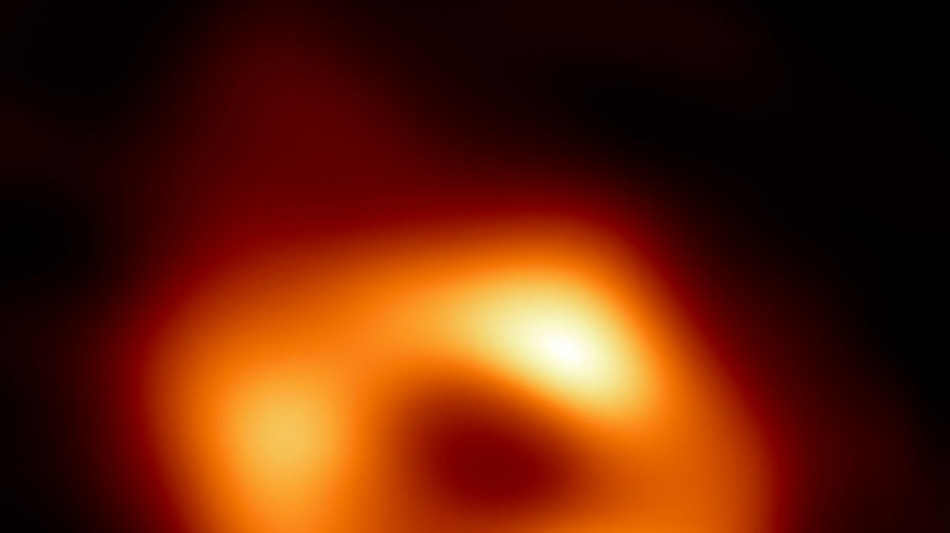
Our galaxy's black hole not as sleepy as thought: astronomers / Photo: © European Southern Observatory/AFP/File

Our galaxy's black hole not as sleepy as thought: astronomers

The supermassive black hole lurking at the centre of our Milky Way galaxy is not as dormant as had been thought, a new study shows.

Text size:

The slumbering giant woke up around 200 years ago to gobble up some nearby cosmic objects before going back to sleep, according to the study published in the journal Nature on Wednesday.

NASA's IXPE space observatory spotted an x-ray echo of this powerful resurgence of activity, the researchers said.

The supermassive black hole Sagittarius A* -- abbreviated to Sgr A* -- is four million times more massive than the Sun. It sits 27,000 light years from Earth at the centre of the Milky Way's spiral.

Last year astronomers revealed the first-ever image of the black hole -- or rather, the glowing ring of gas that surrounds its blackness.

Sgr A* has "always been seen as a dormant black hole," said Frederic Marin, a researcher at France's Strasbourg Astronomical Observatory and the study's first author.

Most supermassive black holes squatting at the middle of their galaxies go dormant after swallowing up all the nearby matter.

"Imagine a bear going into hibernation after devouring everything around it," Marin told AFP.

But the international team of researchers discovered that at around the end of the 19th century, Sgr A* came out of its slumber and consumed any gas and dust unlucky enough to be within its reach.

The feeding frenzy lasted from several months to a year, before the beast went back into hibernation.

- Million times brighter -

When it was active, the black hole was "at least a million times brighter than it is today," Marin said.

Its awakening was noticable because nearby galactic molecular clouds started giving off vastly more x-ray light.

The surge in x-ray light was as "if a single glow-worm hidden in a forest suddenly became as bright as the Sun," French research agency CNRS said in a statement.

Astronomers using NASA's IXPE (Imaging X-ray Polarimetry Explorer) space observatory managed to track the x-ray light and found that it pointed straight back at Sgr A*.

The black hole "emitted an echo of its past activity, which we managed to observe for the first time," Marin said.

The pull of gravity from black holes is so intense that nothing can escape, including light.

But when matter is sucked beyond the black hole's final boundary, known as the event horizon, it emits a massive amount of heat and light before disappearing into the darkness.

Exactly what caused Sgr A* to briefly emerge from its dormant state remains unclear. Could a star or cloud of gas and dust have ventured too close?

The astronomers hope that further observations from the IXPE observatory will help them better understand what happened -- and perhaps reveal more about the origin of supermassive black holes, which remains shrouded in mystery.

M.Zhou--ThChM