The China Mail - Mouse embryos grown in space for first time: Japan researchers

USD -
AED 3.672502
AFN 64.505328
ALL 81.278204
AMD 377.023001
ANG 1.789895
AOA 917.000324
ARS 1396.999767
AUD 1.414137
AWG 1.8025
AZN 1.701643
BAM 1.648148
BBD 2.017081
BDT 122.486127
BGN 1.648986
BHD 0.37698
BIF 2968.655855
BMD 1
BND 1.262698
BOB 6.920205
BRL 5.215105
BSD 1.001462
BTN 90.766139
BWP 13.130917
BYN 2.871071
BYR 19600
BZD 2.014216
CAD 1.36045
CDF 2239.999932
CHF 0.769402
CLF 0.021701
CLP 856.879928
CNY 6.90065
CNH 6.907665
COP 3669.44
CRC 488.174843
CUC 1
CUP 26.5
CVE 92.919683
CZK 20.44345
DJF 178.340138
DKK 6.29587
DOP 62.789414
DZD 129.670971
EGP 46.847101
ERN 15
ETB 155.91814
EUR 0.842703
FJD 2.19355
FKP 0.733683
GBP 0.734005
GEL 2.690173
GGP 0.733683
GHS 10.981149
GIP 0.733683
GMD 73.490979
GNF 8791.097665
GTQ 7.681191
GYD 209.527501
HKD 7.816025
HNL 26.465768
HRK 6.352402
HTG 131.140634
HUF 318.852969
IDR 16829
ILS 3.08335
IMP 0.733683
INR 90.692901
IQD 1311.996225
IRR 42125.000158
ISK 122.379744
JEP 0.733683
JMD 156.446849
JOD 0.709004
JPY 153.548503
KES 129.000258
KGS 87.450038
KHR 4029.780941
KMF 415.999729
KPW 899.945229
KRW 1445.349966
KWD 0.30673
KYD 0.834608
KZT 495.523168
LAK 21477.839154
LBP 89535.074749
LKR 309.834705
LRD 186.775543
LSL 15.890668
LTL 2.95274
LVL 0.60489
LYD 6.316863
MAD 9.145255
MDL 16.970249
MGA 4422.478121
MKD 51.977015
MMK 2099.574581
MNT 3581.569872
MOP 8.064618
MRU 39.97927
MUR 45.896569
MVR 15.449981
MWK 1736.631653
MXN 17.21665
MYR 3.906001
MZN 63.874966
NAD 15.890668
NGN 1356.369782
NIO 36.851175
NOK 9.52409
NPR 145.225485
NZD 1.656685
OMR 0.384492
PAB 1.001546
PEN 3.360847
PGK 4.298602
PHP 58.025005
PKR 280.142837
PLN 3.55129
PYG 6594.110385
QAR 3.650023
RON 4.292401
RSD 98.918961
RUB 77.328254
RWF 1462.164975
SAR 3.750385
SBD 8.038668
SCR 13.452726
SDG 601.496752
SEK 8.92778
SGD 1.26348
SHP 0.750259
SLE 24.449797
SLL 20969.51263
SOS 571.349117
SRD 37.779005
STD 20697.981008
STN 20.646096
SVC 8.763215
SYP 11059.574895
SZL 15.897494
THB 31.066499
TJS 9.42903
TMT 3.51
TND 2.88801
TOP 2.40776
TRY 43.740203
TTD 6.78456
TWD 31.405502
TZS 2607.511637
UAH 43.076943
UGX 3545.214761
UYU 38.401739
UZS 12328.669001
VES 389.80653
VND 25970
VUV 119.325081
WST 2.701986
XAF 552.773529
XAG 0.012697
XAU 0.000201
XCD 2.70255
XCG 1.804974
XDR 0.687473
XOF 552.773529
XPF 100.500141
YER 238.325011
ZAR 16.011601
ZMK 9001.201949
ZMW 18.578116
ZWL 321.999592
  • RBGPF

    0.1000

    82.5

    +0.12%

  • CMSC

    0.0000

    23.7

    0%

  • CMSD

    -0.1280

    23.942

    -0.53%

  • RYCEF

    -0.0600

    16.87

    -0.36%

  • GSK

    0.0500

    58.54

    +0.09%

  • JRI

    0.0300

    13.16

    +0.23%

  • BCE

    0.1800

    25.83

    +0.7%

  • RIO

    -1.6100

    97.91

    -1.64%

  • BCC

    -1.3500

    88.06

    -1.53%

  • NGG

    0.5800

    91.22

    +0.64%

  • RELX

    1.0800

    28.81

    +3.75%

  • VOD

    -0.0600

    15.62

    -0.38%

  • AZN

    -0.2400

    204.52

    -0.12%

  • BTI

    0.2800

    60.61

    +0.46%

  • BP

    -1.3600

    37.19

    -3.66%

Mouse embryos grown in space for first time: Japan researchers
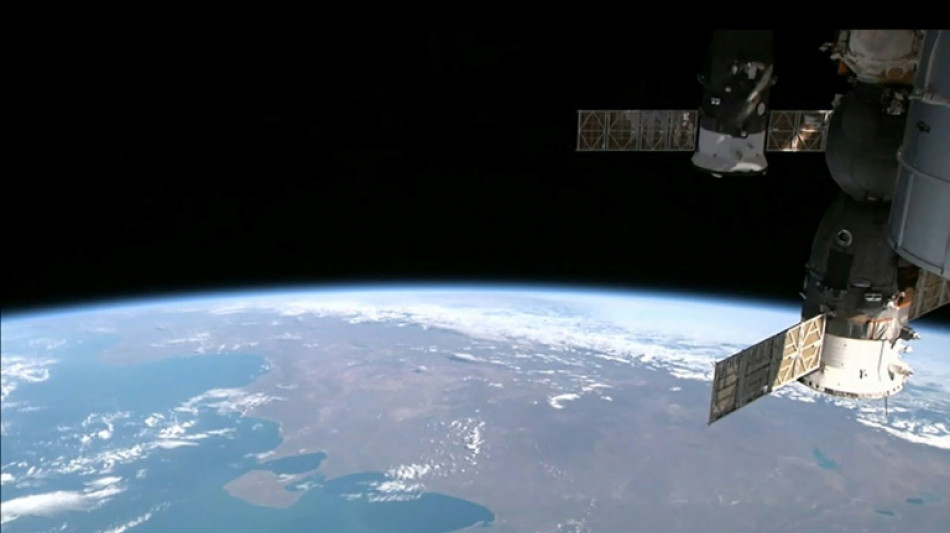
Mouse embryos grown in space for first time: Japan researchers / Photo: © NASA/AFP/File

Mouse embryos grown in space for first time: Japan researchers

Mouse embryos have been grown on the International Space Station and developed normally in the first study indicating it could be possible for humans to reproduce in space, a group of Japanese scientists said.

Text size:

The researchers, including Teruhiko Wakayama, professor of University of Yamanashi's Advanced Biotechnology Centre, and a team from the Japan Aerospace Space Agency (JAXA), sent frozen mouse embryos on board a rocket to the ISS in August 2021.

Astronauts thawed the early-stage embryos using a special device designed for this purpose and grew them on the station for four days.

"The embryos cultured under microgravity conditions developed" normally into blastocysts, cells that develop into the foetus and placenta, the scientists said.

The experiment "clearly demonstrated that gravity had no significant effect," the researchers said in a study that was published online in the scientific journal iScience on Saturday.

They also said there were no significant changes in condition of the DNA and genes, after they analysed the blastocysts that were sent back to their laboratories on Earth.

This is "the first-ever study that shows mammals may be able to thrive in space," University of Yamanashi and national research institute Riken said in a joint statement on Saturday.

It is "the world's first experiment that cultured early-stage mammalian embryos under complete microgravity of ISS," the statement said.

"In the future, it will be necessary to transplant the blastocysts that were cultured in ISS's microgravity into mice to see if mice can give birth" to confirm that the blastocysts are normal, it added.

Such research could be important for future space exploration and colonisation missions.

Under its Artemis programme, NASA plans to send humans back to the Moon in order to learn how to live there long-term to help prepare a trip to Mars, sometime towards the end of the 2030s.

R.Lin--ThChM