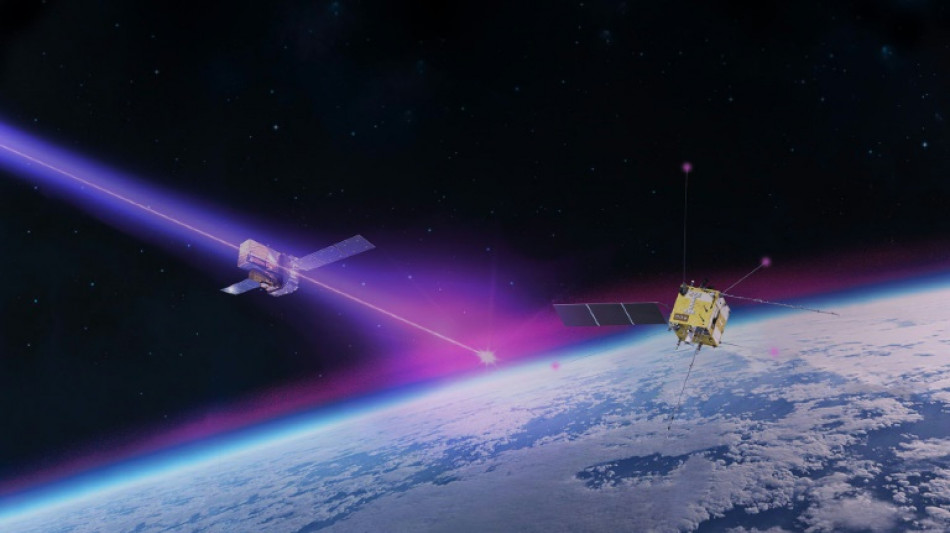
Brightest flash ever disturbed Earth's atmosphere last year / Photo: © ESA/ATG Europe/AFP

Last year the brightest flash of light ever seen in the night sky disturbed Earth's upper atmosphere in a way that has never before detected before, researchers said on Tuesday.
A massive burst of gamma rays from an enormous cosmic explosion around two billion light years away arrived at Earth on October 9, 2022, lighting up telescopes around the world.
Quickly nicknamed the "BOAT" -- for Brightest Of All Time -- the flash lasted just seven minutes but its afterglow was visible to amateur astronomers for seven hours.
The flash activated lightning detectors in India and triggered instruments that normally study explosions on the Sun called solar flares.
It also affected long wave radio communications in the lower ionosphere, a section of Earth's upper atmosphere around 60 to 350 kilometres (37 to 217 miles) above the surface.
The BOAT also affected the upper ionosphere -- the very first time a gamma-ray burst has been observed in this section of the atmosphere, a team of Italian and Chinese researchers said on Tuesday.
From 350 to 950 kilometres above Earth, near the edge of the space, the upper ionosphere is where radiation from the Sun turns into charged particles that form an important electric field.
Mirko Piersanti, a researcher at Italy's University of L'Aquila, told AFP that experts in this field had been debating for two decades whether gamma ray bursts could have any impact on the upper ionosphere.
"I think we finally answered the question," said Piersanti, the lead author of a new study in the journal Nature Communications.
The researchers were lucky that the Chinese–Italian CSES satellite, which has an electric field detector, "was exactly in the zone that was illuminated by the gamma-ray burst" 500 kilometres above Earth in the upper ionosphere, he said.
"We found a shape in the electric field that had never been observed before," Piersanti added.
"It is amazing," European Space Agency gamma-ray expert Erik Kuulkers said in a statement.
"We can see things that are happening in deep space but are also affecting Earth."
- Extinction threat? -
Piersanti said the research would help scientists understand the potential threat that other gamma-ray bursts could pose in the future.
The worst-case scenario would be if such a powerful blast came from much closer to home -- say, within our own Milky Way galaxy. That could "completely erase" Earth's ozone layer, he said.
This would expose everything on the surface to the full might of the Sun's ultraviolet radiation, potentially wiping out life on Earth.
There has previously been speculation that past gamma-ray bursts could have caused ancient mass extinction events.
But Piersanti emphasised that much remains unknown.
It is also possible that the ionosphere would absorb all the gamma rays and "nothing would happen" to those of us on the ground, he explained.
Last year's gamma-ray burst, officially called GRB 221009A, is believed to have been caused by either a massive dying star exploding into a supernova, or the birth of a black hole.
Given its immense power, it could also have been both -- a supernova explosion leading to the creation of a black hole.
The blast came from the direction of the constellation Sagitta and travelled an estimated 1.9 billion years to reach Earth.
It is now 2.4 billion light years away because of the expansion of the universe.
On average, more than one gamma-ray-burst reaches Earth every day.
But one with the brightness of the BOAT is estimated to come around once every 10,000 years.
G.Fung--ThChM