The China Mail - SpaceX launches its mega Starship rocket on second test flight

USD -
AED 3.672504
AFN 64.999537
ALL 81.33886
AMD 361.122502
ANG 1.789785
AOA 917.000035
ARS 1513.022501
AUD 1.444398
AWG 1.80125
AZN 1.67226
BAM 1.743487
BBD 2.013327
BDT 122.956921
BGN 1.747831
BHD 0.377591
BIF 2991.825564
BMD 1
BND 1.281969
BOB 11.720763
BRL 5.097599
BSD 0.999599
BTN 94.969134
BWP 13.742479
BYN 3.017272
BYR 19600
BZD 2.010474
CAD 1.419315
CDF 2313.52571
CHF 0.827897
CLF 0.024941
CLP 981.589897
CNY 6.691203
CNH 6.690261
COP 3177.34
CRC 454.962785
CUC 1
CUP 23.991442
CVE 98.294675
CZK 21.704698
DJF 178.000624
DKK 6.66792
DOP 61.282703
DZD 134.428038
EGP 53.431406
ERN 15
ETB 163.27156
EUR 0.89201
FJD 2.26765
FKP 0.76043
GBP 0.753555
GEL 2.58989
GGP 0.76043
GHS 11.630623
GIP 0.76043
GMD 73.500612
GNF 8794.098638
GTQ 7.63697
GYD 209.078429
HKD 7.847255
HNL 26.837813
HRK 6.719798
HTG 130.89794
HUF 324.396504
IDR 18028
ILS 3.103975
IMP 0.76043
INR 94.52505
IQD 1514.474828
IRR 1795877.500108
ISK 121.490159
JEP 0.76043
JMD 158.942818
JOD 0.708971
JPY 158.149499
KES 129.839569
KGS 87.450398
KHR 4059.583344
KMF 440.000176
KPW 899.999961
KRW 1340.749682
KWD 0.31096
KYD 0.833055
KZT 453.04094
LAK 22484.901161
LBP 89517.060016
LKR 330.904147
LRD 170.435248
LSL 16.519088
LTL 2.95274
LVL 0.60489
LYD 6.421536
MAD 9.796395
MDL 17.963495
MGA 4502.384454
MKD 54.953088
MMK 2099.444361
MNT 3596.720368
MOP 8.080141
MRU 40.052592
MUR 47.307153
MVR 15.460232
MWK 1732.941124
MXN 18.435973
MYR 4.082099
MZN 63.908288
NAD 16.519088
NGN 1330.897808
NIO 36.789417
NOK 9.479897
NPR 151.940099
NZD 1.77843
OMR 0.384489
PAB 0.999666
PEN 3.438747
PGK 4.537452
PHP 63.044004
PKR 276.704729
PLN 3.89635
PYG 5692.383117
QAR 3.643852
RON 4.757698
RSD 104.727545
RUB 83.866756
RWF 1474.885234
SAR 3.753076
SBD 8.064647
SCR 13.951933
SDG 601.498751
SEK 9.958299
SGD 1.28212
SHP 0.754745
SLE 24.679893
SLL 20969.504398
SOS 571.288497
SRD 37.641502
STD 20697.981008
STN 21.840387
SVC 8.746852
SYP 13001.999685
SZL 16.512011
THB 33.519867
TJS 9.211651
TMT 3.51
TND 3.001747
TOP 2.40776
TRY 49.509597
TTD 6.784783
TWD 32.34196
TZS 2639.984999
UAH 44.838258
UGX 4023.070477
UYU 40.203962
UZS 11956.051793
VES 878.023604
VND 25873
VUV 119.689611
WST 2.781623
XAF 585.120197
XAG 0.017491
XAU 0.000240685762
XCD 2.70255
XCG 1.801609
XDR 0.707052
XOF 585.120197
XPF 106.313655
YER 236.150455
ZAR 16.518805
ZMK 9001.194926
ZMW 19.917541
ZWL 321.999592
SSP 5773.824733
MXV 2.08173
  • RYCEF

    0.4000

    19.71

    +2.03%

  • CMSC

    0.0000

    20.4

    0%

  • BTI

    0.4200

    56.05

    +0.75%

  • BP

    0.2800

    44.43

    +0.63%

  • RBGPF

    1.6000

    67

    +2.39%

  • RIO

    -0.1500

    94.41

    -0.16%

  • AZN

    -0.4300

    166.15

    -0.26%

  • GSK

    0.4600

    49.7

    +0.93%

  • BCE

    -0.4100

    20.56

    -1.99%

  • NGG

    -0.2500

    75.24

    -0.33%

  • VOD

    -0.0400

    16.58

    -0.24%

  • RELX

    -0.4500

    33.07

    -1.36%

  • BCC

    -0.5500

    76.59

    -0.72%

  • CMSD

    -0.0300

    20.27

    -0.15%

  • JRI

    -0.2500

    10.77

    -2.32%

SpaceX launches its mega Starship rocket on second test flight
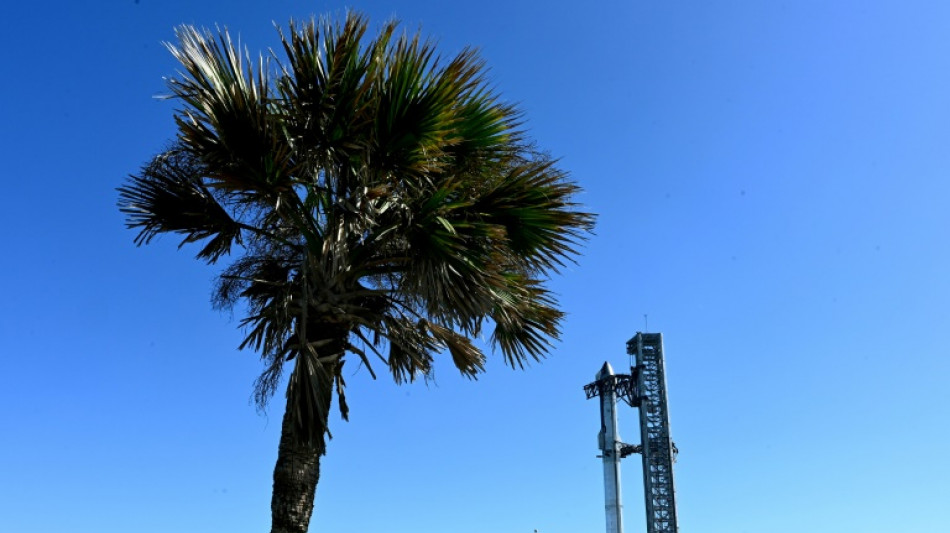
SpaceX launches its mega Starship rocket on second test flight / Photo: © AFP

SpaceX launches its mega Starship rocket on second test flight

SpaceX on Saturday carried out the second test launch of Starship, the largest rocket ever built that Elon Musk hopes will one day colonize Mars, while NASA awaits a modified version to land humans on the Moon.

Text size:

It comes after a first attempt to fly the spaceship in its fully-stacked configuration back in April ended in a spectacular explosion over the Gulf of Mexico.

The rocket blasted off from the company's Starbase in Boca Chica, Texas shortly after 7:00 am local time (1300 GMT).

The booster successfully separated from the ship, but blew up shortly after, while the ship continued on track.

"As you could see, the super heavy booster has just experienced a rapid unscheduled disassembly however, our ship is still underway," an announcer said.

When the two stages of Starship are combined, the rocket stands 397 feet (121 meters) tall -- beating the Statue of Liberty by a comfortable 90 feet.

Its Super Heavy booster produces 16.7 million pounds (74.3 Meganewtons) of thrust, almost double that of the world's second most powerful rocket, NASA's Space Launch System (SLS) -- though the latter is now fully operational.

Both systems are designed to be fully reusable, a key element of SpaceX's design meant to greatly reduce costs.

The booster that blew up had been due to land in the Gulf of Mexico a few minutes after launch, while the upper stage started a partial trip around the Earth, almost obtaining orbital velocity, before being scheduled to belly flopping into the Pacific Ocean near Hawaii after 90 minutes.

- Design changes -

SpaceX was forced to blow up Starship during its first test flight four minutes after launch on April 20, because the two stages failed to separate. The rocket disintegrated into a ball of fire and crashed into the Gulf of Mexico, sending a dust cloud over a town several miles (kilometers) away.

After a months long investigation, the Federal Aviation Administration on Wednesday finally cleared SpaceX to try again, despite objections by conservation groups, who are suing the regulator claiming it failed to comply with environmental law.

SpaceX has insisted that explosions during the early stages of rocket development are welcome and help inform design choices faster than ground tests -- though time is ticking down for a modified Starship to be ready for a planned lunar landing in 2025.

The biggest change since the first launch relates to how the spaceship separates from the booster.

Starship has been modified to use "hot staging," which means the upper stage engines will ignite while it is still attached to the booster, an approach that is commonly used in Russian rockets and could unlock far greater power.

Other changes include improvements to vents to decrease the likelihood of an explosion.

The first launch also caused massive damage to the company's launchpad at Starbase, and this has now been reinforced with high-strength concrete and a system that will jet water to protect against the enormous heat and force generated by launch.

N.Lo--ThChM