The China Mail - Penguins snatch 11 hours of sleep through seconds-long micronaps

USD -
AED 3.672504
AFN 64.501297
ALL 81.278204
AMD 377.023001
ANG 1.790222
AOA 917.000397
ARS 1397.035404
AUD 1.418098
AWG 1.8025
AZN 1.701071
BAM 1.648148
BBD 2.017081
BDT 122.486127
BGN 1.649425
BHD 0.377061
BIF 2968.655855
BMD 1
BND 1.262698
BOB 6.920205
BRL 5.226402
BSD 1.001462
BTN 90.766139
BWP 13.130917
BYN 2.871071
BYR 19600
BZD 2.014216
CAD 1.362065
CDF 2239.999614
CHF 0.76918
CLF 0.021744
CLP 858.560259
CNY 6.90065
CNH 6.904885
COP 3669.44
CRC 488.174843
CUC 1
CUP 26.5
CVE 92.919683
CZK 20.457101
DJF 178.340138
DKK 6.29926
DOP 62.789414
DZD 129.676981
EGP 46.846103
ERN 15
ETB 155.91814
EUR 0.84319
FJD 2.19355
FKP 0.733683
GBP 0.735095
GEL 2.690315
GGP 0.733683
GHS 10.981149
GIP 0.733683
GMD 73.500416
GNF 8791.097665
GTQ 7.681191
GYD 209.527501
HKD 7.81716
HNL 26.465768
HRK 6.354102
HTG 131.140634
HUF 319.496669
IDR 16831
ILS 3.09242
IMP 0.733683
INR 90.61555
IQD 1311.996225
IRR 42125.000158
ISK 122.269902
JEP 0.733683
JMD 156.446849
JOD 0.709002
JPY 153.303505
KES 128.949904
KGS 87.450243
KHR 4029.780941
KMF 416.000078
KPW 899.945229
KRW 1447.284993
KWD 0.30671
KYD 0.834608
KZT 495.523168
LAK 21477.839154
LBP 89535.074749
LKR 309.834705
LRD 186.775543
LSL 15.890668
LTL 2.95274
LVL 0.60489
LYD 6.316863
MAD 9.145255
MDL 16.970249
MGA 4422.478121
MKD 51.981513
MMK 2099.574581
MNT 3581.569872
MOP 8.064618
MRU 39.97927
MUR 45.90009
MVR 15.450202
MWK 1736.631653
MXN 17.23806
MYR 3.907501
MZN 63.901759
NAD 15.890668
NGN 1355.88967
NIO 36.851175
NOK 9.54753
NPR 145.225485
NZD 1.660455
OMR 0.384498
PAB 1.001546
PEN 3.360847
PGK 4.298602
PHP 57.924499
PKR 280.142837
PLN 3.552115
PYG 6594.110385
QAR 3.650023
RON 4.295796
RSD 98.990084
RUB 77.282523
RWF 1462.164975
SAR 3.750311
SBD 8.038668
SCR 13.453032
SDG 601.533829
SEK 8.95655
SGD 1.263799
SHP 0.750259
SLE 24.450268
SLL 20969.502565
SOS 571.349117
SRD 37.778979
STD 20697.981008
STN 20.646096
SVC 8.763215
SYP 11059.574895
SZL 15.897494
THB 31.106971
TJS 9.42903
TMT 3.51
TND 2.88801
TOP 2.40776
TRY 43.739598
TTD 6.78456
TWD 31.434699
TZS 2609.999636
UAH 43.076943
UGX 3545.214761
UYU 38.401739
UZS 12328.669001
VES 389.80653
VND 25970
VUV 119.325081
WST 2.701986
XAF 552.773529
XAG 0.01295
XAU 0.000202
XCD 2.70255
XCG 1.804974
XDR 0.687473
XOF 552.773529
XPF 100.500141
YER 238.325008
ZAR 16.04596
ZMK 9001.207984
ZMW 18.578116
ZWL 321.999592
  • RBGPF

    0.1000

    82.5

    +0.12%

  • RYCEF

    -0.0600

    16.87

    -0.36%

  • BCE

    0.1800

    25.83

    +0.7%

  • VOD

    -0.0600

    15.62

    -0.38%

  • CMSC

    0.0000

    23.7

    0%

  • RIO

    -1.6100

    97.91

    -1.64%

  • NGG

    0.5800

    91.22

    +0.64%

  • GSK

    0.0500

    58.54

    +0.09%

  • RELX

    1.0800

    28.81

    +3.75%

  • CMSD

    -0.1280

    23.942

    -0.53%

  • AZN

    -0.2400

    204.52

    -0.12%

  • JRI

    0.0300

    13.16

    +0.23%

  • BTI

    0.2800

    60.61

    +0.46%

  • BCC

    -1.3500

    88.06

    -1.53%

  • BP

    -1.3600

    37.19

    -3.66%

Penguins snatch 11 hours of sleep through seconds-long micronaps
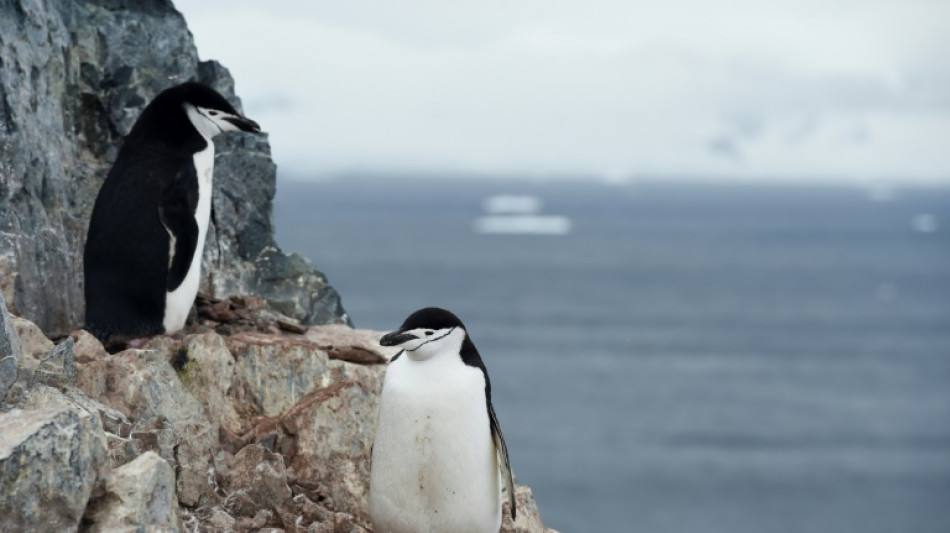
Penguins snatch 11 hours of sleep through seconds-long micronaps / Photo: © AFP/File

Penguins snatch 11 hours of sleep through seconds-long micronaps

In humans, nodding off for a few seconds is a clear sign of insufficient sleep -- and can be dangerous in some situations, such as when driving a car.

Text size:

But a new study published on Thursday finds chinstrap penguins snooze thousands of times per day, accumulating their daily sleep requirement of more than 11 hours in short bursts averaging just four seconds.

The flightless birds might have evolved this trait because of their need to remain constantly vigilant, according to the authors of the paper in Science.

The researchers argued that the findings show, contrary to prior assumptions, the benefits of sleep can accrue incrementally, at least in some species.

Chinstrap penguins (Pygoscelis antarcticus), named for the thin black band of plumage that extends from ear to ear, may be the most abundant species of penguin. Their current population is estimated at nearly eight million breeding pairs that are found mainly on the Antarctic Peninsula and South Atlantic Ocean islands.

When nesting, single parent penguins have to keep watch over their egg, guarding them from predatory birds called skuas while their partners are away on foraging trips that last several days.

They also have to defend their nests from other penguins that might try to steal nest material. Once a penguin partner finally returns, the couple switch roles.

A team led by Paul-Antoine Libourel of Lyon Neuroscience Research Centre implanted electrodes on 14 birds at a colony on King George Island in December 2019. They recorded electrical activity in the brain and neck muscles, and they used accelerometers and GPS to study body movement and location.

Combined with video recordings and direct observation over multiple days, they were able to identify numerous peculiarities.

The penguins' sleep occurred while standing or while lying to incubate their eggs, with the average bout lasting 3.91 seconds. In total they slept more than 10,000 times a day.

Penguins on the periphery got longer and deeper bouts of sleep than those in the center -- which can be explained by the excess noise and physical bumping that occurs in the middle of a colony, or the heightened risk of nest material theft.

Although the scientists did not directly measure whether the birds were gaining the restorative benefits of sleep, the fact the penguins were successful at breeding led them to believe this was indeed the case, with the moments of neuronal silence providing windows for rest and recovery.

In humans, however, conditions that fragment sleep such as sleep apnea have impacts on cognitive function and might even precipitate neurodegenerative disease, such as Alzheimer's.

"Thus, what is abnormal in humans could be perfectly normal in birds or other animals, at least under certain conditions," wrote scientists Christian Harding and Vladyslav Vyazovskiy in a related commentary piece.

N.Lo--ThChM