The China Mail - Taiwan's TSMC to launch Japan chipmaking plant in February

USD -
AED 3.673042
AFN 63.503991
ALL 81.650403
AMD 368.150403
ANG 1.790403
AOA 918.000367
ARS 1463.428504
AUD 1.426279
AWG 1.8025
AZN 1.70397
BAM 1.705709
BBD 2.013483
BDT 122.708482
BGN 1.69088
BHD 0.37702
BIF 2985
BMD 1
BND 1.290663
BOB 6.90816
BRL 5.140304
BSD 0.999721
BTN 94.239742
BWP 13.585663
BYN 2.777729
BYR 19600
BZD 2.010527
CAD 1.417555
CDF 2280.000362
CHF 0.807015
CLF 0.02292
CLP 902.050396
CNY 6.769604
CNH 6.78323
COP 3460.21
CRC 453.506829
CUC 1
CUP 26.5
CVE 95.37504
CZK 21.093604
DJF 177.720393
DKK 6.51463
DOP 58.603884
DZD 133.32304
EGP 49.919804
ERN 15
ETB 158.37504
EUR 0.871504
FJD 2.235504
FKP 0.755912
GBP 0.755572
GEL 2.64504
GGP 0.755912
GHS 11.303856
GIP 0.755912
GMD 73.000355
GNF 8777.503848
GTQ 7.625892
GYD 209.119888
HKD 7.83655
HNL 26.703838
HRK 6.565904
HTG 130.583803
HUF 306.55604
IDR 17790
ILS 2.956604
IMP 0.755912
INR 94.418104
IQD 1310
IRR 1375000.000352
ISK 125.503814
JEP 0.755912
JMD 157.959917
JOD 0.70904
JPY 161.27404
KES 129.503801
KGS 87.450384
KHR 4012.503796
KMF 425.00035
KPW 900.00035
KRW 1530.525039
KWD 0.30801
KYD 0.833035
KZT 487.855928
LAK 22030.000349
LBP 89550.000349
LKR 333.641485
LRD 182.150382
LSL 16.20377
LTL 2.95274
LVL 0.60489
LYD 6.375039
MAD 9.245039
MDL 17.654036
MGA 4200.000347
MKD 53.721133
MMK 2099.523204
MNT 3579.573337
MOP 8.070939
MRU 40.080379
MUR 47.570378
MVR 15.460378
MWK 1736.000345
MXN 17.327039
MYR 4.137904
MZN 63.903729
NAD 16.203727
NGN 1362.000344
NIO 36.610377
NOK 9.684804
NPR 150.787532
NZD 1.74236
OMR 0.384505
PAB 0.999725
PEN 3.384039
PGK 4.38775
PHP 60.647038
PKR 278.303701
PLN 3.71235
PYG 6138.96617
QAR 3.640504
RON 4.565604
RSD 102.290373
RUB 72.987932
RWF 1464
SAR 3.742594
SBD 8.061424
SCR 13.683385
SDG 600.503676
SEK 9.57745
SGD 1.291604
SHP 0.746601
SLE 24.750371
SLL 20969.503664
SOS 571.503662
SRD 37.402504
STD 20697.981008
STN 21.4
SVC 8.747449
SYP 110.532098
SZL 16.203649
THB 32.909504
TJS 9.272075
TMT 3.51
TND 2.91175
TOP 2.40776
TRY 46.438904
TTD 6.779085
TWD 31.639904
TZS 2630.998038
UAH 44.909735
UGX 3638.520172
UYU 39.96965
UZS 12005.000334
VES 596.036404
VND 26320
VUV 118.645306
WST 2.751804
XAF 572.078806
XAG 0.015413
XAU 0.00024
XCD 2.70255
XCG 1.801643
XDR 0.703697
XOF 565.000332
XPF 103.250363
YER 238.625037
ZAR 16.445804
ZMK 9001.203584
ZMW 17.919703
ZWL 321.999592
  • CMSC

    0.0500

    22.37

    +0.22%

  • JRI

    0.0500

    12.67

    +0.39%

  • CMSD

    0.0000

    22.29

    0%

  • RBGPF

    -0.5300

    60.61

    -0.87%

  • BCC

    3.8500

    74.66

    +5.16%

  • NGG

    -1.2400

    79.44

    -1.56%

  • RYCEF

    -0.0300

    18.4

    -0.16%

  • BCE

    0.0000

    23.28

    0%

  • GSK

    -1.4800

    50.67

    -2.92%

  • RIO

    -2.5900

    100.08

    -2.59%

  • RELX

    -0.8300

    31.18

    -2.66%

  • VOD

    -0.2300

    14.3

    -1.61%

  • AZN

    -2.9600

    174.93

    -1.69%

  • BTI

    -0.5800

    58.91

    -0.98%

  • BP

    -1.0400

    39.1

    -2.66%

Taiwan's TSMC to launch Japan chipmaking plant in February
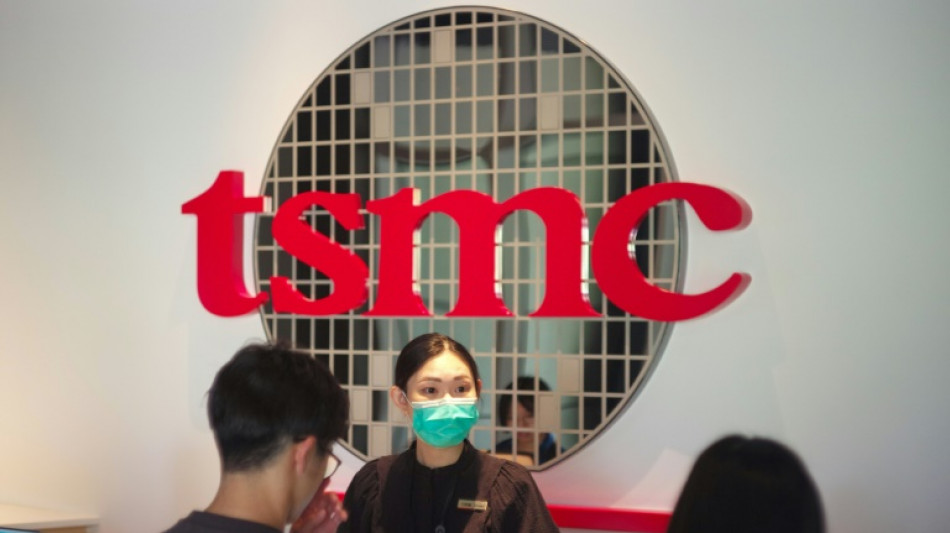
Taiwan's TSMC to launch Japan chipmaking plant in February / Photo: © AFP

Taiwan's TSMC to launch Japan chipmaking plant in February

Taiwan's TSMC will open its latest chipmaking foundry on Japan's Kyushu island on February 24, its chairman said Thursday, part of the semiconductor giant's plan to expand its global manufacturing footprint.

Text size:

Taiwan Semiconductor Manufacturing Company -- which counts Apple and Nvidia as clients -- controls more than half the world's output of silicon wafers, used in everything from smartphones to cars and missiles.

In recent years, the company has had to navigate geopolitical tussles between the United States and China as the two face off over technology import restrictions, trade and Taiwan -- the primary manufacturing base for TSMC.

On Thursday, during an investors' call over fourth-quarter earnings, chairman Mark Liu announced the official date of the long-awaited Japan foundry's opening ceremony would be February 24.

"In Japan, we are building a special technology fab(rication plant) in Kumamoto which will utilise 12- and 16-nanometre and 28- and 22-nanometre process technology," Liu said.

"We will hold an opening ceremony for this fab on February 24 next month and volume production is on track for fourth quarter of 2024."

He added that TSMC's expansion overseas is "based on our customers' needs and a necessary level of government subsidies for support".

"In today's fractured globalisation environment, our strategy is to expand our global manufacturing footprint to increase our customers' trust, expand our future growth potential, and reach for more global talents," Liu said.

Japan's government said last year it plans to spend $13 billion to boost domestic production of strategically important semiconductors and generative AI technology.

Part of that spending would be to support the construction of a second TSMC plant in Kumamoto, a Japanese trade ministry official had said in November.

But Liu said Thursday that the second plant is still in the "serious evaluation stage".

"We are still discussing with the Japanese government, they are very cooperative," he said. "Nothing is definitive."

- 'Challenging year' -

Besides a plant in Japan, TSMC also has a planned fab in Germany, which would be its first in Europe.

Liu said Thursday the fab construction in Germany, in Saxony's capital Dresden, "is scheduled to begin in Q4 (the fourth quarter) this year".

The company also reported a 19.3 percent drop in net profits in the October-December period to Tw$238.7 billion ($7.6 billion), while its revenues were "essentially flat".

CEO C.C. Wei said that while 2023 was a "challenging year" for the global semiconductor industry, the rising demand for generative AI technology also means "we expect 2024 to be a healthy growth year for TSMC".

The chip industry has seen sluggish performance, which companies attribute to high inflation and slowing global economic growth caused in part by geopolitical tensions.

TSMC had sought to quell investor fears in the past by pointing to the increasing demand for AI-related products, like ChatGPT, which needs high-performing silicon wafers to function.

A.Zhang--ThChM