The China Mail - Hubble finds water vapor in small planet's atmosphere

USD -
AED 3.673042
AFN 63.503991
ALL 81.175041
AMD 376.940403
ANG 1.789731
AOA 917.000367
ARS 1399.273604
AUD 1.413527
AWG 1.8
AZN 1.70397
BAM 1.64926
BBD 2.014277
BDT 122.307345
BGN 1.647646
BHD 0.377044
BIF 2965
BMD 1
BND 1.264067
BOB 6.911004
BRL 5.224604
BSD 1.000055
BTN 90.587789
BWP 13.189806
BYN 2.866094
BYR 19600
BZD 2.011317
CAD 1.360455
CDF 2255.000362
CHF 0.768041
CLF 0.021856
CLP 863.010396
CNY 6.90865
CNH 6.90166
COP 3666.71
CRC 485.052916
CUC 1
CUP 26.5
CVE 93.303894
CZK 20.43705
DJF 177.720393
DKK 6.29257
DOP 62.27504
DZD 129.602405
EGP 46.855504
ERN 15
ETB 155.303874
EUR 0.842204
FJD 2.209504
FKP 0.733683
GBP 0.732695
GEL 2.690391
GGP 0.733683
GHS 11.01504
GIP 0.733683
GMD 73.503851
GNF 8780.000355
GTQ 7.67035
GYD 209.236037
HKD 7.81755
HNL 26.503838
HRK 6.343704
HTG 131.126252
HUF 319.54204
IDR 16845
ILS 3.09073
IMP 0.733683
INR 90.57735
IQD 1310.5
IRR 42125.000158
ISK 122.120386
JEP 0.733683
JMD 156.510227
JOD 0.70904
JPY 152.822504
KES 129.000351
KGS 87.450384
KHR 4022.00035
KMF 415.00035
KPW 899.945229
KRW 1442.810383
KWD 0.30662
KYD 0.833418
KZT 494.893958
LAK 21445.000349
LBP 89550.000349
LKR 309.225755
LRD 186.403772
LSL 15.945039
LTL 2.95274
LVL 0.60489
LYD 6.305039
MAD 9.147039
MDL 16.981212
MGA 4405.000347
MKD 51.92021
MMK 2099.574581
MNT 3581.569872
MOP 8.053972
MRU 39.903743
MUR 45.910378
MVR 15.450378
MWK 1736.503736
MXN 17.166385
MYR 3.907504
MZN 63.903729
NAD 15.960377
NGN 1352.980377
NIO 36.703722
NOK 9.49682
NPR 144.93218
NZD 1.654715
OMR 0.384502
PAB 1.000148
PEN 3.354504
PGK 4.29275
PHP 57.903704
PKR 279.550374
PLN 3.54652
PYG 6558.925341
QAR 3.64125
RON 4.290604
RSD 98.876038
RUB 76.652547
RWF 1456
SAR 3.750021
SBD 8.038668
SCR 13.579971
SDG 601.503676
SEK 8.925104
SGD 1.262045
SHP 0.750259
SLE 24.450371
SLL 20969.49935
SOS 571.503662
SRD 37.754038
STD 20697.981008
STN 20.8
SVC 8.750574
SYP 11059.574895
SZL 15.940369
THB 31.070369
TJS 9.435908
TMT 3.5
TND 2.840368
TOP 2.40776
TRY 43.729404
TTD 6.78838
TWD 31.377304
TZS 2600.000335
UAH 43.128434
UGX 3540.03196
UYU 38.554298
UZS 12295.000334
VES 392.73007
VND 25970
VUV 119.325081
WST 2.701986
XAF 553.151102
XAG 0.012818
XAU 0.000199
XCD 2.70255
XCG 1.802336
XDR 0.687473
XOF 552.503593
XPF 100.950363
YER 238.350363
ZAR 15.946037
ZMK 9001.203584
ZMW 18.176912
ZWL 321.999592
  • RYCEF

    0.6300

    17.5

    +3.6%

  • CMSC

    0.0900

    23.79

    +0.38%

  • BCC

    -0.4200

    87.64

    -0.48%

  • BCE

    -0.0150

    25.815

    -0.06%

  • GSK

    0.5300

    59.07

    +0.9%

  • BTI

    -0.8950

    59.715

    -1.5%

  • NGG

    1.7800

    93

    +1.91%

  • RIO

    0.2900

    98.2

    +0.3%

  • BP

    0.3300

    37.52

    +0.88%

  • VOD

    -0.0900

    15.53

    -0.58%

  • RBGPF

    0.1000

    82.5

    +0.12%

  • JRI

    0.1290

    13.1555

    +0.98%

  • AZN

    0.7530

    205.273

    +0.37%

  • RELX

    2.1300

    30.94

    +6.88%

  • CMSD

    0.0997

    23.675

    +0.42%

Hubble finds water vapor in small planet's atmosphere
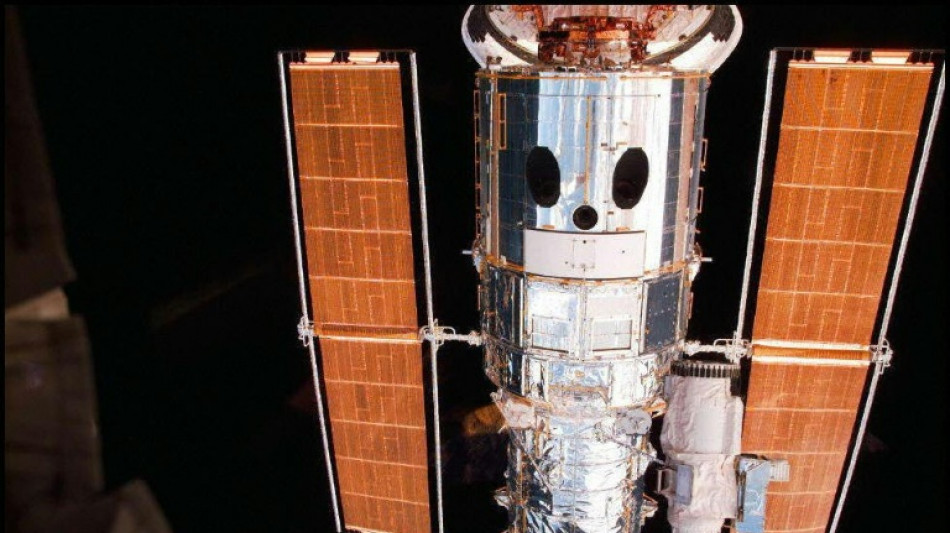
Hubble finds water vapor in small planet's atmosphere / Photo: © AFP/File

Hubble finds water vapor in small planet's atmosphere

The Hubble Space Telescope has observed the smallest planet outside our solar system to contain water vapor in its atmosphere, a "landmark discovery" that brings astronomy a step closer to characterizing Earth-like worlds.

Text size:

At around twice Earth's diameter, planet GJ 9827d orbits a red dwarf star 97 light-years away in the constellation Pisces, NASA and the European Space Agency (ESA) said in statements on Thursday.

The team behind the finding are examining two scenarios: either the planet is a "mini-Neptune" with a hydrogen-rich atmosphere laced with water, or it's a warmer version of Jupiter's moon Europa, which contains twice as much water as Earth under its crust.

"The planet GJ 9827d could be half water, half rock," said Bjorn Benneke of the Universite de Montreal, who co-led the research. "And there would be a lot of water vapor on top of some smaller rocky body."

"Until now, we had not been able to directly detect the atmosphere of such a small planet. And we're slowly getting in this regime now," he added.

Over a period of three years, Hubble observed the planet during 11 transients, or events in which it crossed in front of its star.

During transients, starlight is filtered through the planet's atmosphere, allowing astronomers to use Hubble's instruments to analyze the patterns of colors (wavelengths), which revealed the telltale signature of water molecules.

Even if GJ 9827d has a water-rich atmosphere, its hot, Venus-like temperature of 800 degrees Fahrenheit (425 Celsius) would make it an uninhabitable steamy world.

Nevertheless, the Hubble discovery paves the way to future study of GJ 9827d and similar planets, especially by the James Webb Space Telescope, which can use its high resolution infrared images to look for more atmospheric molecules including carbon dioxide, and methane.

"Water on a planet this small is a landmark discovery," added co-leader Laura Kreidberg of Max Planck Institute for Astronomy in Germany.

"It pushes closer than ever to characterizing truly Earth-like worlds."

V.Fan--ThChM