The China Mail - Japanese startup's space rocket launch fails

USD -
AED 3.672498
AFN 63.99968
ALL 83.250317
AMD 377.160121
ANG 1.790083
AOA 916.999933
ARS 1382.505983
AUD 1.447168
AWG 1.80125
AZN 1.694587
BAM 1.70594
BBD 2.013154
BDT 122.637848
BGN 1.709309
BHD 0.377582
BIF 2964
BMD 1
BND 1.290401
BOB 6.906447
BRL 5.179301
BSD 0.999512
BTN 95.111495
BWP 13.788472
BYN 2.972354
BYR 19600
BZD 2.010179
CAD 1.390825
CDF 2284.999752
CHF 0.796702
CLF 0.023467
CLP 926.609578
CNY 6.88655
CNH 6.885245
COP 3683.58
CRC 464.734923
CUC 1
CUP 26.5
CVE 95.875038
CZK 21.21905
DJF 177.720315
DKK 6.46023
DOP 60.099511
DZD 133.250672
EGP 54.5799
ERN 15
ETB 157.049836
EUR 0.86454
FJD 2.257401
FKP 0.758039
GBP 0.754075
GEL 2.690171
GGP 0.758039
GHS 11.000341
GIP 0.758039
GMD 74.000008
GNF 8775.000407
GTQ 7.64789
GYD 209.174328
HKD 7.837245
HNL 26.598252
HRK 6.510799
HTG 131.185863
HUF 332.194497
IDR 16990.45
ILS 3.136103
IMP 0.758039
INR 93.580801
IQD 1310
IRR 1315875.000027
ISK 123.969689
JEP 0.758039
JMD 158.129555
JOD 0.709009
JPY 158.639504
KES 129.999832
KGS 87.450175
KHR 4010.000018
KMF 428.505954
KPW 899.974671
KRW 1506.999759
KWD 0.30962
KYD 0.832908
KZT 476.211659
LAK 21949.999763
LBP 89509.105032
LKR 315.318459
LRD 183.675058
LSL 17.070062
LTL 2.95274
LVL 0.60489
LYD 6.404997
MAD 9.342497
MDL 17.701369
MGA 4178.000434
MKD 53.264382
MMK 2099.498084
MNT 3571.008867
MOP 8.070843
MRU 40.109711
MUR 46.790262
MVR 15.469725
MWK 1736.999852
MXN 17.88899
MYR 4.037498
MZN 63.949813
NAD 17.070226
NGN 1384.029762
NIO 36.729794
NOK 9.67056
NPR 152.178217
NZD 1.740475
OMR 0.384513
PAB 0.999507
PEN 3.495947
PGK 4.39013
PHP 60.275504
PKR 279.198292
PLN 3.705805
PYG 6474.685228
QAR 3.64399
RON 4.4066
RSD 101.505023
RUB 81.3021
RWF 1460
SAR 3.753424
SBD 8.042037
SCR 14.298932
SDG 600.999861
SEK 9.438835
SGD 1.28561
SHP 0.750259
SLE 24.549865
SLL 20969.510825
SOS 571.499729
SRD 37.374012
STD 20697.981008
STN 21.725
SVC 8.746053
SYP 110.555055
SZL 17.070482
THB 32.620496
TJS 9.580319
TMT 3.51
TND 2.929978
TOP 2.40776
TRY 44.487204
TTD 6.790468
TWD 31.934015
TZS 2585.810972
UAH 43.911606
UGX 3762.887497
UYU 40.550736
UZS 12195.498196
VES 473.27785
VND 26340
VUV 120.343344
WST 2.769273
XAF 572.15615
XAG 0.013415
XAU 0.000213
XCD 2.70255
XCG 1.801363
XDR 0.710952
XOF 570.497088
XPF 104.049704
YER 238.650234
ZAR 16.898898
ZMK 9001.196673
ZMW 19.105686
ZWL 321.999592
  • RBGPF

    -13.5000

    69

    -19.57%

  • RYCEF

    0.7400

    15.09

    +4.9%

  • CMSC

    -0.4028

    21.9

    -1.84%

  • BCC

    0.9000

    75.85

    +1.19%

  • VOD

    0.3200

    15.02

    +2.13%

  • CMSD

    -0.4000

    22.1

    -1.81%

  • BCE

    0.0100

    25.24

    +0.04%

  • JRI

    0.3800

    12.3

    +3.09%

  • NGG

    0.9100

    84.6

    +1.08%

  • RIO

    4.4700

    93.29

    +4.79%

  • RELX

    0.4000

    33.15

    +1.21%

  • GSK

    0.9600

    55.19

    +1.74%

  • BTI

    0.2100

    58.47

    +0.36%

  • BP

    -0.3500

    47

    -0.74%

  • AZN

    3.3400

    197.22

    +1.69%

Japanese startup's space rocket launch fails
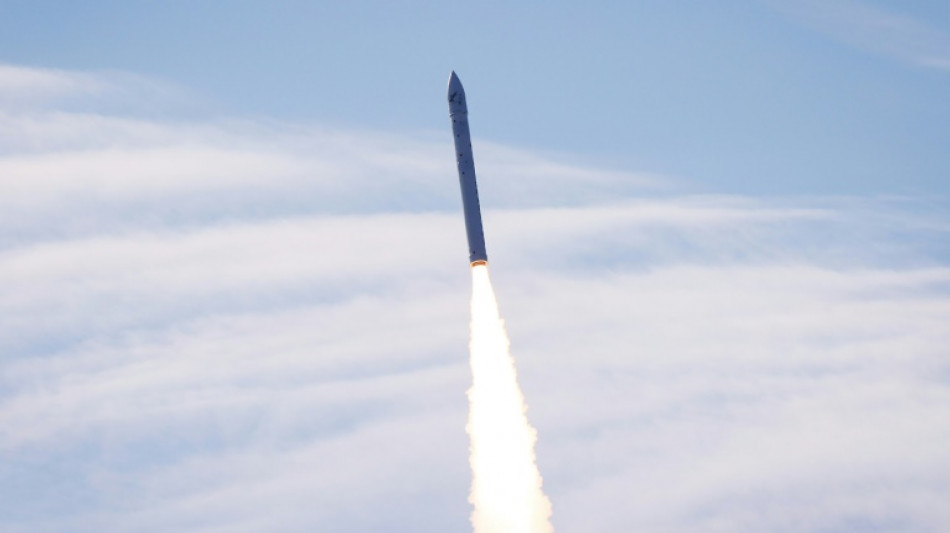
Japanese startup's space rocket launch fails / Photo: © JIJI PRESS/AFP

Japanese startup's space rocket launch fails

A space rocket built by a Japanese startup blasted off on Wednesday but was later seen spiralling downwards in the distance as the company said the launch had to be terminated.

Text size:

It was the second attempt by Space One to become Japan's first private firm to put a satellite into orbit after an initial try in March ended in a mid-air explosion.

Companies such as Space One want to offer cheaper and more frequent space exploration opportunities than governments.

The startup is hoping to establish a satellite-launching service to tap into expanding global demand -- emulating Elon Musk's SpaceX, which has contracts with NASA and the Pentagon.

"We do not regard this event as a failure," Space One president Masakazu Toyoda told reporters.

"We believe that the data and experience gained... is extremely valuable and we think they will be useful for the next challenge," he said.

Company director Mamoru Endo said a glitch 80 seconds after lift-off had affected the altitude of the solid-fuel Kairos rocket.

"Our data shows that the rocket was flying in a western direction instead of the originally planned southern direction," Endo said, and it was not able to get the rocket back on course.

Space One said it hopes to launch a third Kairos rocket as soon as possible but did not give specific dates.

Spectators, gathered near the company's coastal Spaceport Kii launch pad in Japan's rural western Wakayama region, expressed their disappointment to television cameras.

"I'm so shocked," one woman said after the firm announced the failure. "I had been hoping it would go into orbit."

- Flight terminated -

News programmes showed the slim, white 18-metre (60-foot) rocket soaring far into the sky before its dizzy descent.

There was no dramatic explosion -- unlike in March when the first Kairos rocket, carrying a small government test satellite, was ordered to self-destruct due to technical problems just seconds after launch.

The latest rocket on Wednesday was carrying five satellites, including one from the Taiwan Space Agency and others designed by Japanese students and corporate ventures.

Space One, which was still investigating details of the failure, said earlier that "Kairos was launched... but the rocket terminated its flight after judging that the achievement of its mission would be difficult".

Space One was founded in 2018 by businesses including Canon Electronics, IHI Aerospace, construction firm Shimizu and the government-run Development Bank of Japan.

The Japan Aerospace Exploration Agency (JAXA) is also on a mission to become a major player for satellite launches.

JAXA's next-generation H3 launch system had experienced multiple failed take-off attempts before a successful blast-off in February.

However, JAXA had to delay the launch of a compact, solid-fuel Epsilon S rocket after a recent engine test resulted in a large fire.

C.Smith--ThChM