The China Mail - ALMA lets astronomers see building blocks of early galaxies

USD -
AED 3.672504
AFN 63.503991
ALL 83.192586
AMD 375.730804
ANG 1.790083
AOA 917.000367
ARS 1385.503978
AUD 1.450747
AWG 1.8
AZN 1.70397
BAM 1.693993
BBD 2.007535
BDT 122.298731
BGN 1.709309
BHD 0.376597
BIF 2960.807241
BMD 1
BND 1.28353
BOB 6.91265
BRL 5.255304
BSD 0.996752
BTN 94.473171
BWP 13.741284
BYN 2.966957
BYR 19600
BZD 2.004591
CAD 1.38985
CDF 2282.50392
CHF 0.795017
CLF 0.023433
CLP 925.260396
CNY 6.91185
CNH 6.92017
COP 3662.985579
CRC 462.864319
CUC 1
CUP 26.5
CVE 95.504742
CZK 21.309304
DJF 177.489065
DKK 6.492704
DOP 59.330475
DZD 133.010264
EGP 52.642155
ERN 15
ETB 154.083756
EUR 0.866104
FJD 2.257404
FKP 0.75231
GBP 0.750441
GEL 2.680391
GGP 0.75231
GHS 10.921138
GIP 0.75231
GMD 73.503851
GNF 8739.335672
GTQ 7.62808
GYD 208.64406
HKD 7.82615
HNL 26.46399
HRK 6.545204
HTG 130.656966
HUF 338.020388
IDR 16990.8
ILS 3.13762
IMP 0.75231
INR 94.782504
IQD 1305.703521
IRR 1313250.000352
ISK 124.760386
JEP 0.75231
JMD 156.892296
JOD 0.70904
JPY 160.28704
KES 129.470356
KGS 87.450384
KHR 3992.031527
KMF 428.00035
KPW 899.886996
KRW 1508.410383
KWD 0.30791
KYD 0.830627
KZT 481.867394
LAK 21678.576069
LBP 89256.247023
LKR 313.975142
LRD 182.893768
LSL 17.115586
LTL 2.95274
LVL 0.60489
LYD 6.362652
MAD 9.315751
MDL 17.507254
MGA 4153.999394
MKD 53.388766
MMK 2102.490525
MNT 3571.507434
MOP 8.042181
MRU 39.797324
MUR 46.770378
MVR 15.450378
MWK 1728.292408
MXN 18.122104
MYR 3.924039
MZN 63.950377
NAD 17.115586
NGN 1383.460377
NIO 36.680958
NOK 9.70286
NPR 151.156728
NZD 1.745963
OMR 0.38408
PAB 0.996752
PEN 3.472089
PGK 4.307306
PHP 60.550375
PKR 278.184401
PLN 3.72275
PYG 6516.824737
QAR 3.634057
RON 4.427304
RSD 101.684639
RUB 81.295743
RWF 1455.545451
SAR 3.752751
SBD 8.042037
SCR 15.03876
SDG 601.000339
SEK 9.47367
SGD 1.292704
SHP 0.750259
SLE 24.550371
SLL 20969.510825
SOS 569.659175
SRD 37.601038
STD 20697.981008
STN 21.220389
SVC 8.721147
SYP 111.824334
SZL 17.114027
THB 32.495038
TJS 9.523624
TMT 3.5
TND 2.938634
TOP 2.40776
TRY 44.440368
TTD 6.772336
TWD 32.044404
TZS 2571.564679
UAH 43.689489
UGX 3713.134988
UYU 40.344723
UZS 12155.385215
VES 467.928355
VND 26337.5
VUV 119.756335
WST 2.77551
XAF 568.149495
XAG 0.014291
XAU 0.000222
XCD 2.70255
XCG 1.796371
XDR 0.706596
XOF 568.149495
XPF 103.295656
YER 238.603589
ZAR 17.12001
ZMK 9001.203584
ZMW 18.763154
ZWL 321.999592
  • RBGPF

    -13.5000

    69

    -19.57%

  • GSK

    -0.1000

    53.84

    -0.19%

  • NGG

    -0.4800

    81.92

    -0.59%

  • CMSC

    -0.0500

    22.77

    -0.22%

  • BTI

    0.3749

    57.8

    +0.65%

  • RIO

    0.8500

    86.64

    +0.98%

  • AZN

    5.0200

    188.42

    +2.66%

  • BCE

    -0.2200

    25.25

    -0.87%

  • RELX

    -0.1000

    31.97

    -0.31%

  • BP

    0.5100

    46.68

    +1.09%

  • RYCEF

    -0.5900

    14.65

    -4.03%

  • BCC

    0.1400

    74.43

    +0.19%

  • CMSD

    -0.0900

    22.66

    -0.4%

  • JRI

    -0.2700

    11.8

    -2.29%

  • VOD

    -0.1400

    14.49

    -0.97%

ALMA lets astronomers see building blocks of early galaxies
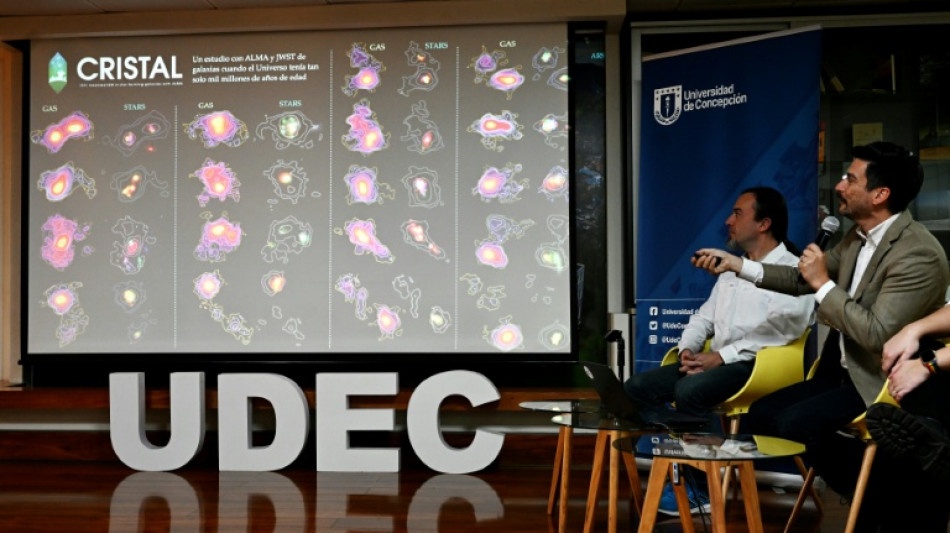
ALMA lets astronomers see building blocks of early galaxies / Photo: © AFP

ALMA lets astronomers see building blocks of early galaxies

Chile's ALMA observatory, which houses some of the world's most powerful telescopes, has captured its most detailed images to date of the building blocks of the early universe -- primarily cold gases, dust and stellar light in 39 galaxies.

Text size:

"We've never achieved so much detail and depth in galaxies from the early universe," Sergio Martin, head of Scientific Operations at ALMA, told AFP during a presentation of the research at University of Concepcion in Santiago.

Due to its dark skies and clear air, Chile hosts the telescopes of more than 30 countries, including the Atacama Large Millimeter/submillimeter Array (ALMA) that was used in the findings.

The research was led by Rodrigo Herrera-Camus, director of the Millennium Nucleus of Galaxies (MINGAL) of Chile, who told AFP the new images provide "the opportunity to study how stars are born."

The survey also found that stars emerged in "giant clumps," Herrera-Camus said.

By combining ALMA's findings with images from the James Webb and Hubble telescopes, researchers were able to learn more about how galaxies evolve, interact, and form stars.

The ALMA telescope was developed by the European Southern Observatory, the US National Radio Astronomy Observatory and the National Astronomical Observatory of Japan.

V.Fan--ThChM