The China Mail - NASA reveals Webb telescope's first cosmic targets

USD -
AED 3.672501
AFN 65.496617
ALL 81.00005
AMD 376.846763
ANG 1.79008
AOA 916.999746
ARS 1404.011905
AUD 1.413308
AWG 1.8025
AZN 1.698896
BAM 1.64226
BBD 2.013225
BDT 122.275216
BGN 1.67937
BHD 0.376971
BIF 2962.558673
BMD 1
BND 1.265482
BOB 6.907178
BRL 5.197301
BSD 0.999559
BTN 90.496883
BWP 13.113061
BYN 2.871549
BYR 19600
BZD 2.010286
CAD 1.355285
CDF 2209.999945
CHF 0.768705
CLF 0.02167
CLP 855.660136
CNY 6.91085
CNH 6.91352
COP 3665.47
CRC 494.655437
CUC 1
CUP 26.5
CVE 92.586917
CZK 20.395302
DJF 177.720247
DKK 6.28431
DOP 62.648518
DZD 129.421413
EGP 46.789601
ERN 15
ETB 155.350112
EUR 0.841135
FJD 2.1921
FKP 0.731721
GBP 0.73355
GEL 2.689858
GGP 0.731721
GHS 10.999761
GIP 0.731721
GMD 73.501055
GNF 8774.581423
GTQ 7.665406
GYD 209.121405
HKD 7.818025
HNL 26.502368
HRK 6.336902
HTG 131.114918
HUF 318.123017
IDR 16785
ILS 3.08274
IMP 0.731721
INR 90.58835
IQD 1310.5
IRR 42125.000158
ISK 121.979992
JEP 0.731721
JMD 156.391041
JOD 0.709029
JPY 154.430977
KES 128.840173
KGS 87.449783
KHR 4029.999526
KMF 414.398376
KPW 900.003053
KRW 1457.110076
KWD 0.30701
KYD 0.832959
KZT 491.773271
LAK 21474.999728
LBP 89702.217085
LKR 309.286401
LRD 186.625004
LSL 15.960319
LTL 2.95274
LVL 0.60489
LYD 6.301488
MAD 9.116985
MDL 16.91696
MGA 4435.999563
MKD 51.845871
MMK 2100.147418
MNT 3570.525201
MOP 8.048802
MRU 39.903383
MUR 45.679957
MVR 15.449743
MWK 1736.000021
MXN 17.19797
MYR 3.925015
MZN 63.899639
NAD 15.96025
NGN 1353.250247
NIO 36.720174
NOK 9.52164
NPR 144.79562
NZD 1.655235
OMR 0.384499
PAB 0.999551
PEN 3.357498
PGK 4.284982
PHP 58.506008
PKR 279.749909
PLN 3.54924
PYG 6578.947368
QAR 3.64125
RON 4.283496
RSD 98.691984
RUB 77.426347
RWF 1454
SAR 3.750835
SBD 8.058149
SCR 13.754362
SDG 601.499699
SEK 8.894501
SGD 1.265285
SHP 0.750259
SLE 24.350055
SLL 20969.499267
SOS 571.490866
SRD 37.890229
STD 20697.981008
STN 20.9
SVC 8.746069
SYP 11059.574895
SZL 15.960193
THB 31.239955
TJS 9.380697
TMT 3.51
TND 2.846026
TOP 2.40776
TRY 43.635195
TTD 6.779547
TWD 31.513796
TZS 2575.000281
UAH 43.048987
UGX 3553.510477
UYU 38.331227
UZS 12305.00008
VES 384.79041
VND 25885
VUV 119.800563
WST 2.713692
XAF 550.798542
XAG 0.012307
XAU 0.000198
XCD 2.70255
XCG 1.801442
XDR 0.685017
XOF 550.500489
XPF 100.674983
YER 238.324995
ZAR 15.942335
ZMK 9001.186468
ZMW 19.016311
ZWL 321.999592
  • SCS

    0.0200

    16.14

    +0.12%

  • RBGPF

    0.1000

    82.5

    +0.12%

  • RYCEF

    0.5300

    17.41

    +3.04%

  • CMSD

    0.1100

    24.08

    +0.46%

  • BCC

    0.7100

    89.73

    +0.79%

  • NGG

    0.3700

    88.76

    +0.42%

  • CMSC

    0.1070

    23.692

    +0.45%

  • JRI

    -0.0300

    12.78

    -0.23%

  • VOD

    -0.2300

    15.25

    -1.51%

  • RIO

    0.3900

    97.24

    +0.4%

  • RELX

    -0.1900

    29.29

    -0.65%

  • BCE

    0.2100

    25.83

    +0.81%

  • GSK

    -0.1900

    58.82

    -0.32%

  • BTI

    -0.9600

    60.19

    -1.59%

  • AZN

    5.3900

    193.4

    +2.79%

  • BP

    -2.2500

    36.97

    -6.09%

NASA reveals Webb telescope's first cosmic targets
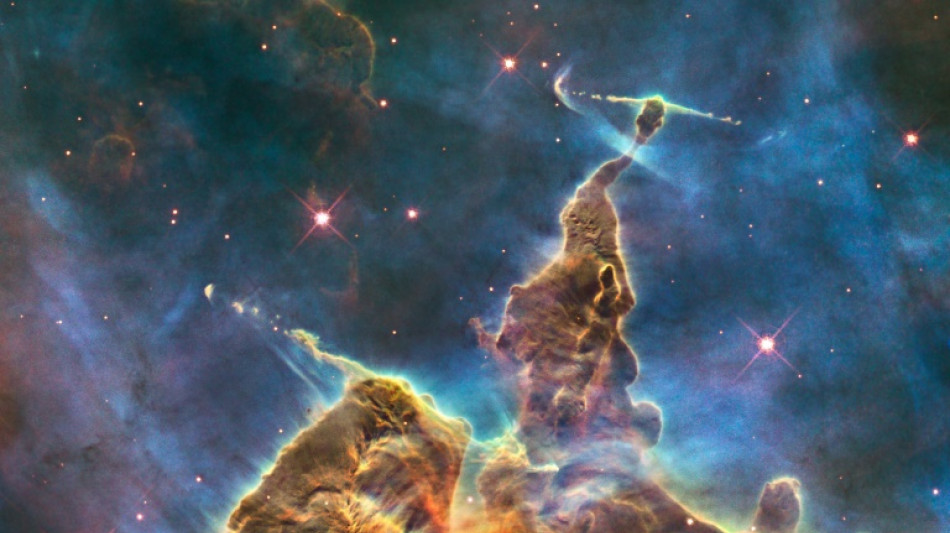
NASA reveals Webb telescope's first cosmic targets / Photo: © NASA/ESA/AFP/File

NASA reveals Webb telescope's first cosmic targets

NASA said Friday the first cosmic images from the James Webb Space Telescope will include unprecedented views of distant galaxies, bright nebulae, and a faraway giant gas planet.

Text size:

The US, European and Canadian space agencies are gearing up for a big reveal on July 12 of early observations by the $10 billion observatory, the successor to Hubble that is set to reveal new insights into the origins of the universe.

"I'm looking very much forward to not having to keep these secrets anymore, that will be a great relief," Klaus Pontoppidan, an astronomer at the Space Telescope Science Institute (STSI) that oversees Webb, told AFP last week.

An international committee decided the first wave of full-color scientific images would include the Carina Nebula, an enormous cloud of dust and gas 7,600 light years away, as well as the Southern Ring Nebula, which surrounds a dying star 2,000 light years away.

Carina Nebula is famous for its towering pillars that include "Mystic Mountain," a three-light-year-tall cosmic pinnacle captured in an iconic image by Hubble.

Webb has also carried out a spectroscopy -- an analysis of light that reveals detailed information -- on a faraway gas giant called WASP-96 b, which was discovered in 2014.

Nearly 1,150 light-years from Earth, WASP-96 b is about half the mass of Jupiter and zips around its star in just 3.4 days.

Next comes Stephan's Quintet, a compact galaxy 290 million light years away. Four of the five galaxies within the quintet are "locked in a cosmic dance of repeated close encounters," NASA said.

Finally, and perhaps most enticing of all, Webb has gathered an image using foreground galaxy clusters called SMACS 0723 as a kind of cosmic magnifying glass for the extremely distant and faint galaxies behind it.

This is known as "gravitational lensing" and uses the mass of foreground galaxies to bend the light of objects behind them, much like a pair of glasses.

Dan Coe, an astronomer at STSI, told AFP on Friday that even in its first images, the telescope had broken scientific ground.

"When I first saw the images... of this deep field of this galaxy cluster lensing, I looked at the images, and I suddenly learned three things about the universe that I didn't know before," he said.

"It's totally blown my mind."

Webb's infrared capabilities allow it to see deeper back in time to the Big Bang, which happened 13.8 billion years ago, than any instrument before it.

Because the Universe is expanding, light from the earliest stars shifts from the ultraviolet and visible wavelengths it was emitted in, to longer infrared wavelengths -- which Webb is equipped to detect at an unprecedented resolution.

C.Fong--ThChM