Ukraine conflict hits Napoleonic war re-enactment in Belarus / Photo: © AFP

The Battle of Berezina in 1812 was a significant moment in Emperor Napoleon Bonaparte's aborted campaign against Tsarist Russia, with French troops suffering heavy losses as they fled the pursuing Imperial army in the freezing winter.
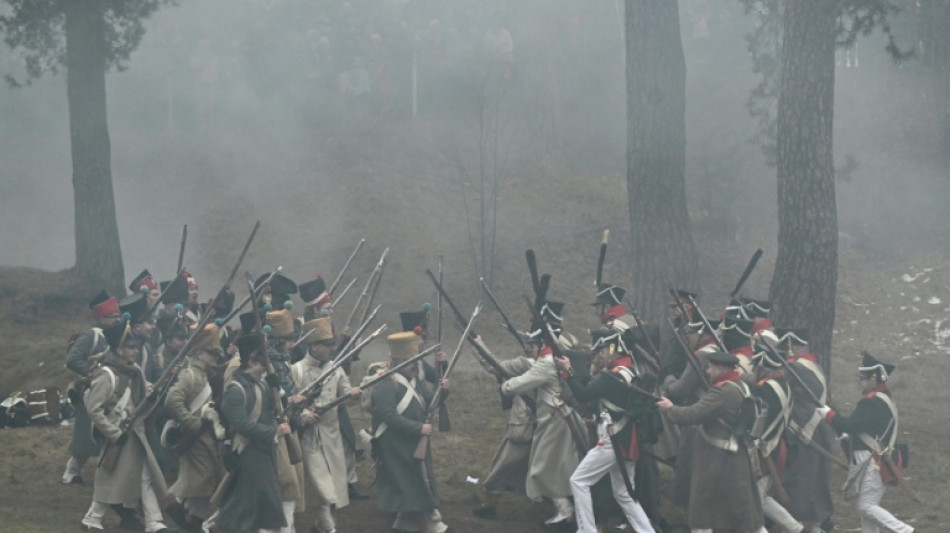
More than two centuries on, rifle fire and cannon rang out again near the site of the conflict, in the town of Barysaw or Borisov in modern-day Belarus, as over 200 people took part in a re-enactment and simulated hand-to-hand combat.
But if France's expansionist aims were behind the original battle, the commemoration was also hit by modern-day Russia's own territorial ambitions in Ukraine.
Unlike in previous years, this year's re-enactment involved no one from western Europe -- a direct result of Moscow's offensive against its neighbour in February 2022 that has made the Kremlin a pariah in Europe and beyond.
Instead, only history buffs from Russia and its ally Belarus took part, kitted out in the uniforms of Napoleonic soldiers and Tsar Alexander I's troops.
"I would very much like to hope that re-enactment will once again gain an international scale," said Alexei Sanko, a 38-year-old history teacher in French army uniform.
"Because history is something that can unite us, regardless of where we live," he told AFP.
- 'Tragic and heroic' -
Napoleon's Grand Army which attacked the Russian Empire was made up of soldiers from several countries allied to the French Empire or under its yoke, notably Poles, Austrians, Dutch and Italians.
After failing to conquer Russia, the French general's troops narrowly avoided being wiped out completely at the November 26-29, 1812 battle at the Berezina river.
They managed to escape thanks to the exploits of sappers who braved the icy waters to construct two makeshift bridges, allowing their comrades to cross.
Mikhail Boikov, 68, recalled that Alexander wanted to capture Napoleon but the French leader escaped.
"It's a moment that is both tragic and heroic," said the former soldier, dressed as a Tsarist infantry officer.
According to estimates, more than 40,000 soldiers on both sides were killed during the fighting at the Berezina.
A century after the battle, the Russian Empire built a monument to the troops who were killed. A commemorative plaque to Napoleon's troops was also placed near the river.
On Saturday, flowers were placed only at the monument for the Tsarist troops, during an official ceremony attended by Belarusian military personnel and students from military academies.
Only a few groups of re-enactors gathered at the French memorial, without any official representation.
A number of participants told AFP that their historical re-enactment societies could no longer travel to events in Europe and were trying to stay in touch with their colleagues online.
This year, a commemoration of another decisive battle of the 1812 Russian campaign -- the Battle of Borodino, some 100 kilometres (60 miles) from Moscow -- was also cancelled.
Daria Sembibratova, 49, dressed in Napoleonic infantry uniform, said it was "because of the danger of drone attacks" from Ukraine.
"Unfortunately, it's currently impossible to ensure safety for spectators and participants."
Despite the freezing, snowy weather, about a thousand people turned out to watch Saturday's re-enactment.
"It's terrifying when the shots are fired, when cannonballs fly and explosions echo," said one spectator, Lyudmila Bolchakova, just a couple of hundred kilometres from another conflict across the border in Ukraine.
"You realise how courageous our soldiers were."
video-rco/liu/phz/sbk
H.Au--ThChM