The China Mail - Astronomers detect cosmic flash from early universe star blast

USD -
AED 3.672502
AFN 65.501476
ALL 81.950414
AMD 381.54996
ANG 1.790403
AOA 917.000178
ARS 1450.4754
AUD 1.491858
AWG 1.80025
AZN 1.696617
BAM 1.6575
BBD 2.013432
BDT 122.154613
BGN 1.658395
BHD 0.377061
BIF 2960
BMD 1
BND 1.284524
BOB 6.932438
BRL 5.520699
BSD 0.999682
BTN 89.664904
BWP 13.157962
BYN 2.900413
BYR 19600
BZD 2.010577
CAD 1.36845
CDF 2199.99935
CHF 0.787277
CLF 0.023141
CLP 907.819802
CNY 7.028503
CNH 7.01801
COP 3756.08
CRC 494.342981
CUC 1
CUP 26.5
CVE 94.050048
CZK 20.59985
DJF 177.719968
DKK 6.330703
DOP 62.625023
DZD 129.653987
EGP 47.475197
ERN 15
ETB 155.309811
EUR 0.84754
FJD 2.269204
FKP 0.743131
GBP 0.73985
GEL 2.685016
GGP 0.743131
GHS 11.484996
GIP 0.743131
GMD 74.502522
GNF 8738.480604
GTQ 7.658669
GYD 209.142683
HKD 7.77745
HNL 26.359677
HRK 6.387597
HTG 131.004441
HUF 331.003496
IDR 16741.95
ILS 3.18618
IMP 0.743131
INR 89.47435
IQD 1310
IRR 42125.000494
ISK 125.439595
JEP 0.743131
JMD 159.859996
JOD 0.709001
JPY 155.978961
KES 128.898647
KGS 87.449794
KHR 4010.000336
KMF 418.000544
KPW 899.961009
KRW 1472.419812
KWD 0.30704
KYD 0.833072
KZT 509.237601
LAK 21629.999761
LBP 89302.830581
LKR 309.455709
LRD 177.683593
LSL 16.690344
LTL 2.95274
LVL 0.60489
LYD 5.424979
MAD 9.12875
MDL 16.824157
MGA 4559.999774
MKD 52.18619
MMK 2099.845274
MNT 3553.409727
MOP 8.008746
MRU 39.779584
MUR 45.97006
MVR 15.449494
MWK 1737.000251
MXN 17.90345
MYR 4.064005
MZN 63.910041
NAD 16.690159
NGN 1460.749753
NIO 36.549876
NOK 10.028985
NPR 143.464185
NZD 1.71108
OMR 0.384501
PAB 0.999695
PEN 3.364503
PGK 4.252503
PHP 58.84497
PKR 280.149963
PLN 3.578515
PYG 6811.190115
QAR 3.640985
RON 4.314602
RSD 99.516003
RUB 77.995703
RWF 1452
SAR 3.750607
SBD 8.153391
SCR 14.469763
SDG 601.502428
SEK 9.163298
SGD 1.283815
SHP 0.750259
SLE 24.074997
SLL 20969.503664
SOS 571.497654
SRD 38.320222
STD 20697.981008
STN 21.25
SVC 8.746833
SYP 11056.89543
SZL 16.689635
THB 31.109914
TJS 9.197007
TMT 3.51
TND 2.885502
TOP 2.40776
TRY 42.85642
TTD 6.800231
TWD 31.504599
TZS 2471.724011
UAH 42.094291
UGX 3611.971542
UYU 39.043366
UZS 12050.000375
VES 288.088835
VND 26331
VUV 121.541444
WST 2.783984
XAF 555.909896
XAG 0.013927
XAU 0.000222
XCD 2.70255
XCG 1.801671
XDR 0.692794
XOF 556.489445
XPF 102.125005
YER 238.449693
ZAR 16.6847
ZMK 9001.202368
ZMW 22.592291
ZWL 321.999592
  • SCS

    0.0200

    16.14

    +0.12%

  • BCC

    -1.0000

    73.23

    -1.37%

  • CMSD

    -0.1800

    23.02

    -0.78%

  • GSK

    0.2600

    48.85

    +0.53%

  • BTI

    0.2700

    57.04

    +0.47%

  • BP

    0.4400

    34.58

    +1.27%

  • AZN

    0.5900

    92.14

    +0.64%

  • BCE

    0.0000

    22.73

    0%

  • RIO

    0.8700

    80.97

    +1.07%

  • RBGPF

    0.0000

    80.22

    0%

  • NGG

    0.8300

    77.24

    +1.07%

  • CMSC

    -0.1100

    23.01

    -0.48%

  • JRI

    0.0400

    13.41

    +0.3%

  • RYCEF

    0.0300

    15.53

    +0.19%

  • VOD

    0.1800

    13.06

    +1.38%

  • RELX

    0.1500

    41.13

    +0.36%

Astronomers detect cosmic flash from early universe star blast
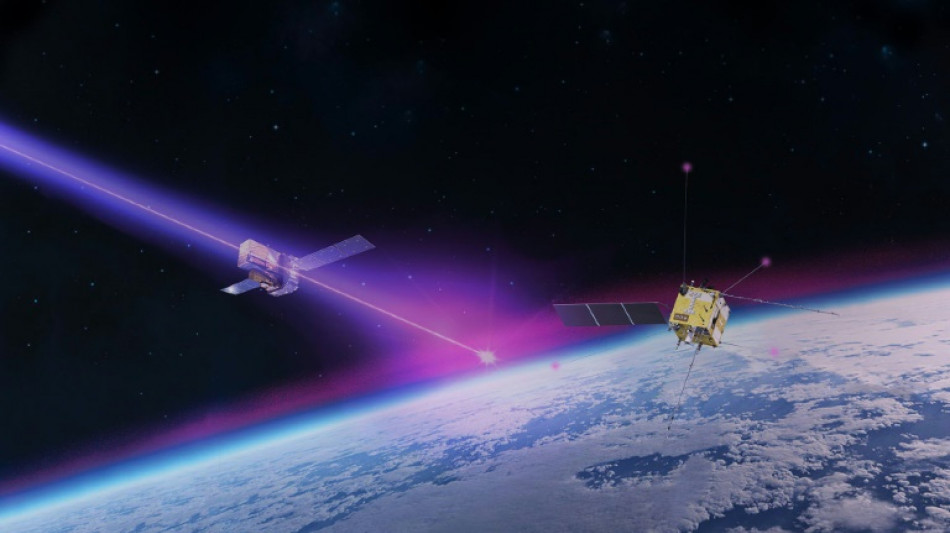
Astronomers detect cosmic flash from early universe star blast / Photo: © ESA/ATG Europe/AFP/File

Astronomers detect cosmic flash from early universe star blast

An immensely powerful flash detected earlier this year was created by a massive star exploding when the universe was just five percent of its current age, astronomers said Tuesday.

Text size:

The flash was spotted on March 14 by a French-Chinese space telescope called SVOM, which launched last year on a mission to track gamma-ray bursts, the brightest and most powerful explosions in the cosmos.

When the young scientists working on the mission for France's Atomic Energy Commission (CEA) received a mobile phone alert that a major burst had arrived at Earth, they urged other telescopes to turn towards the source.

It came from a star around a hundred times bigger than our Sun that exploded 700 million years after the Big Bang, according to two studies published in the Astronomy & Astrophysics journal.

"This is extremely rare -- it's the fifth most distant gamma-ray burst ever detected," said Bertrand Cordier, the CEA's scientific lead for SVOM and a co-author of both studies.

"The photons that reached our instruments travelled for 13 billion years" to reach Earth, he told AFP.

The detection of the burst, which lasted tens of seconds, is also "the most precise in terms of the light we collected and the measurements we made," he added.

- Glimpse of ancient cosmos -

Gamma-ray bursts are the most energetic events in the universe, Cordier explained. They are thought to be caused by cataclysmic cosmic events such as massive stars going supernova or when binary neutron stars merge.

These flashes can release as much energy in a few seconds as our Sun will emit during its 10-billion-year life.

They shoot out matter at "speeds close to the speed of light", creating conditions impossible to reproduce on Earth, Cordier said.

These bright flashes also act as "probes" of the cosmos, illuminating all the matter they pass through before finally reaching us, he added.

This allows scientists a rare glimpse into the distant past of the universe, which is 13.8 billion years old.

The gamma-ray burst in March, called GRB250314A, was created by an explosion during the first generation of stars formed after the Big Bang.

These stars produced the first heavy elements -- such as iron, carbon and oxygen -- which played a fundamental role in the evolution of the universe.

Cordier hopes SVOM will be able to detect one or two similar events every year.

"The challenge is to get everything together in the chain" of observations which involves other telescopes, he said.

For example, after the burst was first detected in March, it took 17 hours before the Very Large Telescope in Chile turned its powerful lens towards the flash.

"During that time, the intensity had decreased," Cordier said.

"If we get there earlier, then we'll have better data."

H.Ng--ThChM