The China Mail - Chinese astronauts set up new lab on space station

USD -
AED 3.672502
AFN 62.999667
ALL 81.492043
AMD 367.461239
ANG 1.79046
AOA 918.0003
ARS 1385.00596
AUD 1.379111
AWG 1.8025
AZN 1.688667
BAM 1.669747
BBD 2.014096
BDT 122.750925
BGN 1.66992
BHD 0.377265
BIF 2977.01223
BMD 1
BND 1.272576
BOB 6.910389
BRL 4.903401
BSD 1.000004
BTN 95.654067
BWP 13.471587
BYN 2.786502
BYR 19600
BZD 2.011227
CAD 1.369055
CDF 2225.000229
CHF 0.781299
CLF 0.022775
CLP 896.349636
CNY 6.7921
CNH 6.787195
COP 3787.27
CRC 455.222638
CUC 1
CUP 26.5
CVE 94.139393
CZK 20.78225
DJF 178.077923
DKK 6.378345
DOP 58.856926
DZD 132.483043
EGP 52.940204
ERN 15
ETB 156.142938
EUR 0.85358
FJD 2.18635
FKP 0.739209
GBP 0.740205
GEL 2.670568
GGP 0.739209
GHS 11.335462
GIP 0.739209
GMD 73.498647
GNF 8773.899421
GTQ 7.629032
GYD 209.214666
HKD 7.83063
HNL 26.593188
HRK 6.430403
HTG 130.601268
HUF 306.176019
IDR 17493
ILS 2.907745
IMP 0.739209
INR 95.65155
IQD 1309.980663
IRR 1312000.00028
ISK 122.579744
JEP 0.739209
JMD 158.150852
JOD 0.708942
JPY 157.764499
KES 129.141589
KGS 87.449974
KHR 4011.833158
KMF 420.000375
KPW 900.016801
KRW 1488.715008
KWD 0.30838
KYD 0.833362
KZT 469.348814
LAK 21915.434036
LBP 89550.577146
LKR 324.546762
LRD 183.004918
LSL 16.465169
LTL 2.95274
LVL 0.60489
LYD 6.332864
MAD 9.166688
MDL 17.150468
MGA 4152.739536
MKD 52.613162
MMK 2099.28391
MNT 3579.674299
MOP 8.066645
MRU 39.973704
MUR 46.810213
MVR 15.395264
MWK 1734.249137
MXN 17.223598
MYR 3.930499
MZN 63.910287
NAD 16.465169
NGN 1370.990111
NIO 36.79625
NOK 9.167597
NPR 153.052216
NZD 1.68578
OMR 0.384497
PAB 1.000021
PEN 3.428454
PGK 4.419687
PHP 61.405977
PKR 278.573203
PLN 3.628604
PYG 6115.348988
QAR 3.645794
RON 4.443898
RSD 100.196001
RUB 73.34847
RWF 1466.515265
SAR 3.757472
SBD 8.029009
SCR 13.955513
SDG 600.500395
SEK 9.316135
SGD 1.272165
SHP 0.746601
SLE 24.624987
SLL 20969.502105
SOS 571.511509
SRD 37.2545
STD 20697.981008
STN 20.917019
SVC 8.749995
SYP 110.578962
SZL 16.458987
THB 32.337497
TJS 9.365014
TMT 3.5
TND 2.913221
TOP 2.40776
TRY 45.417796
TTD 6.784798
TWD 31.529739
TZS 2597.650258
UAH 43.974218
UGX 3749.695849
UYU 39.725261
UZS 12145.531228
VES 504.28356
VND 26348
VUV 117.978874
WST 2.702738
XAF 560.031931
XAG 0.01148
XAU 0.000213
XCD 2.70255
XCG 1.802233
XDR 0.694969
XOF 560.000854
XPF 101.817188
YER 238.64978
ZAR 16.449901
ZMK 9001.201236
ZMW 18.875077
ZWL 321.999592
  • BCC

    -1.2500

    66.68

    -1.87%

  • JRI

    -0.0750

    13.065

    -0.57%

  • NGG

    -0.4600

    86.78

    -0.53%

  • CMSC

    0.0400

    23.15

    +0.17%

  • RYCEF

    -0.0800

    16

    -0.5%

  • BCE

    0.2950

    24.765

    +1.19%

  • RIO

    1.8200

    111.32

    +1.63%

  • RELX

    -1.1900

    31.58

    -3.77%

  • GSK

    0.2400

    51.14

    +0.47%

  • VOD

    0.3350

    15.43

    +2.17%

  • BTI

    1.2800

    64.92

    +1.97%

  • CMSD

    0.0000

    23.6

    0%

  • AZN

    1.6400

    186.18

    +0.88%

  • BP

    -0.3900

    44.01

    -0.89%

  • RBGPF

    0.0000

    61

    0%

Chinese astronauts set up new lab on space station
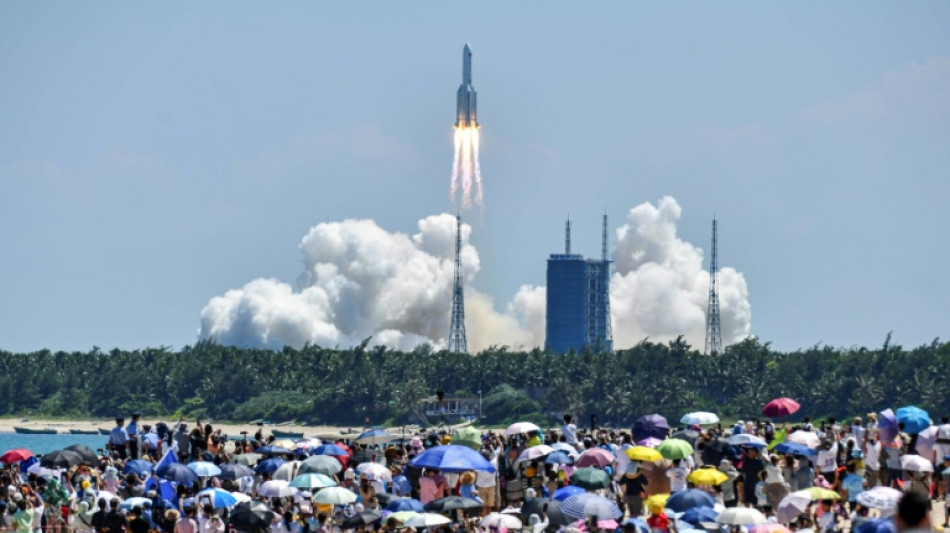
Chinese astronauts set up new lab on space station / Photo: © CNS/AFP/File

Chinese astronauts set up new lab on space station

Astronauts entered the new lab module of China's space station for the first time Monday, in a major step towards completing the orbital outpost by the end of the year.

Text size:

The station is one of the crown jewels of Beijing's ambitious space programme, which has landed robotic rovers on Mars and the Moon, and made China only the third nation to put humans in orbit.

Once completed, Tiangong -- or "heavenly palace" -- will be constantly crewed by rotating teams of three astronauts, who will conduct scientific experiments and help test new technologies.

Wentian, the second of Tiangong's three main sections, docked with the station's core module Tianhe on Monday after successfully launching from southern China a day earlier, state media reported.

A few hours after docking, the three astronauts -- who have been living in the core module since June -- opened the hatch and entered Wentian, footage from state broadcaster CCTV showed.

The crew, dressed in blue jumpsuits, were seen floating around the brightly lit module before facing the camera and saluting.

Wentian will focus on life sciences and biotechnology research, according to official news agency Xinhua, including cell research and growth experiments on plants, fruit flies and zebrafish.

The module will have living space for three additional astronauts, housing up to six people during crew transitions, state media said.

The third and final module, another lab named Mengtian, is scheduled for launch in October.

Tiangong, once completed, is expected to remain in low orbit 400-450 kilometres (250-280 miles) above Earth for at least 10 years.

Next year, China is also planning to launch a space telescope with a field of view 350 times that of NASA's Hubble Space Telescope.

The telescope will be positioned in the same orbit as Tiangong, allowing the station to dock with it for refuelling and servicing when needed.

China has poured billions of dollars into space flight and exploration as it seeks to build a programme that reflects its stature as a rising global power.

The programme has rapidly yielded successes in the last two decades, including launching the first Chinese astronauts, a historic first controlled landing on the far side of the Moon, and delivering a rover to the surface of Mars.

And after several missions to test the technologies needed for a constantly crewed outpost, it is set to finish Tiangong this year.

The station when completed is expected to have a mass of 90 tonnes, around a quarter of the International Space Station -- from which China has been excluded by the United States.

The ISS -- a collaboration between the United States, Russia, Canada, Europe and Japan -- is due to be retired after 2024, although NASA has said it could potentially remain functional beyond 2028.

D.Pan--ThChM