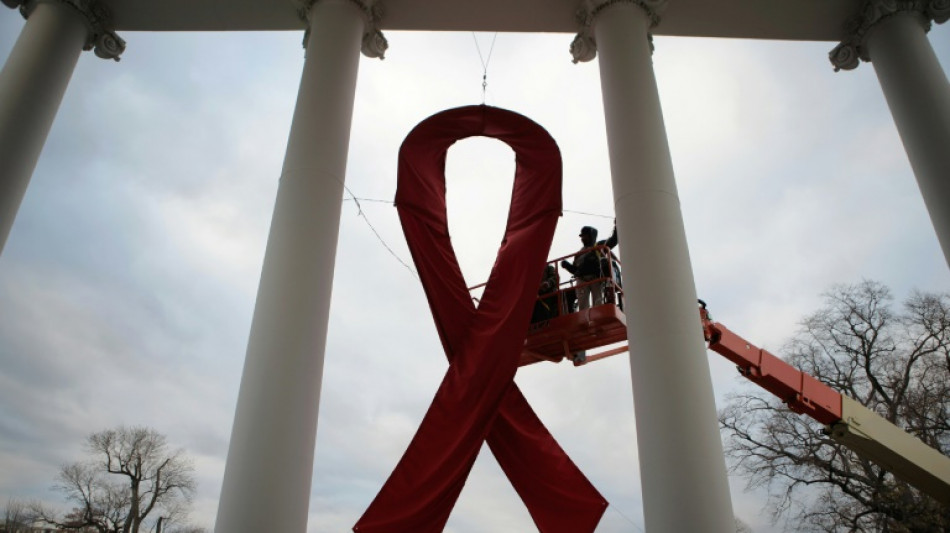
Fourth person 'cured' of HIV, but is a less risky cure in sight? / Photo: © GETTY IMAGES NORTH AMERICA/AFP/File

AIDS researchers announced on Wednesday that a fourth person has been "cured" of HIV, but the dangerous procedure for patients also battling cancer may be little comfort for the tens of millions living with the virus worldwide.
The 66-year-old man, named the "City of Hope" patient after the Californian centre where he was treated, was declared in remission in the lead up to the International AIDS Conference, which begins in Montreal, Canada on Friday.
He is the second person to be announced cured this year, after researchers said in February that a US woman dubbed the New York patient had also gone into remission.
The City of Hope patient, like the Berlin and London patients before him, achieved lasting remission from the virus after a bone marrow transplant to treat cancer.
Another man, the Duesseldorf patient, has also previously been said to have reached remission, potentially bringing the number cured to five.
Jana Dickter, an infectious disease specialist at the City of Hope, told AFP that because the latest patient was the oldest yet to achieve remission, his success could be promising for older HIV sufferers who also have cancer.
Dickter is the lead author of research on the patient which was announced at a pre-conference in Montreal but has not been peer reviewed.
- 'I am beyond grateful' -
"When I was diagnosed with HIV in 1988, like many others, I thought it was a death sentence," said the patient, who does not want to be identified.
"I never thought I would live to see the day that I no longer have HIV," he said in a City of Hope statement. "I am beyond grateful."
Dickter said the patient had told her of the stigma he experienced during the early days of the AIDS epidemic in the 1980s.
"He saw many of his friends and loved ones become very ill and ultimately succumb to the disease," she said.
He had "full-blown AIDS" for a time, she said, but was part of early trials of antiretroviral therapy, which now allows many of the 38 million with HIV globally to live with the virus.
He had HIV for 31 years, longer than any previous patient who went into remission.
After being diagnosed with leukaemia, in 2019 he received a bone marrow transplant with stem cells from an unrelated donor with a rare mutation in which part of the CCR5 gene is missing, making people resistant to HIV.
He waited until getting vaccinated for Covid-19 in March 2021 to stop taking antiretrovirals, and has been in remission from both HIV and cancer since.
Reduced-intensity chemotherapy worked for the patient, potentially allowing older HIV patients with cancer to get the treatment, Dickter said.
But it is a complex procedure with serious side effects and "isn't a suitable option for most people with HIV", she added.
Steven Deeks, an HIV expert at the University of California, San Francisco who was not involved in the research, said the "first thing you do in a bone marrow transplant is you destroy your own immune system temporarily".
"You would never do this if you didn't have cancer," he told AFP.
- 'Holy Grail' -
Also announced at the AIDS conference was research about a 59-year-old Spanish woman with HIV who has maintained an undetectable viral load for 15 years despite stopping antiretroviral therapy.
Sharon Lewin, president-elect of the International AIDS Society which convenes the conference, said that it was not quite the same as the City of Hope patient, because the virus remained at a very low level.
"A cure remains the Holy Grail of HIV research," Lewin said.
"We have seen a handful of individual cure cases before and the two presented today provide continued hope for people living with HIV and inspiration for the scientific community."
She also pointed to a "truly exciting development" towards identifying HIV in an individual cell, which is "a bit like finding a needle in a haystack".
Deeks, an author of the new research also presented at the conference, said it was an "unprecedented deep dive into the biology of the infected cell".
The researchers identified that a cell with HIV has several particular characteristics.
It can proliferate better than most, is hard to kill, and is both resilient and hard to detect, Deeks said.
"This is why HIV is a lifelong infection."
But he said that cases such as the City of Hope patient offered a potential roadmap towards a more broadly available cure, possibly using CRISPR gene-editing technology.
"I think that if you can get rid of HIV, and get rid of CCR5, the door by which HIV gets in, then you can cure someone," Deeks said.
"It's theoretically possible -- we're not there yet -- to give someone a shot in the arm that will deliver an enzyme that will go into the cells and knock out CCR5, and knock out the virus.
"But that's science fiction for now."
R.Yeung--ThChM