Middle East fighting overshadows world telecom show / Photo: © AFP

Fighting over Iran impacted the start on Monday of the Mobile World Congress (MWC) telecoms trade fair thousands of miles away in Barcelona, with Israeli firms absent and activists demonstrating for a boycott of the country's pavilion.
Around 30 Israeli participants had been slated to take their place among the stands in the Catalan capital, where around 109,000 people from around the world were expected to view the latest gadgets and network innovations in the vast halls until Thursday.
But with airspace still closed over Israel two days into joint strikes on Iran with the United States, some such as AI security firm DeepKeep were unable to attend, AFP journalists saw on signs posted at the absent companies' stands.
Nine of the 25 businesses supposed to join the Israeli national pavilion were also kept away.
"Due to the current situation, our flights... were cancelled, and we were unable to reach Barcelona," Nofar Moradian-Shiber of the Israel Export Institute told AFP.
Spanish media reported that thousands of prospective MWC attendees had cancelled, as airports across the Middle East have shut down while fighting continues.
The GSMA telecoms association that organises the trade show played down the disruption.
"A small number of exhibitors, attendees and speakers... might have been affected by travel disruptions," a spokesman said.
"No Iranian companies were due to attend MWC this year," he added.
Catalonia's regional president Salvador Illa said there was "very limited disruption" to the trade show.
- 'Decolonise technology' -
GSMA chief Vivek Badrinath referred to the fighting directly in a Monday morning panel discussion, saying: "Our thoughts are with all those affected by the conflict."
Around 30 demonstrators had earlier gathered at the entrance to the vast congress centre, shouting: "Boycott Israel, boycott USA" and shadowed by several police officers.
"Let's decolonise technology," one demonstrator had written on a sign.
Spanish Prime Minister Pedro Sanchez had on Sunday condemned the US and Israeli strikes on Iran at a Barcelona dinner on the sidelines of MWC.
"You can be against a despicable regime... like the Iranian regime, and at the same time against an unjustified and dangerous military intervention," he said.
Beyond the day's dominant story, actors in the telecoms sector are looking ahead to a year with packed to-do lists, from network improvements to the growing capability of generative artificial intelligence.
- Robot phone head -
Operators and space firms are together racing to offer so-called "direct-to-device" satellite connectivity, in which phones or other connected gadgets communicate directly via satellites overhead without the need for towers on the ground.
Meanwhile governments -- especially in Europe -- are engaged in a push for technological sovereignty to insulate their tech infrastructure from geopolitical tensions.
And device makers are confronted with a surge in the price of working memory (RAM), pumped by massive demand from tech giants building up AI computing capacity.
That could put the brakes on growth in global smartphone sales, which added 1.9 percent to reach 1.26 billion devices last year.
Manufacturers are still betting on the innovations crammed into their latest models.
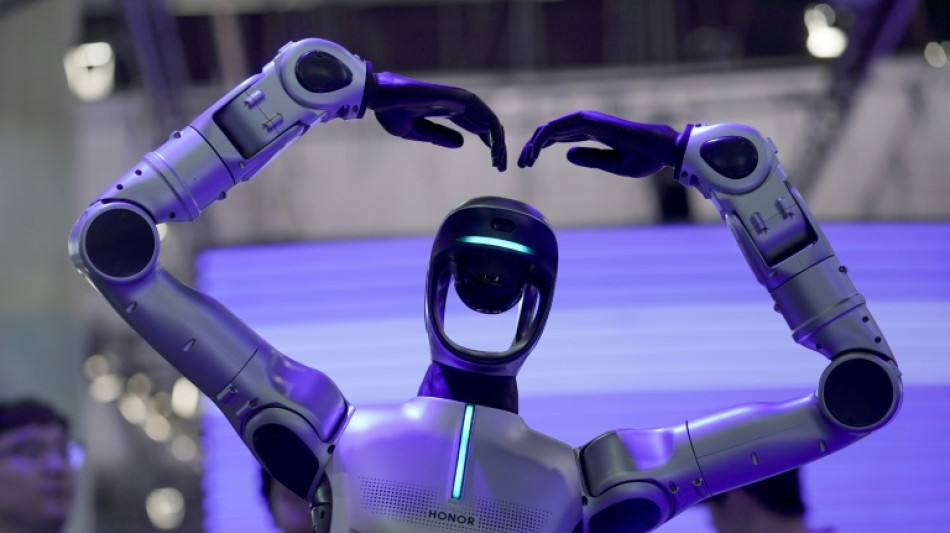
Chinese producer Honor is displaying what it calls a "robot phone" designed to function as a portable AI companion.
The device has a camera on a small robot arm that acts as its head, which Honor said in a Sunday demonstration would be able to nod along with a conversation or look around in response to the user's questions.
The phone is set for launch in the second half of this year.
Chinese competitors Xiaomi and Huawei, sales champions in the connected devices sector, this weekend announced new ranges of watches, headphones and tablets.
R.Yeung--ThChM