The China Mail - Despite reputation, bonobos are aggressive, particularly toward males: study

USD -
AED 3.672952
AFN 64.499526
ALL 81.550227
AMD 361.43058
ANG 1.789785
AOA 918.000074
ARS 1513.143202
AUD 1.434309
AWG 1.8
AZN 1.697378
BAM 1.747405
BBD 2.013572
BDT 123.421934
BGN 1.747831
BHD 0.37766
BIF 2995
BMD 1
BND 1.282034
BOB 11.711836
BRL 5.038366
BSD 0.999772
BTN 95.182957
BWP 13.733399
BYN 3.020865
BYR 19600
BZD 2.010641
CAD 1.423345
CDF 2312.521651
CHF 0.835199
CLF 0.025036
CLP 985.360047
CNY 6.69275
CNH 6.696203
COP 3191.08
CRC 455.660238
CUC 1
CUP 23.993531
CVE 99.398678
CZK 21.845901
DJF 177.720161
DKK 6.703296
DOP 61.249821
DZD 134.726038
EGP 53.069699
ERN 15
ETB 161.12974
EUR 0.89675
FJD 2.26455
FKP 0.754659
GBP 0.75801
GEL 2.606343
GGP 0.754659
GHS 11.665039
GIP 0.754659
GMD 74.000399
GNF 8800.000137
GTQ 7.639869
GYD 209.069102
HKD 7.84789
HNL 26.950058
HRK 6.753703
HTG 130.910423
HUF 326.39401
IDR 17942.55
ILS 3.097603
IMP 0.754659
INR 95.11115
IQD 1513
IRR 1790500.000283
ISK 122.309516
JEP 0.754659
JMD 158.765613
JOD 0.709024
JPY 158.330193
KES 129.750075
KGS 87.449777
KHR 4071.999848
KMF 441.999909
KPW 899.999961
KRW 1341.460093
KWD 0.31184
KYD 0.833099
KZT 451.695332
LAK 22499.999681
LBP 89550.00018
LKR 330.891222
LRD 170.750221
LSL 16.489893
LTL 2.95274
LVL 0.60489
LYD 6.430071
MAD 9.746975
MDL 17.89398
MGA 4500.000066
MKD 55.018986
MMK 2100.02843
MNT 3599.679138
MOP 8.081626
MRU 40.220023
MUR 47.610272
MVR 15.45966
MWK 1742.000393
MXN 18.51695
MYR 4.0837
MZN 63.910163
NAD 16.489878
NGN 1329.930455
NIO 36.850223
NOK 9.515815
NPR 152.293053
NZD 1.784765
OMR 0.384397
PAB 0.999736
PEN 3.430503
PGK 4.45175
PHP 62.884948
PKR 277.034981
PLN 3.920895
PYG 5704.585558
QAR 3.6402
RON 4.784801
RSD 105.30495
RUB 83.610222
RWF 1475
SAR 3.74237
SBD 8.078071
SCR 14.136778
SDG 601.500902
SEK 10.037125
SGD 1.285801
SHP 0.754518
SLE 24.670284
SLL 20969.504398
SOS 571.503444
SRD 37.712039
STD 20697.981008
STN 21.975
SVC 8.747783
SYP 13001.999685
SZL 16.489741
THB 33.639809
TJS 9.227237
TMT 3.5
TND 3.303499
TOP 2.40776
TRY 49.413403
TTD 6.799166
TWD 32.214195
TZS 2630.868006
UAH 44.933885
UGX 4039.293995
UYU 40.187267
UZS 11951.498398
VES 875.701602
VND 25897
VUV 119.372685
WST 2.788609
XAF 588.229566
XAG 0.017972
XAU 0.000243580438
XCD 2.70255
XCG 1.801832
XDR 0.707052
XOF 588.229566
XPF 106.874968
YER 236.197532
ZAR 16.620701
ZMK 9001.197547
ZMW 19.868757
ZWL 321.999592
SSP 5748.524006
MXV 2.090995
  • RYCEF

    0.4000

    19.71

    +2.03%

  • CMSC

    0.0000

    20.4

    0%

  • BTI

    0.4200

    56.05

    +0.75%

  • BP

    0.2800

    44.43

    +0.63%

  • RBGPF

    1.6000

    67

    +2.39%

  • RIO

    -0.1500

    94.41

    -0.16%

  • AZN

    -0.4300

    166.15

    -0.26%

  • GSK

    0.4600

    49.7

    +0.93%

  • BCE

    -0.4100

    20.56

    -1.99%

  • NGG

    -0.2500

    75.24

    -0.33%

  • VOD

    -0.0400

    16.58

    -0.24%

  • RELX

    -0.4500

    33.07

    -1.36%

  • BCC

    -0.5500

    76.59

    -0.72%

  • CMSD

    -0.0300

    20.27

    -0.15%

  • JRI

    -0.2500

    10.77

    -2.32%

Despite reputation, bonobos are aggressive, particularly toward males: study
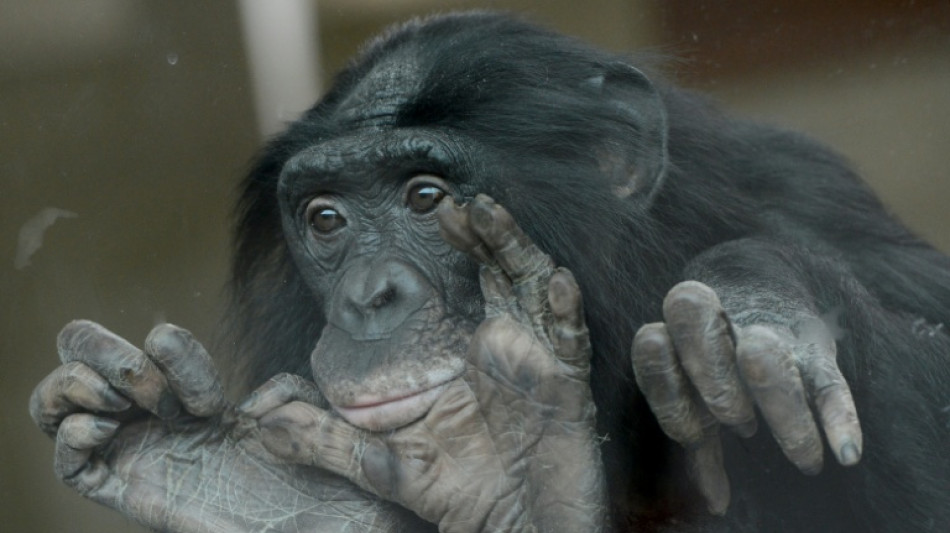
Despite reputation, bonobos are aggressive, particularly toward males: study / Photo: © DPA/AFP

Despite reputation, bonobos are aggressive, particularly toward males: study

Historically considered a more peaceful species than their chimpanzee cousins, bonobos are actually just as aggressive -- but target their ire most often at males, according to a study published Wednesday.

Text size:

Living in matriarchal societies, the gentle-eyed primates once dubbed "hippy apes" are far from violence-free, a group of European researchers reported in the journal Science Advances.

They studied 13 groups of bonobos and nine groups of chimpanzees -- who conversely live in patriarchal systems and are well known for their aggressivity -- in zoos, seeking to find out which is more prone to attacks.

Measuring different types of aggressive behavior, both physical and not -- such as throwing objects, intimidation, or biting and slapping -- they found "no overall differences in absolute aggression rates between the two species."

However, differences emerged "in how the aggression is distributed among group members," co-author Nicky Staes told AFP.

"In chimpanzees aggression mostly comes from males and is directed towards both males and females, whereas in bonobos aggression levels are quite equal in both sexes but are mostly directed at males," she said.

Emile Bryon, another co-author, said that, as bonobos live in female-dominant groups, the fact that both females and males direct most of their aggression toward males surprised researchers.

"Dominant individuals compete amongst each other for resources," he said, so "one could expect aggression among bonobo females. But our study says otherwise."

The relative lack of aggression among female bonobos could be explained by the species' well-studied use of sex to defuse conflicts, or the aggression may be "redirected towards males, who become buffers in the females' competitive dynamics," Bryon said.

- Aggressive ancestors? -

The authors noted limitations to their findings due to the apes living in captivity, where food is not as much of a source of tension, but highlighted the variability of aggressiveness in both species.

Some groups of bonobos and chimpanzees appeared particularly prone to violence and others more peaceful, which "suggests that limiting our understanding of a species to a handful of groups can prevent grasping the full species-wide diversity in behavioral expressions," said Bryon.

As our closest primate relatives, the behavior of chimpanzees and bonobos are of particular interest to science.

"There is big debate in evolutionary anthropology whether humans descended from a violent ape or a more cooperative, peaceful one," Staes explained.

The new study suggests that "aggression was likely present in the common ancestor of humans, chimpanzees, and bonobos."

They also show that aggression can vary widely among apes, said Bryon.

"Recognizing this variation and understanding its roots suggests that it can be better understood, managed, and even reduced."

H.Ng--ThChM