The China Mail - New particle discovered by Large Hadron Collider

USD -
AED 3.672498
AFN 62.999732
ALL 81.2693
AMD 368.114362
ANG 1.78969
AOA 918.000494
ARS 1384.994141
AUD 1.382409
AWG 1.8025
AZN 1.695524
BAM 1.666077
BBD 2.014457
BDT 122.941149
BGN 1.666332
BHD 0.377471
BIF 2977.296929
BMD 1
BND 1.273246
BOB 6.911416
BRL 4.911196
BSD 1.000217
BTN 95.599836
BWP 13.500701
BYN 2.796427
BYR 19600
BZD 2.01156
CAD 1.369235
CDF 2224.999743
CHF 0.780655
CLF 0.023209
CLP 913.460046
CNY 6.792094
CNH 6.792665
COP 3788.36
CRC 456.440902
CUC 1
CUP 26.5
CVE 93.93689
CZK 20.746599
DJF 178.103956
DKK 6.36761
DOP 59.027231
DZD 132.38791
EGP 52.898594
ERN 15
ETB 156.17715
EUR 0.85225
FJD 2.18535
FKP 0.732576
GBP 0.738925
GEL 2.669894
GGP 0.732576
GHS 11.291855
GIP 0.732576
GMD 73.497463
GNF 8776.211713
GTQ 7.631494
GYD 209.250717
HKD 7.828305
HNL 26.597149
HRK 6.4204
HTG 130.672573
HUF 304.843501
IDR 17533.2
ILS 2.91395
IMP 0.732576
INR 95.53775
IQD 1310.162706
IRR 1312000.00026
ISK 122.390071
JEP 0.732576
JMD 158.040677
JOD 0.708994
JPY 157.664501
KES 129.170419
KGS 87.449773
KHR 4012.437705
KMF 420.000201
KPW 900.018246
KRW 1498.094998
KWD 0.30811
KYD 0.833461
KZT 463.898117
LAK 21925.486738
LBP 89566.76932
LKR 323.055495
LRD 183.03638
LSL 16.532284
LTL 2.95274
LVL 0.60489
LYD 6.327815
MAD 9.128129
MDL 17.117957
MGA 4179.356229
MKD 52.519926
MMK 2098.953745
MNT 3580.85029
MOP 8.064861
MRU 39.897262
MUR 46.706991
MVR 15.397171
MWK 1734.441354
MXN 17.2296
MYR 3.929502
MZN 63.90968
NAD 16.532073
NGN 1370.106476
NIO 36.810495
NOK 9.18415
NPR 152.953704
NZD 1.68165
OMR 0.384494
PAB 1.000175
PEN 3.427819
PGK 4.355862
PHP 61.516496
PKR 278.627173
PLN 3.62445
PYG 6105.472094
QAR 3.645959
RON 4.433496
RSD 100.04046
RUB 73.824676
RWF 1462.859869
SAR 3.754672
SBD 8.029009
SCR 14.649939
SDG 600.527064
SEK 9.295175
SGD 1.272565
SHP 0.746601
SLE 24.625042
SLL 20969.499428
SOS 571.611117
SRD 37.254502
STD 20697.981008
STN 20.871402
SVC 8.751171
SYP 110.529423
SZL 16.526884
THB 32.367023
TJS 9.351751
TMT 3.5
TND 2.908879
TOP 2.40776
TRY 45.41337
TTD 6.787631
TWD 31.570501
TZS 2600.150145
UAH 43.959484
UGX 3759.408104
UYU 39.772219
UZS 12133.112416
VES 504.28356
VND 26349.5
VUV 118.32345
WST 2.709295
XAF 558.801055
XAG 0.011607
XAU 0.000213
XCD 2.70255
XCG 1.802539
XDR 0.694969
XOF 558.801055
XPF 101.593413
YER 238.650219
ZAR 16.51652
ZMK 9001.198013
ZMW 18.8284
ZWL 321.999592
  • CMSD

    -0.0100

    23.6

    -0.04%

  • BCC

    -1.2700

    67.93

    -1.87%

  • NGG

    0.0800

    87.24

    +0.09%

  • BTI

    3.2000

    63.64

    +5.03%

  • BCE

    0.1900

    24.47

    +0.78%

  • JRI

    0.0100

    13.14

    +0.08%

  • CMSC

    -0.0100

    23.11

    -0.04%

  • RIO

    1.6000

    109.5

    +1.46%

  • GSK

    1.0900

    50.9

    +2.14%

  • RBGPF

    0.0000

    61

    0%

  • RYCEF

    -0.3900

    16.2

    -2.41%

  • AZN

    2.6800

    184.54

    +1.45%

  • BP

    0.1800

    44.4

    +0.41%

  • VOD

    -1.2250

    15.095

    -8.12%

  • RELX

    -0.5000

    32.77

    -1.53%

New particle discovered by Large Hadron Collider
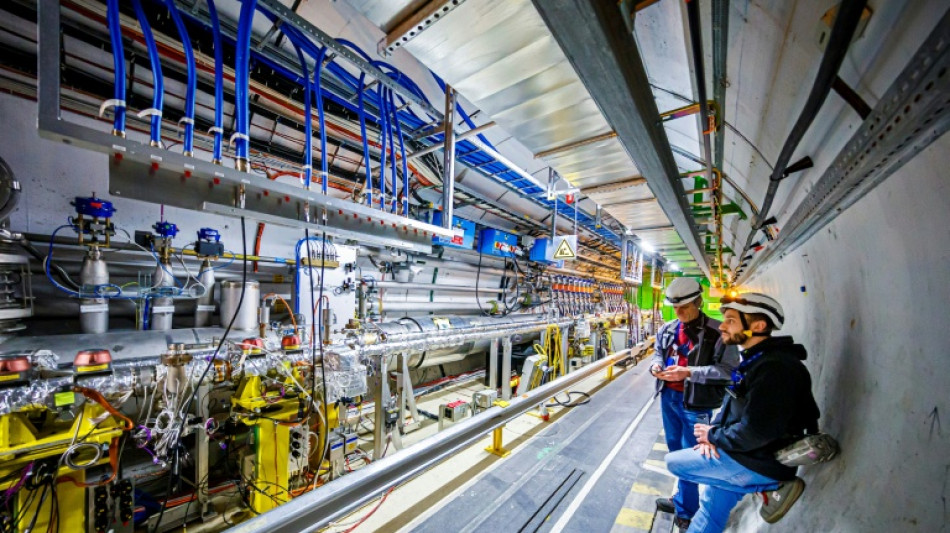
New particle discovered by Large Hadron Collider / Photo: © AFP/File

New particle discovered by Large Hadron Collider

The Large Hadron Collider has discovered a new particle, the 80th identified so far by the world's most powerful particle smasher, Europe's CERN physics laboratory announced Tuesday.

Text size:

The new particle has been named "Xi-cc-plus". Scientists hope the particle -- which is similar to a proton but four times heavier -- will reveal more about the strange behaviour of quantum mechanics.

All the matter around us -- including the protons and neutrons that make up the nucleus of atoms -- are made of baryons.

These common particles are composed of three quarks, which are fundamental building blocks of matter.

Quarks come in six "flavours": up, down, charm, strange, top and bottom. Each has varying mass, electric charge and quantum properties.

In theory, there could be many different types of baryons that mix these flavours -- however most are extremely difficult to observe.

To chase them down, the Large Hadron Collider sends particles whizzing around an underground ring at phenomenal speeds until they smash into each other.

This gives scientists a brief chance to measure how the more stable elements decay, then deduce the properties of the original particle.

The newly discovered "Xi-cc-plus" contains two "charm" quarks and one "down" quark.

Normal protons have two "up" quarks and one "down" quark. Because the new particle has two heavier "charm" quarks instead of "up" ones, it has a much greater mass.

Vincenzo Vagnoni, spokesman for the Large Hadron Collider beauty (LHCb) experiment, said it was "only the second time a baryon with two heavy quarks has been observed".

It is also "the first new particle identified after the upgrades to the LHCb detector that were completed in 2023," he said in a statement.

"The result will help theorists test models of quantum chromodynamics, the theory of the strong force that binds quarks into not only conventional baryons and mesons but also more exotic hadrons such as tetraquarks and pentaquarks."

In 2017, the LHCb experiment announced that it had discovered a similar particle, made of two "charmed" quarks and one "up" quark.

The new particle has an expected lifetime six times shorter than this earlier one, making it far more tricky to spot, CERN said.

The Large Hadron Collider is a 27-kilometre (17 mile) long proton-smashing ring running about 100 metres below France and Switzerland. Mostly famously, it proved the existence of the Higgs boson -- known as the "God particle" -- in 2012.

The latest discovery comes as CERN plans to build an even bigger particle smasher, the Future Circular Collider, to continue probing the mysteries of the universe.

F.Jackson--ThChM