The China Mail - The Sun may not engulf Earth after all, scientists say

USD -
AED 3.672503
AFN 64.000081
ALL 82.483757
AMD 367.60217
ANG 1.790403
AOA 918.000006
ARS 1451.003301
AUD 1.425649
AWG 1.8025
AZN 1.700973
BAM 1.705709
BBD 2.013483
BDT 122.708482
BGN 1.69088
BHD 0.377011
BIF 2981.022483
BMD 1
BND 1.290663
BOB 6.90816
BRL 5.1598
BSD 0.999721
BTN 94.239742
BWP 13.585663
BYN 2.777729
BYR 19600
BZD 2.010527
CAD 1.41513
CDF 2299.999587
CHF 0.806597
CLF 0.022864
CLP 899.82007
CNY 6.769304
CNH 6.788585
COP 3446.46
CRC 453.506829
CUC 1
CUP 26.5
CVE 96.16609
CZK 21.126799
DJF 178.019649
DKK 6.51815
DOP 58.432611
DZD 133.484005
EGP 49.920401
ERN 15
ETB 158.232624
EUR 0.87203
FJD 2.24625
FKP 0.755912
GBP 0.755665
GEL 2.654994
GGP 0.755912
GHS 11.196435
GIP 0.755912
GMD 72.479702
GNF 8757.914566
GTQ 7.625892
GYD 209.119888
HKD 7.838765
HNL 26.742077
HRK 6.5737
HTG 130.583803
HUF 307.440178
IDR 17807
ILS 2.962155
IMP 0.755912
INR 94.3712
IQD 1309.588181
IRR 1375250.000366
ISK 125.569701
JEP 0.755912
JMD 157.959917
JOD 0.709013
JPY 161.219693
KES 129.450284
KGS 87.45041
KHR 4009.069899
KMF 431.000051
KPW 900.00035
KRW 1529.930165
KWD 0.30801
KYD 0.833035
KZT 487.855928
LAK 22078.029679
LBP 89521.504603
LKR 333.641485
LRD 181.943451
LSL 16.48506
LTL 2.95274
LVL 0.60489
LYD 6.376132
MAD 9.314071
MDL 17.654036
MGA 4208.910576
MKD 53.780376
MMK 2099.523204
MNT 3579.573337
MOP 8.070939
MRU 39.897263
MUR 47.86972
MVR 15.400062
MWK 1733.450199
MXN 17.33638
MYR 4.137198
MZN 63.909523
NAD 16.48506
NGN 1364.66019
NIO 36.786381
NOK 9.683745
NPR 150.787532
NZD 1.74118
OMR 0.384501
PAB 0.999725
PEN 3.383074
PGK 4.381574
PHP 60.734967
PKR 278.085242
PLN 3.71615
PYG 6138.96617
QAR 3.644308
RON 4.569603
RSD 102.366978
RUB 73.17496
RWF 1464.43989
SAR 3.748994
SBD 8.058296
SCR 13.647644
SDG 600.498647
SEK 9.56976
SGD 1.291005
SHP 0.746601
SLE 24.7506
SLL 20969.503664
SOS 571.331391
SRD 37.369005
STD 20697.981008
STN 21.367149
SVC 8.747449
SYP 110.532098
SZL 16.480613
THB 32.856498
TJS 9.272075
TMT 3.5
TND 2.954074
TOP 2.40776
TRY 46.442601
TTD 6.779085
TWD 31.605104
TZS 2625.003018
UAH 44.909735
UGX 3638.520172
UYU 39.96965
UZS 12045.839075
VES 606.63266
VND 26320
VUV 118.645306
WST 2.751804
XAF 572.078806
XAG 0.015417
XAU 0.00024
XCD 2.70255
XCG 1.801643
XDR 0.703697
XOF 572.083795
XPF 104.010047
YER 237.125002
ZAR 16.474325
ZMK 9001.201269
ZMW 17.919703
ZWL 321.999592
  • VOD

    -0.2300

    14.3

    -1.61%

  • CMSC

    0.0500

    22.37

    +0.22%

  • RELX

    -0.8300

    31.18

    -2.66%

  • NGG

    -1.2400

    79.44

    -1.56%

  • RBGPF

    -0.5300

    60.61

    -0.87%

  • RYCEF

    -0.0300

    18.4

    -0.16%

  • GSK

    -1.4800

    50.67

    -2.92%

  • BTI

    -0.5800

    58.91

    -0.98%

  • BP

    -1.0400

    39.1

    -2.66%

  • RIO

    -2.5900

    100.08

    -2.59%

  • BCC

    3.8500

    74.66

    +5.16%

  • CMSD

    0.0000

    22.29

    0%

  • AZN

    -2.9600

    174.93

    -1.69%

  • JRI

    0.0500

    12.67

    +0.39%

  • BCE

    0.0000

    23.28

    0%

The Sun may not engulf Earth after all, scientists say
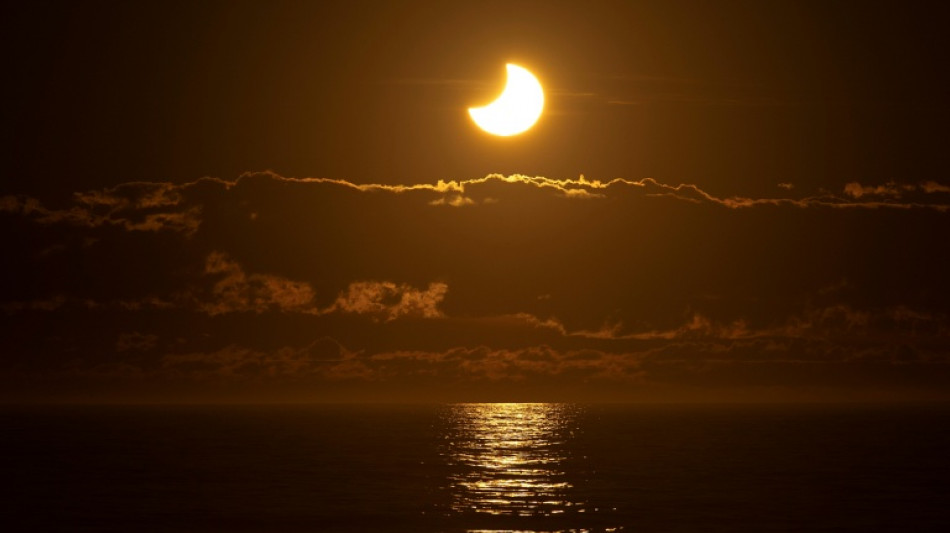
The Sun may not engulf Earth after all, scientists say / Photo: © AFP/File

The Sun may not engulf Earth after all, scientists say

Need some good news on a Friday after a long week?

Text size:

The Earth may not be engulfed by the expanding fireball of the dying Sun, which has long been assumed to be our home planet's ultimate fate, according to scientists.

Don't worry: this is not expected to happen for another five billion years, long after all life on Earth has been wiped out.

When the Sun burns through all of the hydrogen in its core, it will go through two immense expansion phases: first becoming a red giant, then, when its helium is spent, an "AGB" star.

This fiery death will bring about some significant changes back here on Earth.

As the Sun grows, increasing gravitational forces will pull the Earth towards it.

For the Earth and the Moon, this force creates the push and pull of the tides in our oceans. The energy from these tides, which dissipates at the bottom of the ocean, slows Earth's rotation and gradually pushes the Moon away from us.

As the Sun expands and its blistering surface approaches Earth, intense tidal waves will stir within the star. When they dissipate, it will pull Earth into its doomed embrace.

However, the growing Sun will also lose a lot of its mass due to stellar wind, which pushes our planet further away.

"Earth's fate depends on a delicate balance between these two effects," explained Mats Esseldeurs, the lead author of a study published in the journal Astronomy & Astrophysics on Friday.

"If tidal interactions predominate, Earth is engulfed by the Sun. If the Sun's mass loss predominates, Earth escapes into an orbit larger than the radius of its star," the astrophysicist at Belgium's University of Leuven said in a statement.

Until now, scientists had favoured the first hypothesis.

- Catching some Sun -

However their calculations relied on relatively simple descriptions of tidal dissipation within giant stars.

Advances made in modelling these tides over the last 15 years have enabled the study's authors to show that "the dissipation is lower than previously expected", Stephane Mathis, an astrophysicist at the CEA Paris-Saclay centre in France, told AFP.

To estimate how much mass the Sun could lose, the team focused in particular on a nearby star called L2 Puppis that is like the Sun's "old cousin", the study's co-author said.

"A better understanding of tidal physics and the most advanced constraints we have on mass loss allow us to say that -- in the current state of knowledge -- Earth could move away from the Sun, contrary to what was predicted before," Mathis said.

According to the new modelling, Mars also escapes a death spiral into the Sun.

But the two planets closest to the Sun, Mercury and Venus, are not so lucky. They will be inexorably swallowed by the expanding fireball.

After all this, the Sun will eventually become an extremely dense star called a white dwarf.

No longer capable of fusion reactions, it will slowly become dimmer and cooler over time.

J.Liv--ThChM