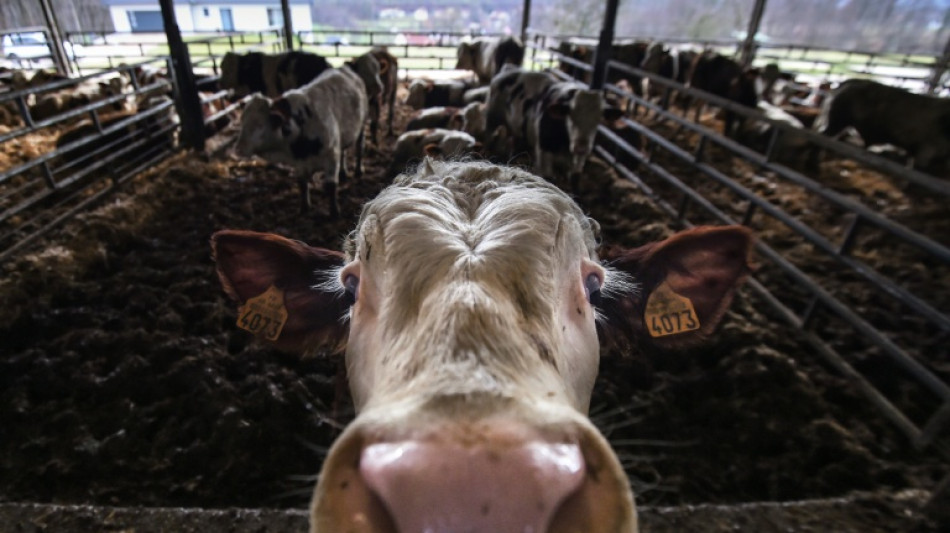
The China Mail - French farmers suffer arid crops, heat-stricken animals

USD -
AED 3.672504
AFN 65.000368
ALL 81.9979
AMD 361.046432
ANG 1.790403
AOA 917.000367
ARS 1596.41556
AUD 1.500826
AWG 1.8025
AZN 1.70397
BAM 1.785874
BBD 2.016984
BDT 125.580971
BGN 1.77347
BHD 0.377665
BIF 3008.811578
BMD 1
BND 1.291513
BOB 11.872346
BRL 5.559104
BSD 1.001415
BTN 93.180843
BWP 14.815322
BYN 3.013286
BYR 19600
BZD 2.014062
CAD 1.42715
CDF 2280.000362
CHF 0.836062
CLF 0.026234
CLP 1033.182669
CNY 6.664504
CNH 6.655204
COP 3490.663379
CRC 444.596631
CUC 1
CUP 24.034151
CVE 100.684838
CZK 22.338604
DJF 178.331735
DKK 6.833704
DOP 59.909601
DZD 136.546592
EGP 54.510341
ERN 15
ETB 163.703511
EUR 0.913204
FJD 2.29315
FKP 0.763199
GBP 0.763388
GEL 2.590391
GGP 0.763199
GHS 11.892435
GIP 0.763199
GMD 74.000355
GNF 8883.71456
GTQ 7.656485
GYD 209.478154
HKD 7.83005
HNL 26.922339
HRK 6.831965
HTG 131.397525
HUF 338.340388
IDR 18354.45
ILS 3.327204
IMP 0.763199
INR 92.995504
IQD 1518.148199
IRR 1960166.000352
ISK 125.470386
JEP 0.763199
JMD 158.489705
JOD 0.70904
JPY 159.55504
KES 130.383966
KGS 87.450384
KHR 4071.588367
KMF 449.00035
KPW 900.00035
KRW 1333.750383
KWD 0.31272
KYD 0.834589
KZT 459.060403
LAK 22585.034014
LBP 89678.765466
LKR 333.625531
LRD 164.23321
LSL 17.382824
LTL 2.95274
LVL 0.60489
LYD 6.491348
MAD 10.03689
MDL 18.436744
MGA 4534.538648
MKD 56.206912
MMK 2100.121159
MNT 3611.229368
MOP 8.074967
MRU 40.639182
MUR 46.850378
MVR 15.403739
MWK 1736.474456
MXN 19.654704
MYR 4.120804
MZN 64.250377
NAD 17.382824
NGN 1356.550377
NIO 36.853399
NOK 9.801604
NPR 149.089166
NZD 1.829492
OMR 0.382331
PAB 1.001415
PEN 3.473497
PGK 4.582934
PHP 63.756038
PKR 276.722367
PLN 4.08575
PYG 6451.171072
QAR 3.650641
RON 4.884804
RSD 107.446469
RUB 81.69164
RWF 1480.253847
SAR 3.75163
SBD 8.177162
SCR 13.864037
SDG 601.503676
SEK 10.266204
SGD 1.290371
SHP 0.763854
SLE 23.000338
SLL 20969.503664
SOS 572.341688
SRD 37.26037
STD 20697.981008
STN 22.371365
SVC 8.76227
SYP 13002.000337
SZL 17.378441
THB 33.948038
TJS 9.293339
TMT 3.5
TND 3.035383
TOP 2.40776
TRY 50.743804
TTD 6.794503
TWD 33.002104
TZS 2691.412135
UAH 45.089348
UGX 4320.869287
UYU 40.770671
UZS 12037.620417
VES 921.380504
VND 25836.5
VUV 121.507995
WST 2.838507
XAF 599.022624
XAG 0.02286
XAU 0.000273664075
XCD 2.70255
XCG 1.804867
XDR 0.707052
XOF 599.022624
XPF 108.898324
YER 236.603589
ZAR 17.36045
ZMK 9001.203584
ZMW 20.904899
ZWL 321.999592
SSP 5775.400178
MXV 2.198782
  • RYCEF

    0.4000

    19.71

    +2.03%

  • CMSC

    0.0000

    20.4

    0%

  • BTI

    0.4200

    56.05

    +0.75%

  • BP

    0.2800

    44.43

    +0.63%

  • RBGPF

    1.6000

    67

    +2.39%

  • RIO

    -0.1500

    94.41

    -0.16%

  • AZN

    -0.4300

    166.15

    -0.26%

  • GSK

    0.4600

    49.7

    +0.93%

  • BCE

    -0.4100

    20.56

    -1.99%

  • NGG

    -0.2500

    75.24

    -0.33%

  • VOD

    -0.0400

    16.58

    -0.24%

  • RELX

    -0.4500

    33.07

    -1.36%

  • BCC

    -0.5500

    76.59

    -0.72%

  • CMSD

    -0.0300

    20.27

    -0.15%

  • JRI

    -0.2500

    10.77

    -2.32%

French farmers suffer arid crops, heat-stricken animals
French farmers suffer arid crops, heat-stricken animals / Photo: © AFP

French farmers suffer arid crops, heat-stricken animals

France's current heatwave is taking a toll on farmers, who are seeing livestock die and are racing against time to harvest cereals without sparking fires in the tinder-dry crops.

Text size:

Stephane Delapre, a farmer in Beauvoir-sur-Mer, near the western coast, said half his chickens had died of suffocation on Monday.

"In 42 years, I've never seen that," he told AFP as he waited for an official to collect the carcasses.

Depre raises around 17,500 free-range hens and 70,000 quails in sheds with outdoor runs.

"We put in a few fans but... it went up to 40–41C. There was nothing we could do," he said.

Sixty kilometres (40 miles) away, Regis Bonnin, 57, said he had set up misting systems to cool his 120 dairy cows, who were producing four to five litres less milk per day.

He had already lost a heifer with weak lungs and feared future reproductive problems.

He said he would hang on until next week to cut his wheat, for fear the combine harvester would spark a fire in the parched crop.

Neighbours had "already put out two blazes".

His main crop worry was his maize yield.

"If it flowers when temperatures are above 30C the pollen will be sterile," meaning the ears of corn will have fewer grains, he said glumly.

- Pressure cooker -

The heat also generates logistical headaches.

Sebastien Mery, who farms wheat and rapeseed in the Gatinais region, south of Paris, harvests early in the morning and late at night to avoid the worst of the heat.

But those timings mean he cannot get the cereal straight to a local silo because they are not open then.

Where regional authorities have banned harvesting between 2:00 pm and 7:00 pm, some silos are now opening overnight.

Stephane Baron, from Charente-Maritime, western France, is bracing for disastrous harvests, due to downpours in February and successive heatwaves in May and June.

His soft wheat yield was half what was needed for the crop to be profitable, he said.

France's powerful intensive-farming union FNSEA said maize and sunflowers were likely to survive this year "with a bit of water" but wheat could be problematic.

"Sometimes the wheat's too dry, so the grain is too small and risks being thrown out with the straw" by the combine harvester, said Franck Laborde, FNSEA's head of climate risk.

The worst heatwave in most French farmers' memory was the disaster of 2003.

But that came in August, when crops were already three-quarters grown, Bonnin pointed out.

This time, the searing heat has come much earlier in the growing cycle.

"The difference now is we've got a succession of extreme events," said Inaki Garcia de Cortazar-Atauri of research institute INRAE.

"There's no magic formula against the pressure-cooker effect," he said, but stressed that environmental farming practices offer a "framework" for adaptation that can be developed "in every region and every sector".

O.Yip--ThChM