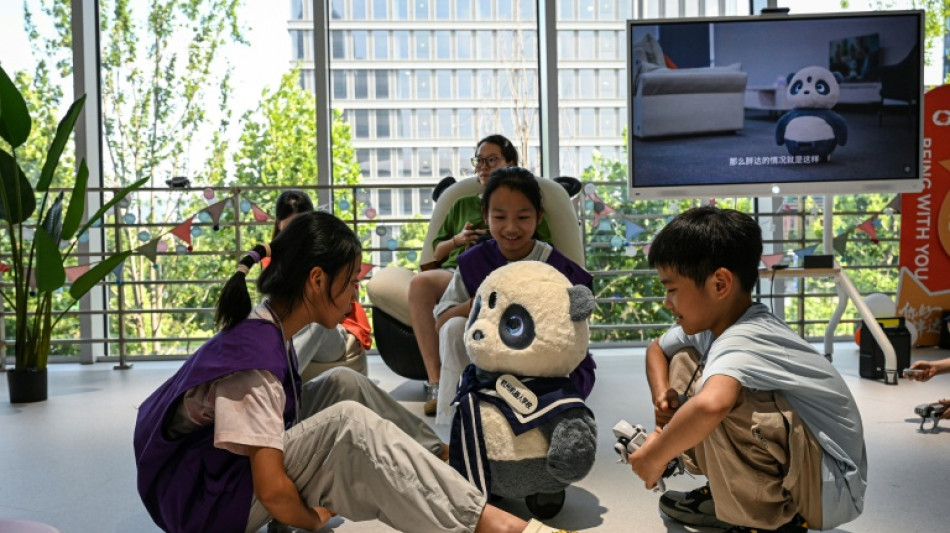
China's robots open to opportunities in search of commercial breakthrough / Photo: © AFP

A horde of schoolchildren watched excitedly as a diminutive humanoid tour guide named Wuji welcomed them to a robot school in eastern China, gesticulating theatrically as it described the institute's aspiration to train the mechanical workforce of the future.
A steady buzz is growing around China as advanced robotics emerges as the next frontier of the global AI boom, encompassing both investor enthusiasm and alarm from rivals such as the United States.
Hundreds of companies are taking part in the World Robot Conference in Beijing on Wednesday, the same day national champion Unitree made its much-anticipated stock market debut.
The firm's shares jumped over 600 percent on opening, but the frenzy is very much a bet on the future, with commercial application of even the most sophisticated humanoids currently limited.
When AFP met Hangzhou Robot School's Wuji -- a customised Unitree model -- it asked visitors to bear with it as it showed them around the school's reception.
"I'm still in my training period, so I'm feeling a little nervous," the self-described "intern" said in an earnest female voice, explaining how the school provided tailored courses and certification for specific robot jobs.
Unitree humanoids are among the world's most recognisable, having wowed audiences with fluid martial arts dances and robot-on-robot kickboxing skirmishes.
However, in its prospectus, the company said large-scale commercial deployment "still faces uncertainty, with a risk that progress will fall short of expectations".
Experts say the holy grail -- machines capable of independently reacting to the unpredictability of any real-life situation -- is a long way off for any company.
"Training the 'brain' (of a robot) is a very difficult task," Zhu Tianle, an engineer at the robot school, told AFP.
"Although we have built up a certain level of technical expertise, enabling robots to understand the world remains a global challenge."
"The challenge goes way beyond just putting AI into a robot," said Lian Jye Su from technology research group Omdia, who dislikes the term "physical AI" for downplaying the complexity of the hardware solutions needed.
"As a consumer you might think: my old folks can already talk to ChatGPT, so surely a robot will soon be able to take care of them. The reality is we are extremely far from that future."
- 'Real-world application' -
Beijing has thrown its weight behind narrowing that timeframe, calling for the sector's development in its last two five-year plans.
The manufacturing supply chain is already comprehensive, sharing many similarities with that of electric vehicles.
"The next phase of the industry is less about demonstrating that a robot can walk and more about demonstrating that it can perform economically useful tasks," Morningstar equity analyst Kangyuxiao Li told AFP.
That is the premise of Hangzhou Robot School, run by Zhejiang University (ZJU) with support from local government.
It aims to help companies bridge expertise gaps "to move towards real-world application", said Zhao Han, deputy director of the ZJU institute behind the school.
AFP did not see many "students" when visiting earlier this month, but the size of the training room was a clear statement of intent.
Companies enrol robots, who are evaluated and given training tailored to their "future role in the workplace".
The school will issue qualifications confirming a machine's ability to do a specific role -- "much like a human's graduation certificate", said Zhao.
Robots are popping up more in everyday life in China, with trial jobs including directing traffic, cleaning houses or working on factory floors.
Aside from hardware issues, large-scale deployment requires gathering huge amounts of data -- the real-world equivalent of the online content large language models train on.
At one training company visited by AFP, humans holding what looked like PlayStation controllers repeated a single task -- folding clothes, moving blocks, spraying a canister -- as humanoid partners mirrored their actions.
Generally, an employee told AFP, a usable model required tens of thousands of hours of data.
- Tech race -
Beijing's strategic investment has not gone unnoticed.
In July, Washington banned the import of foreign humanoids and quadruped robots on national security grounds, effectively opening up a new front in the tech war.
China's advantages lie in manufacturing scale, supply chain integration and cost competitiveness, said Counterpoint Research's Ethan Qi, while the United States is "much stronger" on software and cutting-edge research.
AFP contacted multiple Chinese companies to ask for reaction to the ban, including main exporters Unitree, UBTECH and Agibot.
None replied, but industry insiders and analysts downplayed the effect on the overall sector.
"My sense is that companies are too busy chasing the next technical breakthrough and figuring out what actually scales commercially to spend much time on overseas markets," said Rui Ma, founder of the Tech Buzz China newsletter.
US sales make up a fraction of most companies' revenue, with China claiming more than 90 percent of the humanoid market, according to Counterpoint.
Omdia's Su cautioned that the danger to firms was more existential.
"The valuation that goes into all these companies is based on the fact that these robots will become general purpose, human-like at some point," he said.
"Failing to deliver that will be a very massive blow."
O.Tse--ThChM