The China Mail - Milky Way's fastest star discovered spinning around black hole

USD -
AED 3.672501
AFN 64.999988
ALL 79.173956
AMD 364.00811
ANG 1.789783
AOA 918.000126
ARS 1497.250009
AUD 1.407203
AWG 1.80125
AZN 1.699613
BAM 1.673104
BBD 2.01539
BDT 122.281202
BGN 1.696366
BHD 0.377268
BIF 2973.916317
BMD 1
BND 1.271932
BOB 11.542986
BRL 5.194103
BSD 1.000659
BTN 95.718306
BWP 13.434508
BYN 3.043612
BYR 19600
BZD 2.012524
CAD 1.377015
CDF 2273.000487
CHF 0.798955
CLF 0.023464
CLP 923.460242
CNY 6.72975
CNH 6.726645
COP 3052.8
CRC 453.402228
CUC 1
CUP 26.5
CVE 94.330261
CZK 20.677203
DJF 178.187838
DKK 6.400015
DOP 58.471778
DZD 132.809899
EGP 50.913404
ERN 15
ETB 163.449465
EUR 0.85609
FJD 2.1993
FKP 0.735015
GBP 0.733865
GEL 2.599925
GGP 0.735015
GHS 11.132356
GIP 0.735015
GMD 73.489513
GNF 8792.543704
GTQ 7.635945
GYD 209.26741
HKD 7.84379
HNL 26.831146
HRK 6.447995
HTG 130.914597
HUF 312.548496
IDR 17798.5
ILS 2.99225
IMP 0.735015
INR 95.78055
IQD 1310.845723
IRR 1374599.999891
ISK 121.570358
JEP 0.735015
JMD 158.313693
JOD 0.709007
JPY 158.768501
KES 129.531461
KGS 87.450427
KHR 4023.337582
KMF 422.00032
KPW 900.000294
KRW 1396.624937
KWD 0.308296
KYD 0.833925
KZT 456.002874
LAK 22541.886418
LBP 89608.575327
LKR 330.163782
LRD 181.619088
LSL 16.146032
LTL 2.95274
LVL 0.60489
LYD 6.337338
MAD 9.252116
MDL 17.181525
MGA 4276.542323
MKD 52.628652
MMK 2099.608389
MNT 3598.398104
MOP 8.084231
MRU 39.988023
MUR 46.809482
MVR 15.450303
MWK 1735.176615
MXN 16.991015
MYR 4.044397
MZN 63.89495
NAD 16.145824
NGN 1348.090005
NIO 36.828238
NOK 9.33371
NPR 153.148806
NZD 1.68278
OMR 0.384497
PAB 1.000654
PEN 3.350814
PGK 4.498929
PHP 61.872499
PKR 277.656585
PLN 3.697255
PYG 6025.116772
QAR 3.647726
RON 4.496039
RSD 100.425032
RUB 83.327854
RWF 1470.917848
SAR 3.756633
SBD 8.032258
SCR 13.740667
SDG 601.50433
SEK 9.491825
SGD 1.272155
SHP 0.740866
SLE 24.59611
SLL 20969.499227
SOS 571.883194
SRD 37.742003
STD 20697.981008
STN 20.959339
SVC 8.755908
SYP 13001.999906
SZL 16.142113
THB 32.921496
TJS 9.246023
TMT 3.5
TND 2.9105
TOP 2.40776
TRY 47.955302
TTD 6.781357
TWD 31.9335
TZS 2647.975969
UAH 44.634778
UGX 3722.127883
UYU 40.105225
UZS 11847.637787
VES 776.44435
VND 26102
VUV 118.216132
WST 2.729275
XAF 561.160206
XAG 0.0152
XAU 0.000224
XCD 2.70255
XCG 1.803429
XDR 0.707052
XOF 561.165007
XPF 102.02362
YER 237.075008
ZAR 16.17335
ZMK 9001.201353
ZMW 18.886955
ZWL 321.999592
  • RBGPF

    0.3500

    69.35

    +0.5%

  • CMSC

    -0.0184

    21.28

    -0.09%

  • RYCEF

    -0.0900

    20.51

    -0.44%

  • NGG

    0.5800

    81.24

    +0.71%

  • CMSD

    -0.0800

    21.07

    -0.38%

  • RIO

    1.8800

    102.32

    +1.84%

  • BCC

    -1.4000

    81.73

    -1.71%

  • BCE

    -0.0100

    23.69

    -0.04%

  • VOD

    -0.1150

    16.055

    -0.72%

  • GSK

    -0.4500

    52.43

    -0.86%

  • RELX

    0.4250

    35.525

    +1.2%

  • JRI

    0.0800

    12.46

    +0.64%

  • BTI

    0.6000

    56.58

    +1.06%

  • BP

    1.5550

    45.285

    +3.43%

  • AZN

    -0.3800

    164.57

    -0.23%

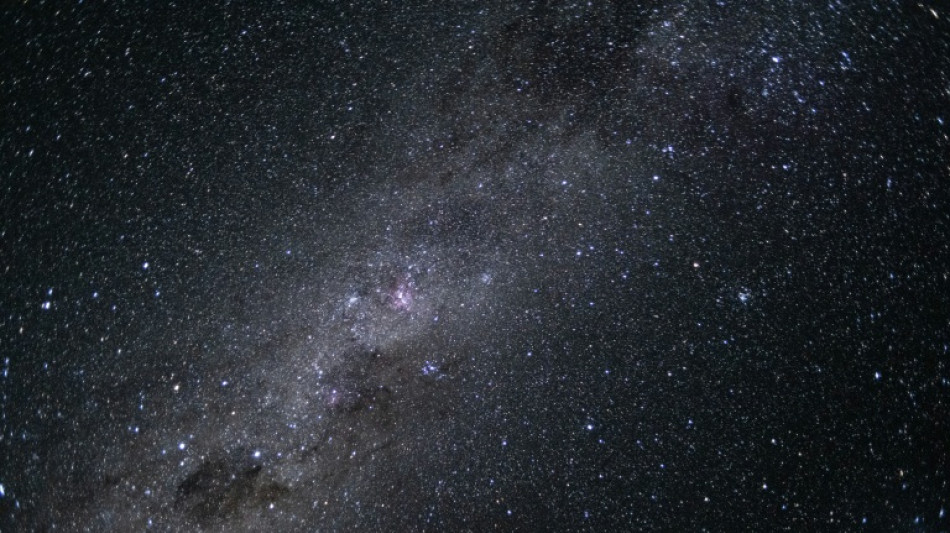
Milky Way's fastest star discovered spinning around black hole
Milky Way's fastest star discovered spinning around black hole / Photo: © NASA/AFP/File

Milky Way's fastest star discovered spinning around black hole

Astronomers have discovered the fastest star in the Milky Way zooming at 25,000 kilometres a second around the supermassive black hole at the centre of our galaxy.

Text size:

The star, named S301, orbits so dangerously close to the black hole that scientists believe it can shed light on this unimaginably powerful cosmic monster -- and test out Albert Einstein's theory of relativity.

"Decades carefully tracking stars orbiting our galaxy's central black hole, Sagittarius A*, have led to this breakthrough discovery," Reinhard Genzel of the Max Planck Institute for Extraterrestrial Physics in Germany said in a statement.

"Because it orbits so close to Sagittarius A*, S301 opens a new window to the fundamental properties of spacetime in this extreme black-hole environment," added Genzel, who shared a 2020 physics Nobel prize for discovering the black hole.

To spot S301 -- which is two billion times fainter than the star Betelgeuse in our sky -- the team of astronomers used the European Southern Observatory's Very Large Telescope in the Chilean desert.

They first noticed the star in 2023, and have been tracking its orbit since.

"What is special about this star is that it's orbiting Sagittarius A* on a very tight orbit, taking just 8.7 years to complete it," explained Felix Mang, a co-author of a new study describing the discovery.

The star gets roughly as close to the black hole as Saturn gets to our Sun, which is "unprecedented", the PhD student emphasised.

- Torn from its partner -

When the star gets closest to the immense suck of the black hole, it is travelling around 25,000 kilometres per second (15,500 miles per second).

That is 100,000 times faster than a commercial airplane, or more than eight percent of the speed of light, making it the fastest star ever detected in our galaxy.

Scientists believe that S301 was once part of a binary star system that was torn apart by the almighty pull of the black hole.

While S301 became trapped in the black hole's gravity, its partner star was blasted out with such force it likely left the galaxy entirely.

The astronomers will get another good look at the star when it makes its next closest approach to the black hole in 2031.

The team hopes that data from two complete orbits will allow them to determine the star's trajectory with enough precision they can also directly measure the black hole's rotation.

Like most objects in the universe, black holes are thought to spin.

Einstein's theory of general relativity predicted that a spinning black hole would drag spacetime along with it, twisting it in a way that changes the orbits of the surrounding stars.

Within the next 10 years, the astronomers hope to use S301 to measure the black hole's spin for the first time.

"Without this star, we would need to measure the motion of other stars for several more decades to get anywhere close to measuring the spin of the black hole," explained French astronomer and study co-author Juan Osorno.

The study was published in Nature on Wednesday.

O.Tse--ThChM