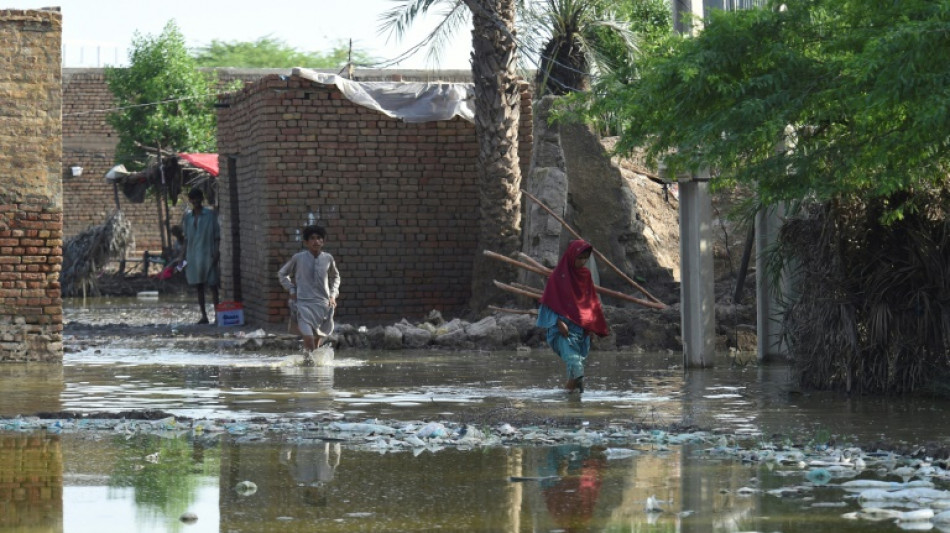
Tens of millions battle Pakistan floods as death toll rises / Photo: © AFP

Tens of millions of people across swathes of Pakistan were Monday battling the worst monsoon floods in a decade, with countless homes washed away, vital farmland destroyed, and the country's main river threatening to burst its banks.
Officials say 1,061 people have died since June when the seasonal rains began, but the final toll could be higher as hundreds of villages in the mountainous north have been cut off after flood-swollen rivers washed away roads and bridges.
The annual monsoon is essential for irrigating crops and replenishing lakes and dams across the Indian subcontinent, but it can also bring destruction.
This year's flooding has affected more than 33 million people -- one in seven Pakistanis -- said the National Disaster Management Authority.
"What we see now is an ocean of water submerging entire districts," Climate Minister Sherry Rehman told AFP Monday.
"This is very far from a normal monsoon -- it is climate dystopia at our doorstep."
This year's floods are comparable to 2010 -- the worst on record -- when more than 2,000 people died and nearly a fifth of the country was under water.
Near Sukkur, a city in southern Sindh province and home to an ageing colonial-era barrage on the Indus River that is vital to preventing further catastrophe, one farmer lamented the devastation wrought on his rice fields.
Millions of acres of rich farmland have been flooded by weeks of non-stop rain, but now the Indus is threatening to burst its banks as torrents of water course downstream from tributaries in the north.
"Our crop spanned over 5,000 acres on which the best quality rice was sown and is eaten by you and us," Khalil Ahmed, 70, told AFP.
"All that is finished."
- Landscape of water -
Much of Sindh is now an endless landscape of water, hampering a massive military-led relief operation.
"There are no landing strips or approaches available... our pilots find it difficult to land," one senior officer told AFP.
The army's helicopters were also struggling to pluck people to safety in the north, where soaring mountains and deep valleys make for treacherous flying conditions.
Many rivers in Khyber Pakhtunkhwa province -- which boasts some of Pakistan's best tourist spots -- have burst their banks, demolishing scores of buildings including a 150-room hotel that crumbled into a raging torrent.
The government has declared an emergency and appealed for international help, and on Sunday the first aid flights began arriving -- from Turkey and the UAE.
The flooding could not have come at a worse time for Pakistan, where the economy is in free fall.
The International Monetary Fund executive board was scheduled to meet in Washington later Monday to decide whether to green-light the resumption of a $6 billion loan programme essential for the country to service its foreign debt, but it is already clear the country will need more to repair and rebuild after this monsoon.
The prices of basic goods -- particularly onions, tomatoes and chickpeas -- are soaring as vendors bemoan a lack of supplies from the flooded breadbasket provinces of Sindh and Punjab.
The met office said the country as a whole had received twice the usual monsoon rainfall, but Balochistan and Sindh had more than four times the average of the last three decades.
Padidan, a small town in Sindh was drenched by more than 1.2 metres (47 inches) of rain since June, making it the wettest place in the country.
- More arriving daily -
Across Sindh, thousands of displaced people are camped alongside elevated highways and railway tracks -- often the only dry spots as far as the eye can see.
More are arriving daily at Sukkur's city ring road, belongings piled on boats and tractor trollies, looking for shelter until the floodwaters recede.
Sukkur Barrage supervisor Aziz Soomro told AFP the main headway of water was expected to arrive around September 5, but was confident the 90-year-old sluice gates would cope.
The barrage diverts water from the Indus into 10,000 km of canals that make up one of the world's biggest irrigation schemes, but the farms it supplies are now mostly under water.
"Dry weather is forecasted for this week and there is no chance of significant rains," said met office spokesman Zaheer Ahmed Babar.
H.Au--ThChM