Rice work: Dutch test new crop to save sinking peatlands / Photo: © AFP

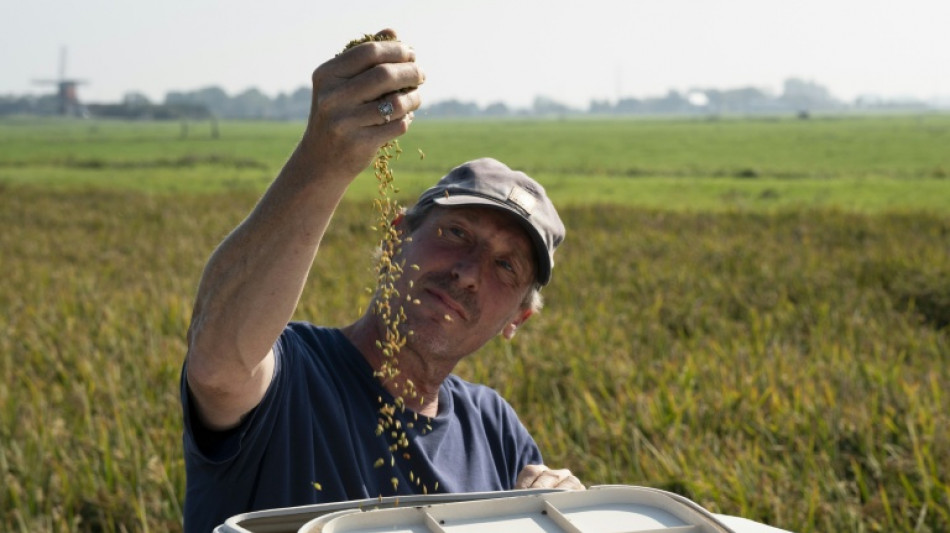
In a soggy field between Amsterdam and The Hague, farmer Sander Roeleveld ploughs a small white combine harvester into his crops, gathering a grain never before harvested in the Netherlands: rice.
The surroundings could scarcely be more Dutch. Canals criss-cross polders lying two metres below sea level. Windmills grace the horizon as cows -- for centuries the country's agricultural staple -- graze in the nearby grassland.
But the warming climate is allowing Dutch farmers to produce wine and now even experiment with rice, previously unthinkable in such a wet, temperate country.
And researchers behind the scheme hope rice cultivation could help address one of the country's most pressing environmental challenges: peat soils that are sinking as they dry out, pushing parts of the low-lying Netherlands ever lower.
"It's extraordinary," said Philippe Terheggen, chairman of the Land van Ons association that has provided the fields for the rice harvest.
"We would never have thought maybe 20 years ago that we would be able to grow rice in the Netherlands," the 68-year-old told AFP as the harvester whirred behind him.
"But it's also scary because it tells you what is possible... now the climate has changed," he said.
For now, the project is a pilot scheme, consisting of just 0.6 hectares (1.5 acres), with organisers hoping to produce around three tonnes of short-grain rice suitable for sushi or risotto.
The team is working with around 30 different rice cultivars from as far afield as Russia, China, Japan and Uzbekistan, to see which grows best in the Dutch climate.
Roeleveld, who describes himself as a "pioneer", said he wanted to show other farmers that rice could grow in boggy Dutch soil.
"My goal is to show that more things are possible on wetland than just grass," the 53-year-old told AFP.
"Of course, when you have had cows for 600 years, it's really hard to imagine that you want to do something else than having milk from your cow," he laughed.
"I just want to show that things can be changed for the benefit of the future."
- 'Crazy idea' -
But the project is about much more than crop diversification. Researchers believe it could help tackle one of the Netherlands' most persistent environmental problems.
Roughly one-tenth of the country is peatland, which farmers drain for grass to feed their cattle.
As the peat dries out, it releases millions of tonnes of carbon dioxide while causing the land to subside by up to several centimetres a year in the worst-affected areas.
According to Wageningen University, greenhouse gas emissions from Dutch peat soils account for around two to three percent of the country's total emissions.
The only way to resolve this vicious cycle is to keep the fields wet -- but then farmers would have nothing to grow there... until now.
"Basically it started with just a crazy idea," explained Julian Helfenstein, a researcher from Wageningen University and Research, who is piloting the project along with colleagues from nearby Leiden University.
It is a rare combination of both adapting to climate change and mitigating its effects, said the 36-year-old.
"Rice is an opportunity for this part of the world to adapt to climate change, so to grow something that previously wasn't possible," he said.
"But also to mitigate climate change because it stops this peat from degrading and emitting all the CO2 because you can keep it wet."
The peat issue affects not just the Netherlands, but much of northern Europe, including Germany, Belgium, even the Baltic states, he said.
Helfenstein and his team are closely monitoring the CO2 and methane emissions from cultivating rice compared to maintaining grassland -- to ensure the cure is not worse than the illness.
"So far the results are promising," he said.
"As an environmental scientist, you're always pointing to the problems. And it can be a bit depressing, like, 'oh, here's more climate change, here's more pollution'," said Helfenstein.
"And then here's an opportunity for science to work also towards a solution. So I find that thrilling."
- 'Chewy, but great' -
Local restaurants have already voiced an interest in offering premium Dutch-sourced rice, said Guusje van der Vossen from the Wij Land association which helps farmers transition to more sustainable production.
She said the rice being harvested now was a grain from northern Japan, which seems the best adapted to Dutch conditions.
The 27-year-old is one of the few people ever to have eaten Dutch-grown rice -- from an experimental batch grown last year.
"It tasted delicious, to be honest," she laughed, saying the aim was to make sushi with it -- and maybe sake.
"It was a bit chewy, but also great."
B.Carter--ThChM