The China Mail - Nobel winner Halzen says years of October 'misery' finally over

USD -
AED 3.672504
AFN 65.000368
ALL 81.9979
AMD 361.046432
ANG 1.790403
AOA 917.000367
ARS 1596.41556
AUD 1.500826
AWG 1.8025
AZN 1.70397
BAM 1.785874
BBD 2.016984
BDT 125.580971
BGN 1.77347
BHD 0.377665
BIF 3008.811578
BMD 1
BND 1.291513
BOB 11.872346
BRL 5.559104
BSD 1.001415
BTN 93.180843
BWP 14.815322
BYN 3.013286
BYR 19600
BZD 2.014062
CAD 1.42715
CDF 2280.000362
CHF 0.836062
CLF 0.026234
CLP 1033.182669
CNY 6.664504
CNH 6.655204
COP 3490.663379
CRC 444.596631
CUC 1
CUP 24.034151
CVE 100.684838
CZK 22.338604
DJF 178.331735
DKK 6.833704
DOP 59.909601
DZD 136.546592
EGP 54.510341
ERN 15
ETB 163.703511
EUR 0.913204
FJD 2.29315
FKP 0.763199
GBP 0.763388
GEL 2.590391
GGP 0.763199
GHS 11.892435
GIP 0.763199
GMD 74.000355
GNF 8883.71456
GTQ 7.656485
GYD 209.478154
HKD 7.83005
HNL 26.922339
HRK 6.831965
HTG 131.397525
HUF 338.340388
IDR 18354.45
ILS 3.327204
IMP 0.763199
INR 92.995504
IQD 1518.148199
IRR 1960166.000352
ISK 125.470386
JEP 0.763199
JMD 158.489705
JOD 0.70904
JPY 159.55504
KES 130.383966
KGS 87.450384
KHR 4071.588367
KMF 449.00035
KPW 900.00035
KRW 1333.750383
KWD 0.31272
KYD 0.834589
KZT 459.060403
LAK 22585.034014
LBP 89678.765466
LKR 333.625531
LRD 164.23321
LSL 17.382824
LTL 2.95274
LVL 0.60489
LYD 6.491348
MAD 10.03689
MDL 18.436744
MGA 4534.538648
MKD 56.206912
MMK 2100.121159
MNT 3611.229368
MOP 8.074967
MRU 40.639182
MUR 46.850378
MVR 15.403739
MWK 1736.474456
MXN 19.654704
MYR 4.120804
MZN 64.250377
NAD 17.382824
NGN 1356.550377
NIO 36.853399
NOK 9.801604
NPR 149.089166
NZD 1.829492
OMR 0.382331
PAB 1.001415
PEN 3.473497
PGK 4.582934
PHP 63.756038
PKR 276.722367
PLN 4.08575
PYG 6451.171072
QAR 3.650641
RON 4.884804
RSD 107.446469
RUB 81.69164
RWF 1480.253847
SAR 3.75163
SBD 8.177162
SCR 13.864037
SDG 601.503676
SEK 10.266204
SGD 1.290371
SHP 0.763854
SLE 23.000338
SLL 20969.503664
SOS 572.341688
SRD 37.26037
STD 20697.981008
STN 22.371365
SVC 8.76227
SYP 13002.000337
SZL 17.378441
THB 33.948038
TJS 9.293339
TMT 3.5
TND 3.035383
TOP 2.40776
TRY 50.743804
TTD 6.794503
TWD 33.002104
TZS 2691.412135
UAH 45.089348
UGX 4320.869287
UYU 40.770671
UZS 12037.620417
VES 921.380504
VND 25836.5
VUV 121.507995
WST 2.838507
XAF 599.022624
XAG 0.02286
XAU 0.000273664075
XCD 2.70255
XCG 1.804867
XDR 0.707052
XOF 599.022624
XPF 108.898324
YER 236.603589
ZAR 17.36045
ZMK 9001.203584
ZMW 20.904899
ZWL 321.999592
SSP 5775.400178
MXV 2.198782
  • RYCEF

    0.4000

    19.71

    +2.03%

  • CMSC

    0.0000

    20.4

    0%

  • BTI

    0.4200

    56.05

    +0.75%

  • BP

    0.2800

    44.43

    +0.63%

  • RBGPF

    1.6000

    67

    +2.39%

  • RIO

    -0.1500

    94.41

    -0.16%

  • AZN

    -0.4300

    166.15

    -0.26%

  • GSK

    0.4600

    49.7

    +0.93%

  • BCE

    -0.4100

    20.56

    -1.99%

  • NGG

    -0.2500

    75.24

    -0.33%

  • VOD

    -0.0400

    16.58

    -0.24%

  • RELX

    -0.4500

    33.07

    -1.36%

  • BCC

    -0.5500

    76.59

    -0.72%

  • CMSD

    -0.0300

    20.27

    -0.15%

  • JRI

    -0.2500

    10.77

    -2.32%

Nobel winner Halzen says years of October 'misery' finally over
Nobel winner Halzen says years of October 'misery' finally over / Photo: © AFP

Nobel winner Halzen says years of October 'misery' finally over

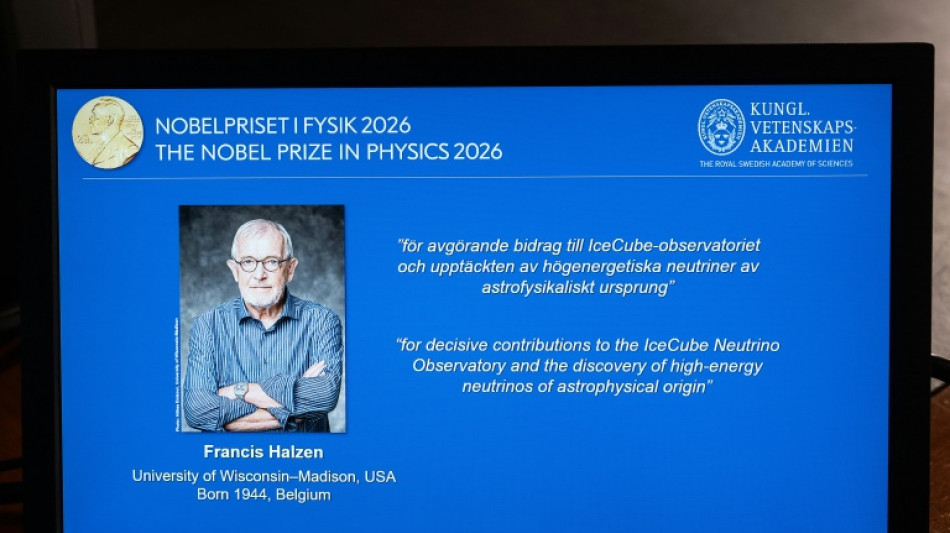
Physicist Francis Halzen has an impressively long list of academic accolades -- but every October, as the Nobel Prize rolled around, his failure to bag the biggest award of them all left him "miserable," he admits.

Text size:

"It's a great relief for me, because this was not totally unexpected," he told a press conference Tuesday at the University of Wisconsin–Madison, where he serves as a professor. He spoke by video from a hotel room in Italy where he was attending a scientific meeting.

"Around this time of the year, I always felt miserable because I didn't win the prize, and thought... it was terrible for my collaborators who deserved it so much, and that I disappointed the whole IceCube collaboration every October," he added. "So that problem is finally solved. I'm very grateful for it."

The 82-year-old is the brains behind the IceCube Neutrino Observatory, a telescope embedded in a cubic kilometer of Antarctic ice that detects neutrinos -- particles with almost no mass that seldom interact with other matter.

Every second, about 65 billion neutrinos from the Sun pass through your little fingernail. Those from deeper in space carry clues about cosmic mysteries, like the supermassive black holes at the heart of galaxies.

Halzen, who grew up in Belgium, paid rich tribute to the roughly 450 people across more than a dozen countries who have helped turn an idea he conceived in the late 1980s into reality.

"UW took incredible risks on this project," he said of his university. "We had several milestones we had to pass, and at each point, this project could have failed."

He also thanked the National Science Foundation (NSF) for taking a chance on the project, "which in retrospect amazes me, I am not sure this could happen today, but it happened, and we were very lucky."

President Donald Trump's administration has called for deep cuts to the NSF, the US agency that funds fundamental research, and directed it to focus on the administration's technology priorities.

Physicists before Halzen had suggested water could capture neutrinos from space: when a neutrino hits an atomic nucleus, it produces a charged particle that travels in the same direction and emits blue light, which can be detected because water is transparent.

Halzen's great leap was to use ice instead -- unlike liquid water, it isn't disturbed by living creatures, and its darkness is constant at great depth.

Making it work was a struggle, but the first neutrino images, captured by an R&D precursor to IceCube, were "the greatest excitement I ever felt about this project," he said. "It was just incredible. It was the fact that we could make this work."

IceCube has been fully operational since 2011 and has detected high-energy neutrinos from a distant galaxy in the direction of the constellation Orion, as well as from our own Milky Way.

As for the future, Halzen noted that whenever humanity has opened a new "window on the universe," predictions about what would follow have proven wrong.

"What this will bring is impossible to predict, but it has always been great in the past, and there is no reason not to think that it will be great again."

L.Johnson--ThChM