The China Mail - NASA's Moon mission pushed back, again

USD -
AED 3.672952
AFN 64.499526
ALL 81.550227
AMD 361.43058
ANG 1.789785
AOA 918.000074
ARS 1513.143202
AUD 1.434309
AWG 1.8
AZN 1.697378
BAM 1.747405
BBD 2.013572
BDT 123.421934
BGN 1.747831
BHD 0.37766
BIF 2995
BMD 1
BND 1.282034
BOB 11.711836
BRL 5.038366
BSD 0.999772
BTN 95.182957
BWP 13.733399
BYN 3.020865
BYR 19600
BZD 2.010641
CAD 1.423345
CDF 2312.521651
CHF 0.835199
CLF 0.025036
CLP 985.360047
CNY 6.69275
CNH 6.696203
COP 3191.08
CRC 455.660238
CUC 1
CUP 23.993531
CVE 99.398678
CZK 21.845901
DJF 177.720161
DKK 6.703296
DOP 61.249821
DZD 134.726038
EGP 53.069699
ERN 15
ETB 161.12974
EUR 0.89675
FJD 2.26455
FKP 0.754659
GBP 0.75801
GEL 2.606343
GGP 0.754659
GHS 11.665039
GIP 0.754659
GMD 74.000399
GNF 8800.000137
GTQ 7.639869
GYD 209.069102
HKD 7.84789
HNL 26.950058
HRK 6.753703
HTG 130.910423
HUF 326.39401
IDR 17942.55
ILS 3.097603
IMP 0.754659
INR 95.11115
IQD 1513
IRR 1790500.000283
ISK 122.309516
JEP 0.754659
JMD 158.765613
JOD 0.709024
JPY 158.330193
KES 129.750075
KGS 87.449777
KHR 4071.999848
KMF 441.999909
KPW 899.999961
KRW 1341.460093
KWD 0.31184
KYD 0.833099
KZT 451.695332
LAK 22499.999681
LBP 89550.00018
LKR 330.891222
LRD 170.750221
LSL 16.489893
LTL 2.95274
LVL 0.60489
LYD 6.430071
MAD 9.746975
MDL 17.89398
MGA 4500.000066
MKD 55.018986
MMK 2100.02843
MNT 3599.679138
MOP 8.081626
MRU 40.220023
MUR 47.610272
MVR 15.45966
MWK 1742.000393
MXN 18.51695
MYR 4.0837
MZN 63.910163
NAD 16.489878
NGN 1329.930455
NIO 36.850223
NOK 9.515815
NPR 152.293053
NZD 1.784765
OMR 0.384397
PAB 0.999736
PEN 3.430503
PGK 4.45175
PHP 62.884948
PKR 277.034981
PLN 3.920895
PYG 5704.585558
QAR 3.6402
RON 4.784801
RSD 105.30495
RUB 83.610222
RWF 1475
SAR 3.74237
SBD 8.078071
SCR 14.136778
SDG 601.500902
SEK 10.037125
SGD 1.285801
SHP 0.754518
SLE 24.670284
SLL 20969.504398
SOS 571.503444
SRD 37.712039
STD 20697.981008
STN 21.975
SVC 8.747783
SYP 13001.999685
SZL 16.489741
THB 33.639809
TJS 9.227237
TMT 3.5
TND 3.303499
TOP 2.40776
TRY 49.413403
TTD 6.799166
TWD 32.214195
TZS 2630.868006
UAH 44.933885
UGX 4039.293995
UYU 40.187267
UZS 11951.498398
VES 875.701602
VND 25897
VUV 119.372685
WST 2.788609
XAF 588.229566
XAG 0.017972
XAU 0.000243580438
XCD 2.70255
XCG 1.801832
XDR 0.707052
XOF 588.229566
XPF 106.874968
YER 236.197532
ZAR 16.620701
ZMK 9001.197547
ZMW 19.868757
ZWL 321.999592
SSP 5748.524006
MXV 2.090995
  • RYCEF

    0.4000

    19.71

    +2.03%

  • CMSC

    0.0000

    20.4

    0%

  • BTI

    0.4200

    56.05

    +0.75%

  • BP

    0.2800

    44.43

    +0.63%

  • RBGPF

    1.6000

    67

    +2.39%

  • RIO

    -0.1500

    94.41

    -0.16%

  • AZN

    -0.4300

    166.15

    -0.26%

  • GSK

    0.4600

    49.7

    +0.93%

  • BCE

    -0.4100

    20.56

    -1.99%

  • NGG

    -0.2500

    75.24

    -0.33%

  • VOD

    -0.0400

    16.58

    -0.24%

  • RELX

    -0.4500

    33.07

    -1.36%

  • BCC

    -0.5500

    76.59

    -0.72%

  • CMSD

    -0.0300

    20.27

    -0.15%

  • JRI

    -0.2500

    10.77

    -2.32%

NASA's Moon mission pushed back, again
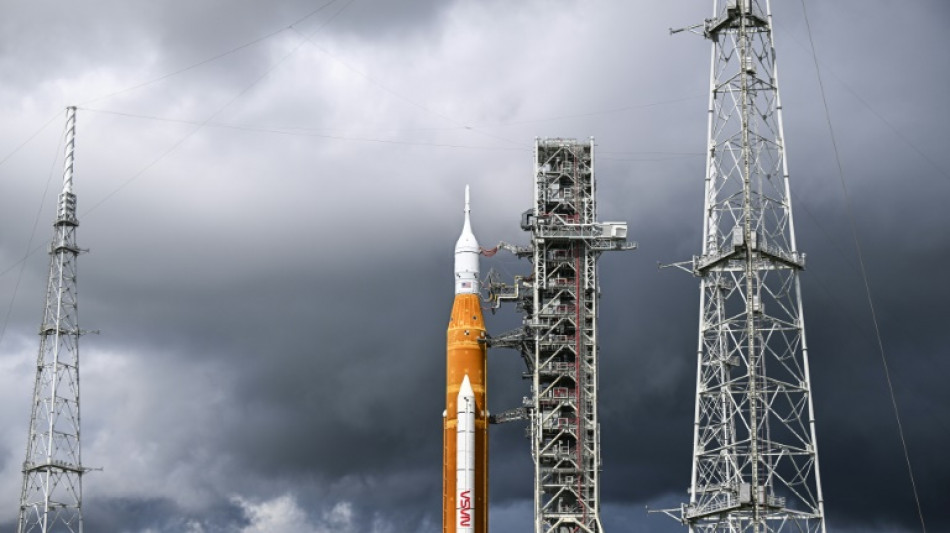
NASA's Moon mission pushed back, again / Photo: © AFP/File

NASA's Moon mission pushed back, again

NASA is now targeting September 27 as the earliest possible launch date for its uncrewed Artemis 1 mission to the Moon, the agency said in a blog post Monday.

Text size:

The date would depend on engineering teams successfully carrying out a test to fuel up the Space Launch System rocket, and receive a waiver to avoid retesting batteries on an emergency flight system that is used to destroy the rocket if it strays from its designated range.

If it does not receive the waiver, the rocket will have to be wheeled back to its assembly building, pushing the timeline back several weeks.

For the September 27 date, a "70-minute launch window opens at 11:37 am EDT," while the mission would end with an ocean splashdown of the Orion capsule on November 5.

A potential next date comes on October 2.

The Artemis 1 space mission hopes to test the SLS as well as the unmanned Orion capsule that sits atop it, in preparation for future Moon-bound journeys with humans aboard.

Once launched, it will take several days for the spacecraft to reach the Moon, flying around 60 miles (100 kilometers) at its closest approach.

One of the trip's main objectives is to test the capsule's heat shield -- which at 16 feet (five meters) in diameter is the largest ever built -- when the ship re-enters the atmosphere.

The next mission, Artemis 2, will take astronauts to the Moon without landing on its surface, while the third -- set for the mid-2020s -- would see the first woman and person of color on lunar soil.

NASA wants to build a lunar space station called Gateway and keep a sustained presence on the Moon to gain insight into how to survive very long space missions, ahead of a mission to Mars in the 2030s.

Z.Ma--ThChM