The China Mail - Mars rover sees hints of past life in latest rock samples

USD -
AED 3.673099
AFN 61.999925
ALL 81.601999
AMD 368.630213
ANG 1.79046
AOA 918.000331
ARS 1391.809741
AUD 1.377306
AWG 1.80125
AZN 1.703014
BAM 1.669747
BBD 2.014096
BDT 122.750925
BGN 1.66992
BHD 0.37725
BIF 2975.5
BMD 1
BND 1.272576
BOB 6.910389
BRL 4.985302
BSD 1.000004
BTN 95.654067
BWP 13.471587
BYN 2.786502
BYR 19600
BZD 2.011227
CAD 1.370785
CDF 2240.999925
CHF 0.782215
CLF 0.022546
CLP 887.601842
CNY 6.79095
CNH 6.78666
COP 3793.36
CRC 455.222638
CUC 1
CUP 26.5
CVE 94.450305
CZK 20.780703
DJF 177.720114
DKK 6.382505
DOP 59.249732
DZD 132.415872
EGP 52.915299
ERN 15
ETB 157.375004
EUR 0.85419
FJD 2.184901
FKP 0.739209
GBP 0.739951
GEL 2.679803
GGP 0.739209
GHS 11.301015
GIP 0.739209
GMD 73.00028
GNF 8777.499256
GTQ 7.629032
GYD 209.214666
HKD 7.83055
HNL 26.610146
HRK 6.435103
HTG 130.601268
HUF 305.774965
IDR 17514.6
ILS 2.910695
IMP 0.739209
INR 95.65435
IQD 1310
IRR 1313000.000011
ISK 122.640335
JEP 0.739209
JMD 158.150852
JOD 0.708992
JPY 157.901021
KES 129.180272
KGS 87.450068
KHR 4011.000117
KMF 421.000273
KPW 900.016801
KRW 1489.490202
KWD 0.30826
KYD 0.833362
KZT 469.348814
LAK 21949.999791
LBP 89750.815528
LKR 324.546762
LRD 183.14971
LSL 16.409763
LTL 2.95274
LVL 0.60489
LYD 6.324976
MAD 9.17375
MDL 17.150468
MGA 4175.000032
MKD 52.635175
MMK 2099.28391
MNT 3579.674299
MOP 8.066645
MRU 39.999833
MUR 46.809829
MVR 15.410057
MWK 1741.500559
MXN 17.18301
MYR 3.9305
MZN 63.902909
NAD 16.410403
NGN 1370.110102
NIO 36.704971
NOK 9.170101
NPR 153.052216
NZD 1.68522
OMR 0.384488
PAB 1.000021
PEN 3.4285
PGK 4.19245
PHP 61.39796
PKR 278.59606
PLN 3.628499
PYG 6115.348988
QAR 3.643499
RON 4.448301
RSD 100.309836
RUB 74.166773
RWF 1460
SAR 3.751772
SBD 8.032258
SCR 14.665034
SDG 600.501883
SEK 9.321865
SGD 1.272775
SHP 0.746601
SLE 24.602819
SLL 20969.502105
SOS 571.499903
SRD 37.193997
STD 20697.981008
STN 21.25
SVC 8.749995
SYP 110.578962
SZL 16.484987
THB 32.357979
TJS 9.365014
TMT 3.51
TND 2.880498
TOP 2.40776
TRY 45.409397
TTD 6.784798
TWD 31.529006
TZS 2597.649524
UAH 43.974218
UGX 3749.695849
UYU 39.725261
UZS 12077.999884
VES 508.06467
VND 26348
VUV 117.978874
WST 2.702738
XAF 560.031931
XAG 0.011331
XAU 0.000213
XCD 2.70255
XCG 1.802233
XDR 0.694969
XOF 558.501691
XPF 102.299865
YER 238.625007
ZAR 16.423399
ZMK 9001.201889
ZMW 18.875077
ZWL 321.999592
  • RBGPF

    0.0000

    61

    0%

  • RYCEF

    -0.0800

    16

    -0.5%

  • CMSC

    -0.0600

    23.05

    -0.26%

  • NGG

    -0.2600

    86.98

    -0.3%

  • RIO

    2.5400

    112.04

    +2.27%

  • GSK

    0.0900

    50.99

    +0.18%

  • AZN

    3.1800

    187.72

    +1.69%

  • BCC

    -0.9500

    66.98

    -1.42%

  • BCE

    -0.0800

    24.39

    -0.33%

  • RELX

    -1.1500

    31.62

    -3.64%

  • JRI

    -0.0100

    13.13

    -0.08%

  • VOD

    0.4150

    15.51

    +2.68%

  • CMSD

    -0.0400

    23.56

    -0.17%

  • BTI

    1.7100

    65.35

    +2.62%

  • BP

    -0.2600

    44.14

    -0.59%

Mars rover sees hints of past life in latest rock samples
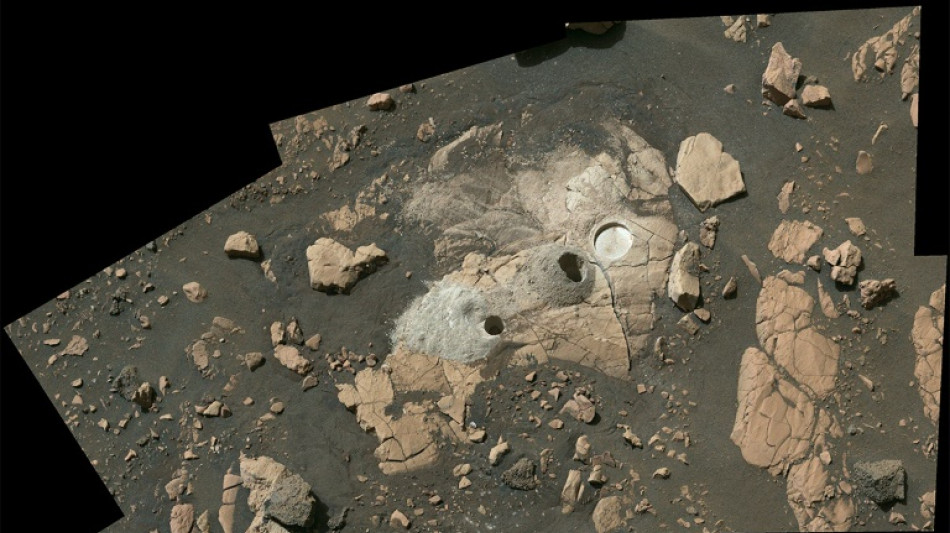
Mars rover sees hints of past life in latest rock samples / Photo: © NASA/JPL-Caltech/ASU/MSSS/AFP

Mars rover sees hints of past life in latest rock samples

NASA's Perseverance Mars rover has detected its highest concentrations yet of organic molecules, in a potential signal of ancient microbes that scientists are eager to confirm when the rock samples are eventually brought to Earth.

Text size:

While organic matter has been found on the Red Planet before, the new discovery is seen as especially promising because it came from an area where sediment and salts were deposited into a lake -- conditions where life could have arisen.

"It is very fair to say that these are going to be, these already are, the most valuable rock samples that have ever been collected," David Shuster, a Perseverance return sample scientist, told reporters during a briefing.

Organic molecules -- compounds made primarily of carbon that usually include hydrogen and oxygen, but also at times other elements -- are not always created by biological processes.

Further analysis and conclusions will have to wait for the Mars Sample Return mission -- a collaboration between NASA and the European Space Agency (ESA) to bring back the rocks that is set for 2033.

Nicknamed Percy, the rover landed on Mars' Jezero Crater in February 2021, tasked with caching samples that may contain signs of ancient life, as well as characterizing the planet's geology and past climate.

The delta it is exploring formed 3.5 billion years ago. The rover is currently there investigating sedimentary rocks, which came about from particles of various sizes settling in the then watery environment.

Percy cored two samples from a rock called "Wildcat Ridge," which is about three feet (one meter) wide, and on July 20 abraded some of its surface so it could be analyzed with an instrument called SHERLOC that uses ultraviolet light.

The results showed a class of organic molecules called aromatics, which play a key role in biochemistry.

"This is a treasure hunt for potential signs of life on another planet," NASA astrobiologist Sunanda Sharma said.

"Organic matter is a clue and we're getting stronger and stronger clues...I personally find these results so moving because it feels like we're in the right place, with the right tools, at a very pivotal moment."

There have been other tantalizing clues about the possibility of life on Mars before, including repeated detections of methane by Perseverance's predecessor, Curiosity.

While methane is a digestive byproduct of microbes here on Earth, it can also be generated by geothermal reactions where no biology is at play.

R.Yeung--ThChM