The China Mail - NASA says delayed Moon rocket passed fueling test

USD -
AED 3.672502
AFN 65.502111
ALL 80.679645
AMD 366.288928
ANG 1.789664
AOA 916.999784
ARS 1492.493525
AUD 1.418832
AWG 1.8
AZN 1.697547
BAM 1.696374
BBD 2.01504
BDT 123.207827
BGN 1.696878
BHD 0.377301
BIF 2991.001149
BMD 1
BND 1.280135
BOB 11.800369
BRL 5.183603
BSD 1.000494
BTN 95.325328
BWP 13.468235
BYN 2.988078
BYR 19600
BZD 2.012178
CAD 1.39535
CDF 2274.999547
CHF 0.812725
CLF 0.023232
CLP 914.35027
CNY 6.74385
CNH 6.745725
COP 3148.14
CRC 454.496173
CUC 1
CUP 26.5
CVE 95.636864
CZK 21.011399
DJF 178.163462
DKK 6.48621
DOP 58.416636
DZD 132.821798
EGP 50.3901
ERN 15
ETB 161.833944
EUR 0.86765
FJD 2.215896
FKP 0.740201
GBP 0.741885
GEL 2.610329
GGP 0.740201
GHS 11.455112
GIP 0.740201
GMD 74.000292
GNF 8788.949845
GTQ 7.633694
GYD 209.352652
HKD 7.84634
HNL 26.817009
HRK 6.5369
HTG 130.869412
HUF 315.654977
IDR 17862
ILS 2.98683
IMP 0.740201
INR 95.414551
IQD 1310.654981
IRR 1374625.00023
ISK 123.200564
JEP 0.740201
JMD 158.387073
JOD 0.709037
JPY 159.407498
KES 129.404543
KGS 87.449883
KHR 4051.504677
KMF 428.000039
KPW 899.99995
KRW 1422.698099
KWD 0.30874
KYD 0.833785
KZT 465.845863
LAK 22573.692359
LBP 89594.462731
LKR 334.433424
LRD 181.588728
LSL 16.166066
LTL 2.95274
LVL 0.60489
LYD 6.381133
MAD 9.293065
MDL 17.343863
MGA 4305.533269
MKD 53.378853
MMK 2099.846019
MNT 3597.969266
MOP 8.086666
MRU 39.989592
MUR 47.150062
MVR 15.460263
MWK 1734.876641
MXN 17.077396
MYR 4.087402
MZN 63.901015
NAD 16.165786
NGN 1361.849887
NIO 36.819394
NOK 9.52265
NPR 152.519028
NZD 1.71378
OMR 0.384514
PAB 1.000494
PEN 3.381269
PGK 4.425266
PHP 61.306988
PKR 277.903301
PLN 3.73547
PYG 5970.006852
QAR 3.647624
RON 4.5483
RSD 101.779516
RUB 83.600705
RWF 1473.717079
SAR 3.768513
SBD 8.064941
SCR 13.71844
SDG 600.500226
SEK 9.56229
SGD 1.28046
SHP 0.740866
SLE 24.550277
SLL 20969.500541
SOS 571.758165
SRD 37.669975
STD 20697.981008
STN 21.250298
SVC 8.75418
SYP 13002.000123
SZL 16.149806
THB 33.1485
TJS 9.254468
TMT 3.5
TND 2.937771
TOP 2.40776
TRY 47.775196
TTD 6.785291
TWD 32.147901
TZS 2649.998006
UAH 44.704688
UGX 3711.397434
UYU 40.271134
UZS 11963.328534
VES 765.401353
VND 26074
VUV 118.594628
WST 2.730779
XAF 568.945344
XAG 0.015519
XAU 0.000228
XCD 2.70255
XCG 1.803137
XDR 0.707585
XOF 568.947811
XPF 103.439901
YER 237.149668
ZAR 16.174896
ZMK 9001.202199
ZMW 18.829417
ZWL 321.999592
  • RBGPF

    0.0000

    72.16

    0%

  • RYCEF

    0.5500

    21.1

    +2.61%

  • CMSC

    0.0100

    21.45

    +0.05%

  • BP

    -0.2300

    42.93

    -0.54%

  • AZN

    -0.2500

    158.5

    -0.16%

  • RELX

    -0.8200

    34.55

    -2.37%

  • GSK

    -0.6000

    50.3

    -1.19%

  • NGG

    0.4100

    80.68

    +0.51%

  • BTI

    -0.9700

    55.84

    -1.74%

  • VOD

    0.1900

    16.09

    +1.18%

  • RIO

    0.2300

    101.22

    +0.23%

  • CMSD

    -0.0400

    21.59

    -0.19%

  • BCE

    -0.2400

    23.13

    -1.04%

  • BCC

    -1.2800

    84.25

    -1.52%

  • JRI

    -0.0200

    12.71

    -0.16%

NASA says delayed Moon rocket passed fueling test
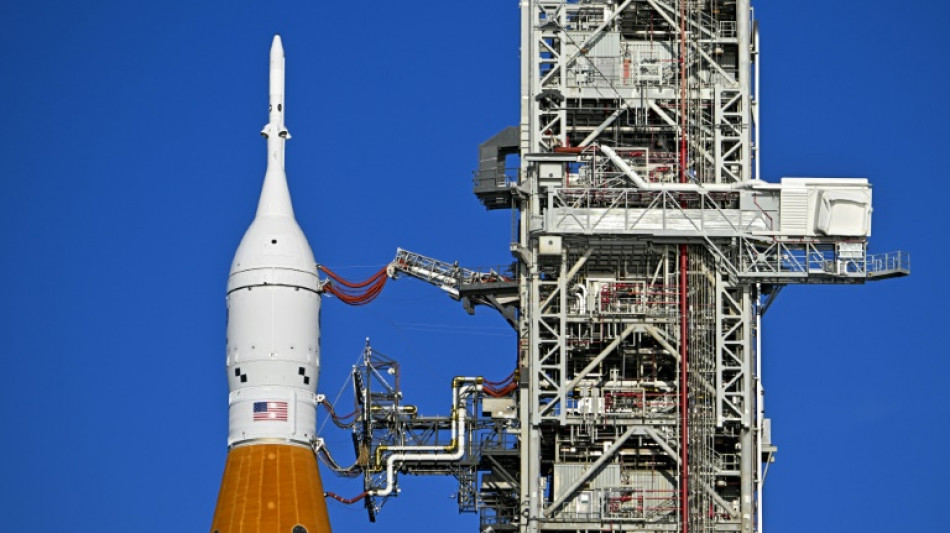
NASA says delayed Moon rocket passed fueling test / Photo: © AFP

NASA says delayed Moon rocket passed fueling test

NASA said Wednesday it had successfully trialed the fueling process for its new rocket, after technical issues a few weeks ago halted two attempts to get the behemoth off the ground and headed towards the Moon.

Text size:

"All of the objectives that we set out to do we were able to accomplish today," said Charlie Blackwell-Thompson, launch director of the program called Artemis 1.

The unmanned mission hopes to test the new 30-story SLS rocket as well as the unmanned Orion capsule that sits atop it, in preparation for future Moon-bound journeys with humans aboard.

The last attempt in early September to launch NASA's most powerful rocket yet had to be aborted because of a leak while its cryogenic fuels -- liquid hydrogen and oxygen -- were being pumped into the rocket's tanks.

Repairs were carried out and Wednesday's test involved filling those tanks again.

Though a small hydrogen leak was detected during the test, NASA engineers were able to get it under control.

Last week NASA said it is now aiming for September 27 as the next date for liftoff. October 2 was set as a backup date.

"Teams will evaluate the data from the test, along with weather and other factors, before confirming readiness to proceed into the next launch opportunity," NASA said.

Asked about the timing of the next launch attempt, Blackwell-Thompson declined to comment, though she said she was "extremely encouraged by the test today."

US officials are also keeping a close eye on Hurricane Fiona's trajectory off the coast in the Atlantic.

For the September 27 date to be possible, NASA must receive a waiver to avoid retesting the batteries on a detonation system used to destroy the rocket if it strays uncontrollably off course.

The next mission, Artemis 2, would take astronauts to the Moon without landing on its surface, while the third -- set for the mid-2020s -- would see the first woman and person of color on lunar soil.

NASA wants to build a lunar space station called Gateway and keep a sustained presence on the Moon to gain insight into how to survive very long space missions, ahead of a mission to Mars in the 2030s.

X.So--ThChM