The China Mail - 'Incredible': Astronomers hail first images of asteroid impact

USD -
AED 3.672498
AFN 63.503463
ALL 83.463315
AMD 376.986282
ANG 1.790083
AOA 916.999701
ARS 1385.5001
AUD 1.455519
AWG 1.8
AZN 1.697717
BAM 1.699513
BBD 2.014051
BDT 122.697254
BGN 1.709309
BHD 0.377509
BIF 2970.416618
BMD 1
BND 1.287696
BOB 6.935386
BRL 5.249203
BSD 0.999996
BTN 94.787611
BWP 13.787859
BYN 2.976638
BYR 19600
BZD 2.011105
CAD 1.38957
CDF 2282.497331
CHF 0.79815
CLF 0.023381
CLP 923.220134
CNY 6.91185
CNH 6.910575
COP 3675.3
CRC 464.366558
CUC 1
CUP 26.5
CVE 95.823032
CZK 21.287398
DJF 178.063563
DKK 6.487585
DOP 59.522516
DZD 133.12557
EGP 53.60199
ERN 15
ETB 154.582495
EUR 0.868195
FJD 2.24025
FKP 0.752712
GBP 0.753015
GEL 2.679845
GGP 0.752712
GHS 10.957154
GIP 0.752712
GMD 73.496975
GNF 8767.699413
GTQ 7.653569
GYD 209.330315
HKD 7.83265
HNL 26.549649
HRK 6.542699
HTG 131.078738
HUF 337.827038
IDR 16992
ILS 3.13965
IMP 0.752712
INR 94.54595
IQD 1309.975365
IRR 1313250.000126
ISK 124.680163
JEP 0.752712
JMD 157.400126
JOD 0.709001
JPY 159.638505
KES 130.050221
KGS 87.450178
KHR 4004.935568
KMF 427.999997
KPW 900.00296
KRW 1515.180048
KWD 0.308023
KYD 0.833344
KZT 483.44391
LAK 21749.12344
LBP 89547.486737
LKR 314.996893
LRD 183.502503
LSL 17.171359
LTL 2.95274
LVL 0.60489
LYD 6.383247
MAD 9.346391
MDL 17.564303
MGA 4167.481307
MKD 53.547773
MMK 2098.832611
MNT 3571.142668
MOP 8.068492
MRU 39.926487
MUR 46.9159
MVR 15.449664
MWK 1733.901626
MXN 18.05465
MYR 4.019496
MZN 63.949773
NAD 17.171583
NGN 1382.179868
NIO 36.800007
NOK 9.73768
NPR 151.645993
NZD 1.74163
OMR 0.384435
PAB 1.000013
PEN 3.483403
PGK 4.321285
PHP 60.756974
PKR 279.086043
PLN 3.715515
PYG 6537.91845
QAR 3.646009
RON 4.4255
RSD 101.931978
RUB 81.502485
RWF 1460.256772
SAR 3.752499
SBD 8.042037
SCR 14.901688
SDG 600.999691
SEK 9.45515
SGD 1.28755
SHP 0.750259
SLE 24.550138
SLL 20969.510825
SOS 571.503052
SRD 37.600996
STD 20697.981008
STN 21.28926
SVC 8.74968
SYP 110.527654
SZL 17.169497
THB 32.779898
TJS 9.555322
TMT 3.5
TND 2.948402
TOP 2.40776
TRY 44.41694
TTD 6.794374
TWD 32.0145
TZS 2584.999806
UAH 43.831285
UGX 3725.347921
UYU 40.479004
UZS 12195.153743
VES 467.928355
VND 26335
VUV 119.385423
WST 2.775484
XAF 569.988487
XAG 0.014146
XAU 0.000221
XCD 2.70255
XCG 1.802248
XDR 0.708991
XOF 569.988487
XPF 103.633607
YER 238.59797
ZAR 17.06745
ZMK 9001.197652
ZMW 18.824133
ZWL 321.999592
  • CMSC

    0.0272

    22.33

    +0.12%

  • NGG

    0.8200

    84.5

    +0.97%

  • GSK

    0.4850

    54.735

    +0.89%

  • RIO

    2.9500

    91.79

    +3.21%

  • BCC

    1.4300

    76.4

    +1.87%

  • RELX

    0.1600

    32.9

    +0.49%

  • BCE

    0.0400

    25.275

    +0.16%

  • RYCEF

    -0.3000

    14.35

    -2.09%

  • AZN

    0.9750

    194.795

    +0.5%

  • CMSD

    0.0500

    22.55

    +0.22%

  • JRI

    0.1700

    12.14

    +1.4%

  • BTI

    0.6350

    58.9

    +1.08%

  • RBGPF

    -13.5000

    69

    -19.57%

  • VOD

    0.3450

    15.045

    +2.29%

  • BP

    0.6650

    48.045

    +1.38%

'Incredible': Astronomers hail first images of asteroid impact
'Incredible': Astronomers hail first images of asteroid impact / Photo: © NASA/University of Hawaii/AFP

'Incredible': Astronomers hail first images of asteroid impact

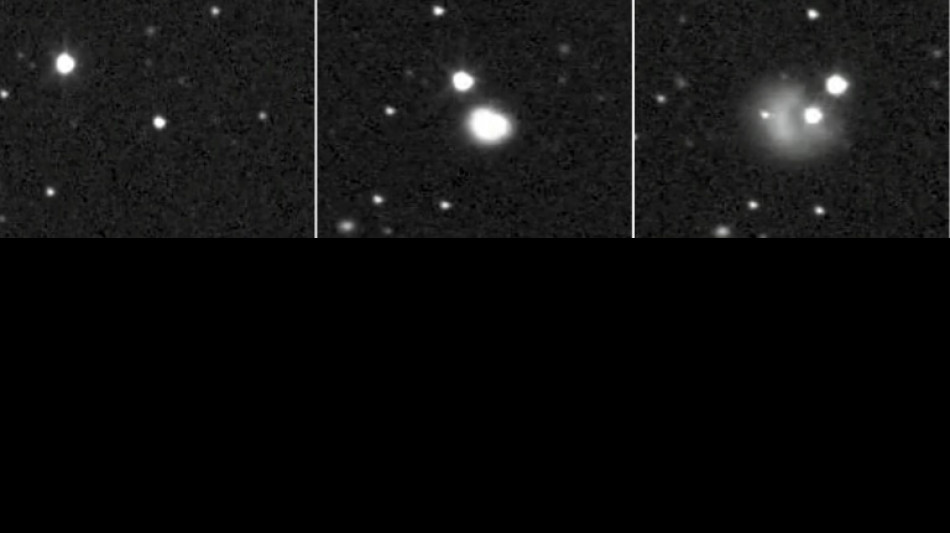
The asteroid is flying through space in the grainy black and white video, when suddenly a massive cloud of debris sprays out in front of it, meaning only one thing: impact.

Text size:

Astronomers have hailed this early footage of the first time humanity deliberately smashed a spacecraft into an asteroid, saying it looks like it did a "lot of damage".

That would be good news, because NASA's Double Asteroid Redirection Test (DART) impactor struck the asteroid Dimorphos at 23,500 kilometres (14,500 miles) per hour on Monday night with the goal of deflecting its trajectory.

While Dimorphos is 11 million kilometres (6.8 million miles) away and poses no threat to Earth, it is being used as a historic test run so the world can be ready to defend itself if a future astroid heads Earth's way.

After the impact, ground-based telescopes and the toaster-sized satellite LICIACube, which separated from DART a few weeks ago, revealed the first images of the collision.

"On the LICIACube images, the plume of what came off the surface was quite impressive," Antonella Barucci of the Paris Observatory's LESIA laboratory told AFP.

By examining the plume, "we can begin to estimate the density of the material on the surface," she said.

- 'Very, very big' plume -

The Asteroid Terrestrial-impact Last Alert System (ATLAS) project on Tuesday tweeted a nine-second video of the impact taken by its telescope in South Africa.

Larry Denneau, the ATLAS co-principal investigator, said the telescope took one image every 40 seconds.

"So the whole sequence that you've seen on Twitter lasts about two hours in real time," he told AFP.

He said the "very, very big" plume was made by dust shooting off the asteroid.

"A lot of the dust is released at a speed that's greater than the gravity of the asteroid, and so it escapes," Denneau said.

The plume expanded to around "several thousand miles in diameter," he added.

In the coming days and weeks astronomers around the world will work to confirm whether the asteroid's trajectory was definitively altered by the impact.

Then the European Space Agency's Hera mission will arrive at Dimorphos in 2026 to survey the surface and discover the extent of DART's impact.

Hera mission principal investigator Patrick Michel said "we are all impressed by the magnitude of the event".

"We have done a lot of damage to Dimorphos," Michel said.

"We have a quantity of ejected matter that is quite incredible."

The amount of matter ripped from the asteroid will help scientists work out exactly how much its trajectory has been affected -- if at all.


"So it's a pretty good sign," he added.

juc-la-pcl-dl/yad

C.Mak--ThChM