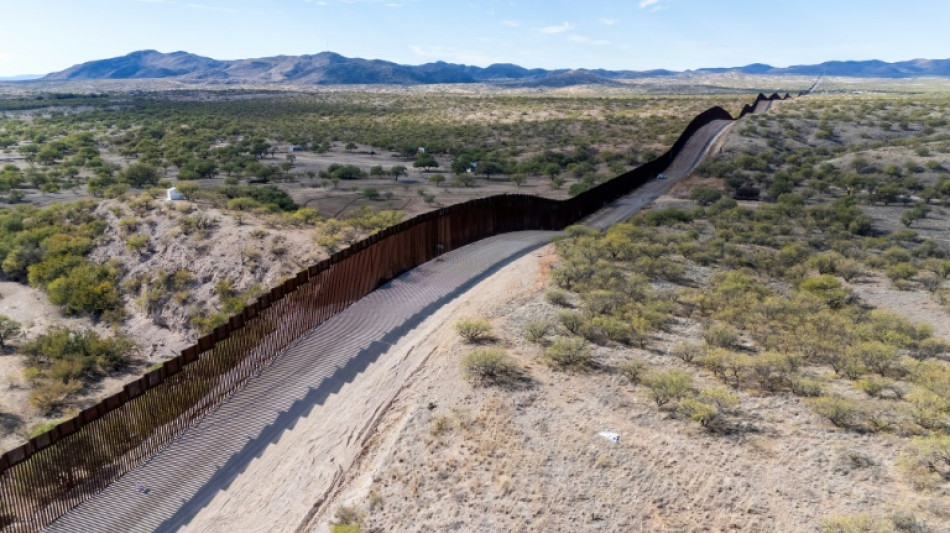
US-Mexico border wall threatening rare wildlife / Photo: © AFP

Jaguars don't understand borders, but where the United States meets Mexico, they are having to adapt to them.
Once the master of the Sonoran Desert, the animal is now struggling to survive in a landscape cut in two by a wall.
The barrier, which former US president Donald Trump boasted he would make "impenetrable," does little to discourage the thousands of people from Latin America, Asia, Africa and Eastern Europe who arrive in the country every day, fleeing poverty and persecution.
But, say conservationists, the fencing erected by successive administrations in Washington is deadly to wildlife.
"One of the most important things for the health of ecosystems is habitat connectivity," says Laiken Jordahl from the Center for Biological Diversity.
"Animals need to be able to roam, to find food, water, to find mates. Having wide expanses of connected landscape is critical."
A metal fence rises 30 feet (9 meters) at the southern edge of the Buenos Aires National Wildlife Refuge, a 117,000-acre (47,000-hectare) home for threatened and endangered plants and animals in Arizona.
The barrier marks the end of the United States, but not the end of the habitat for dozens of species, including American antelope, mule deer, lynx, mountain lions and jaguars.
"This wall is clearly going to sever this entire ecosystem from all of the wild lands in Mexico that will make animals on this side and that side of the wall more vulnerable to drought, to climate change, to inbreeding," Jordahl said.
Scientists think there are about 150 jaguars on the Mexican side; there have been only seven documented sightings on the American side in recent decades.
"One individual jaguar can roam hundreds or thousands of acres, they can walk hundreds of miles in a matter of days. They need massive landscapes available to them," said Jordahl.
"Jaguars are coming up to Arizona from Sonora in Mexico, but a lot of them are being met with a solid border wall."
- 'Undercutting' -
A physical barrier at the US-Mexico border has been in the works for decades along stretches of the 2,000-mile (3,000-kilometer) frontier.
It is present in national parks, nature reserves and on indigenous lands in Texas, New Mexico, Arizona and California, ending a few yards (meters) out into the Pacific Ocean.
Each piece of the jigsaw reveals the administration that put it there -- Trump's section of wall, for example, stands the highest, a reflection of the Republican's signature pledge to shutter the border.
Trump's White House repealed or circumvented rules designed to lessen environmental impacts, causing "irreparable" damage in nature reserves and on indigenous lands, according to a report released in September by the Government Accountability Office, the auditing arm of Congress.
Democrat Joe Biden halted the expansion of the wall when he came to office in 2021, but in October his administration authorized the closing of some gaps, mainly in Arizona.
For Jordahl, the rush to erect the barrier undermined years of careful conservation work by the government.
"The federal government has put hundreds of millions of dollars into protecting landscapes around the border, into recovering animals like the Mexican gray wolf and the jaguar.
"But at the same time, they're undercutting all of those goals by building this impermeable structure that stops... migrations dead in their tracks.
"Essentially, we're pulling thread after thread out of this patchwork that is the intact ecosystem," said Jordahl.
"It's only a matter of time until it all does start to unravel."
O.Tse--ThChM