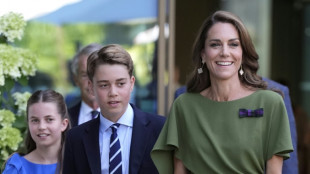
Kate Middleton conspiracies linger after cancer revelation / Photo: © AFP

The revelation that Britain's Catherine, Princess of Wales, has cancer prompted a swift backlash over a torrent of lurid social media speculation around her health, including by those positing she was secretly dead. But the somber news has not stopped the seemingly endless churn of conspiracy theories.
Kate Middleton, 42, received an outpouring of global sympathy after her video message on Friday revealed she was undergoing preventative chemotherapy, seeking to put an end to a maelstrom of unfounded claims circulated amid her monthslong absence from public life.
The manipulation of a royal photograph the palace released to the media, as well as the British monarchy's culture of secrecy, had fueled much of the online speculation.
But the proliferation of evidence-free theories on social media –- including posts peppered with skull emojis claiming the princess was dead or in an induced coma -- illustrates the new normal of information chaos in an age of artificial intelligence and misinformation that has warped public understanding of reality.
The speculation took a serious turn last week when the British police were asked to probe a reported attempt to access her confidential medical records.
"Kate has effectively been bullied into this statement," writer Helen Lewis wrote in US magazine the Atlantic.
"The alternative -- a wildfire of gossip and conspiracy theories -- was worse."
Britain's Daily Mail tabloid also lashed out, asking: "How do all those vile online trolls feel now?"
If social media posts are to be believed, they are not too sorry.
- 'Cruel grifters' -
Many on X, formerly Twitter, and TikTok claimed Kate's video message was an AI-enabled deepfake.
Some users posted slowed down versions of the video to support the baseless claim that it was digitally manipulated, asking why nothing in the background -- a leaf or blade of grass -- moved.
Others scrutinized her facial movements and speculated why a dimple, as seen in previous images, wasn't visible.
"Sorry House of Windsor, Kate Middleton (and) legacy media -- I'm still not buying what you're selling," said one post on X.
"Actually not sorry - you've all read 'The Little Boy That Cried Wolf' right?"
And then there was misinformation about cancer itself, with posts falsely claiming that the disease was not fatal while comparing chemotherapy with "poison."
And how could anti-vaccine campaigners be left behind?
Many of them jumped on the conspiracy bandwagon, baselessly linking Kate's diagnosis to "turbo cancer," a myth linked to Covid-19 vaccines that has been repeatedly debunked.
"There is no evidence to support the 'turbo cancer' lie," said Timothy Caulfield, a misinformation expert from the University of Alberta in Canada.
Conspiracy theorists "are cruel grifters marketing fear (and) misinformation," he added.
- 'Seed of doubt' -
The proliferation of wild theories highlights how facts are increasingly under scrutiny on a misinformation-filled internet landscape, an issue exacerbated by public distrust of institutions and traditional media.
The same distrust, researchers say, has tainted online conversations about serious issues, including elections, climate and health care.
"People don't trust what they are seeing and reading," Karen Douglas, a professor of social psychology at the University of Kent, told AFP.
"Once a seed of doubt has been sown, and people lose trust, conspiracy theories are able to gain traction."
The rumor mill surrounding Kate spiraled since she retreated from public life after attending a Christmas Day church service and undergoing abdominal surgery in January.
Conspiracy theories exploded after the princess admitted to editing a Mother's Day family portrait, a move that prompted news agencies including AFP to withdraw it.
Conspiracy theorists went down a new rabbit hole when a subsequent video emerged showing Kate strolling in a market with her husband, baselessly asserting that she had been replaced by a body double.
"When it comes to an institution as old and opaque as the royal family, public distrust creates an appetite for a lot of sleuthing," Dannagal Young, from the University of Delaware, told AFP.
Social media hashtags about the princess gained such virality that many users began using them to promote unrelated posts about topics that receive far less traction, including human rights abuses in India and the Middle East.
What made the frenzy worse, researchers say, was a culture of royal secrecy and the seemingly botched PR strategy of the palace.
"To be honest, the palace could have nipped the situation in the bud much earlier," Douglas said.
X.So--ThChM