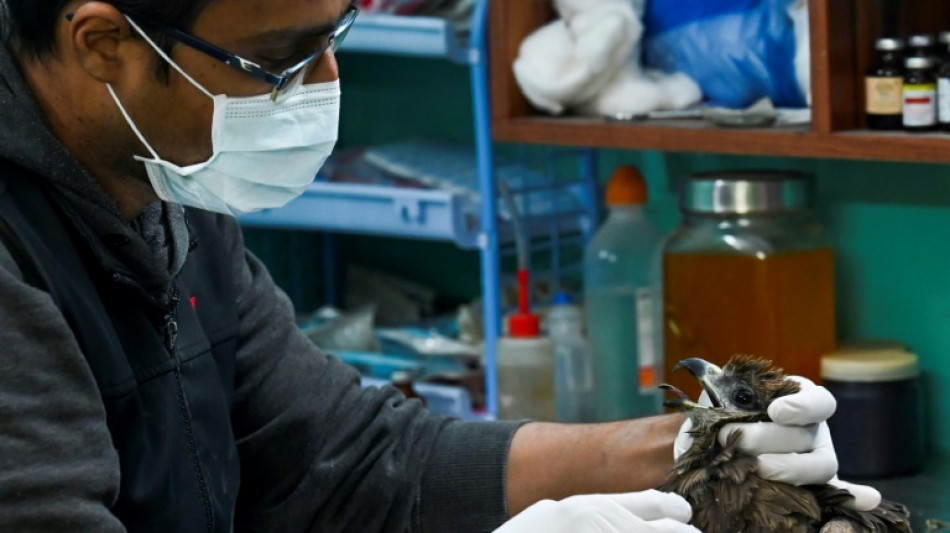
Birds of a feather: India's raptor-rescuing brothers

Nursed back from near death, a skittish vulture flaps its wings and returns to the grey skies above India's capital after weeks of tender care from two devoted brothers.
New Delhi is home to a magnificent array of predatory birds, but untold numbers are maimed each week by kite strings, cars and other grave encounters with human activity.
A fortunate few are found and cared for by Nadeem Shehzad and Mohammad Saud, siblings who run a rescue group devoted to injured creatures at the top of the avian food chain.
Both men are fighting an uphill battle: their patients are considered ill omens, and few donors are willing to shell out in support of Wildlife Rescue, their shoestring operation on the city's outskirts.
"There's a superstition in India that birds of prey are unlucky birds," Shehzad, 44, tells AFP.
"They are not liked by many. Sometimes people hate them."
When they were younger, the brothers found an injured predatory bird and carted it to a "vegetarian" veterinary hospital -- one caring exclusively for herbivores -- only to despair at the staff's refusal to treat it.
Eventually, they began taking similarly hurt birds home to help them recover.
"Some of the birds started flying back into the wild, and that gave us much-needed confidence," Shehzad said.
Now, on the roof of their small office, a huge aviary hosts a colourful assortment of raptors in various states of convalescence.
Among them are endangered Egyptian vultures, instantly recognisable by their bright yellow beaks and tousled cream crowns.
A colony of the species lives at a waste dump in Delhi's east, drawn by the pungent refuse dumped there by surrounding slaughterhouses and fish markets.
One of their flock was recently returned to the wild by the brothers after being wounded by the taut string of a kite.
Kites are popular in the city, and Saud says the Wildlife Rescue clinic takes in half a dozen birds each day that are injured after colliding with them.
In a treatment room, he carefully jostles with one flapping patient still ensnared by a wire, a bare wing bone peeking through a bloodied clump of feathers.
Successful treatment depends on how soon the injured birds are brought to their attention, Saud said, pointing to another bird in obvious pain, with discoloured edges around an old wound.
"He will die in a few days, his wound is already gangrenous," he tells AFP.
- 'We are the destroyers' -
Delhi has grown at a remarkable pace in recent years, and the sprawling megacity is now home to about 20 million people.
The loss of natural habitat and smog -- Delhi is consistently ranked among cities with the world's worst air pollution -- has strained the cornucopia of bird species nesting around the capital.
As was the case for other ecosystems reeling from human encroachment, India's strict coronavirus lockdowns were a massive boon to the city's bird population, veterinarian Rajkumar Rajput tells AFP.
Rajput runs another charity clinic for injured birds in Delhi's south, largely caring for doves, pigeons and more gentle feathered friends than the carnivores nursed by Shehzad and Saud.
He is an adherent of the Jain faith, which maintains a strict prohibition on animal slaughter, and the few raptors he does treat are kept on a vegetarian diet.
Rajput warns the brief respite granted by the lockdowns is ending and the tide is beginning to turn back.
"The distance between humans and birds has only been increasing. We are unable to bridge this distance because people are gradually losing their love for nature," the 38-year-old said.
"These birds are the builders of natural environment, and us humans are the destroyers."
V.Liu--ThChM