A coffin for Pol Pot's memory, 50 years after Phnom Penh's fall / Photo: © AFP

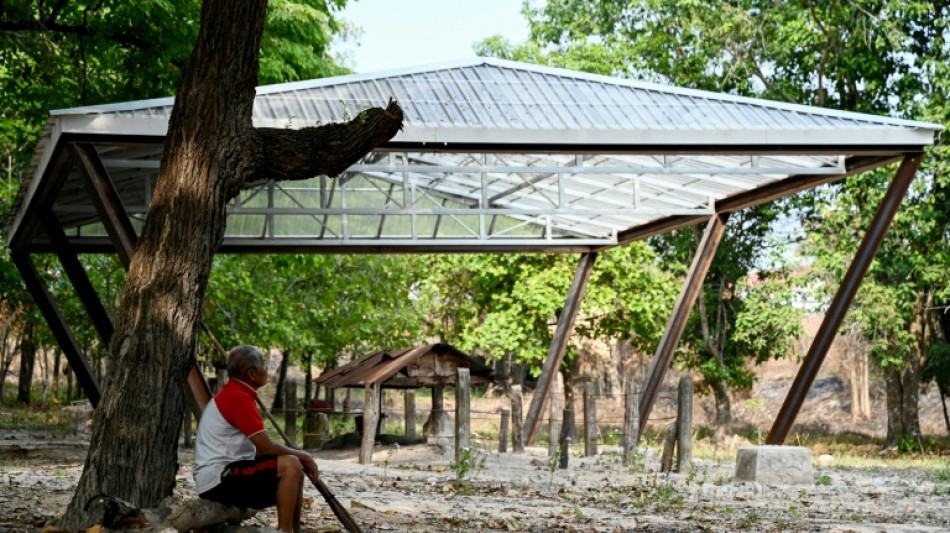
A new coffin-shaped structure topped with a clear plastic roof looms over the cremation site of Pol Pot in Anlong Veng, a testament to the estimated two million Cambodian lives lost under his genocidal rule.
One of history's most notorious mass murderers, his Khmer Rouge forces captured Phnom Penh 50 years ago on Thursday, and his dark legacy still casts a long shadow over modern Cambodia.
Now Anlong Veng in the Dangrek mountains offers a unique window into the complexities of memory and reconciliation.
The Khmer Rouge reset the calendar to "Year Zero" and began a brutal reign of terror, emptying the capital and sending its people to work camps in the countryside as they pursued an ideal peasant society free from money, class and religion.
Over the next four years, a quarter of the population died from exhaustion, starvation, disease, torture or through executions.
Ousted by Vietnamese forces allied with longtime leader and former Khmer Rouge cadre Hun Sen, the Maoist movement retreated to a few strongholds along the Thai border.
Deposed as leader in factional infighting and given a show trial by his former comrades, Pol Pot died in 1998 and was cremated on a pile of old tyres.
"All people, regardless of how high their status is, when we die, we sleep in the same coffin," said the new structure's co-designer Chhoeun Vannet.
Its rusted steel beams, with the connotation of potential disease, are intended to evoke the menace of the Khmer Rouge, "a genocide regime", he told AFP.
The roof was intended to preserve the site as proof of history, said Youk Chhang, director of the Documentation Center of Cambodia (DC-CAM), which led the project and maintains extensive archives of the period.
Cambodia is one of the rare countries that "preserves the grave site of a murderer such as Pol Pot", he said.
"If you don't do it, it will be destroyed and disappear -- and the young won't have any evidence to believe that Pol Pot existed."
- Multi-storey casino -
Thousands of former Khmer Rouge members and their descendants still live in Anlong Veng district, also home to bank branches, Buddhist temples and a multi-storey casino 100 metres from the cremation site.
Many still hold Pol Pot in high regard.
"He wasn't such a bad guy," said former Khmer Rouge soldier Peanh Poeun, 65. "I don't think he killed anyone, but everyone can have their opinion."
And Phong Heang, 72, who lost his legs to a landmine in 1984, insisted: "I have no regrets.
"I'm not ashamed of being a Khmer Rouge. I followed orders," he said, adding: "I want to bury the past."
Researchers say political pressures complicate Cambodia's reckoning with its history as a result of ex-prime minister Hun Sen's policy of reconciliation, which reintegrated most Khmer Rouge into society.
Pol Pot himself was tried in absentia, convicted of genocide and sentenced to death by the Vietnamese-installed authorities in 1979, but he was never brought to justice before an internationally recognised court.
A special tribunal sponsored by the United Nations convicted three key Khmer Rouge figures before ceasing operations in 2022, but other former cadres continue to live freely.
At the house of former Khmer Rouge military commander Ta Mok, researcher Sout Vichet -- himself the son and grandson of Khmer Rouge soldiers -- explained the movement's crimes to a group of visiting high school students.
"The work of reconciliation and historical education is endless," he said.
- 'Beautiful world' -
Others want to move on.
"The past is behind us. I'm more focused on the present and the future," said 15-year-old Prom Srey Den, who has two grandparents who were in the Khmer Rouge, and who dreams of emigrating to the United States.
The cremation site roof sparked some negative reactions on social media, with critics speaking of a glorification of Pol Pot, whose ban on religion deprived his victims of Buddhist funeral rites seen as essential in Cambodian culture.
Co-designer Chhoeun Vannet -- a 26-year-old architecture student born after Pol Pot's death -- rejects the accusation.
The acrylic roof, he said, was intended "to tell Pol Pot that this world is so wide, when we look up, we see a big and beautiful world".
"It is not like his rule."
Z.Huang--ThChM