The China Mail - Conservationists sue Trump admin over inaction on horseshoe crabs

USD -
AED 3.672504
AFN 61.999888
ALL 81.335434
AMD 370.651109
ANG 1.789884
AOA 917.999769
ARS 1398.511897
AUD 1.39083
AWG 1.8
AZN 1.698512
BAM 1.665716
BBD 2.014904
BDT 123.076268
BGN 1.668102
BHD 0.377484
BIF 2973.214666
BMD 1
BND 1.273687
BOB 6.913086
BRL 4.969695
BSD 1.000383
BTN 94.177916
BWP 13.469318
BYN 2.809522
BYR 19600
BZD 2.014053
CAD 1.36034
CDF 2314.999629
CHF 0.784015
CLF 0.022711
CLP 893.770081
CNY 6.836299
CNH 6.82271
COP 3554.51
CRC 454.541583
CUC 1
CUP 26.5
CVE 93.910488
CZK 20.7338
DJF 178.145893
DKK 6.36078
DOP 59.47281
DZD 132.367207
EGP 52.568501
ERN 15
ETB 156.205085
EUR 0.85124
FJD 2.198802
FKP 0.740868
GBP 0.736965
GEL 2.680124
GGP 0.740868
GHS 11.099093
GIP 0.740868
GMD 73.498703
GNF 8779.968488
GTQ 7.648086
GYD 209.300345
HKD 7.837335
HNL 26.586893
HRK 6.416097
HTG 130.979858
HUF 309.608503
IDR 17207
ILS 2.97875
IMP 0.740868
INR 94.127901
IQD 1310.56509
IRR 1316999.999971
ISK 122.41003
JEP 0.740868
JMD 157.927011
JOD 0.709006
JPY 159.221962
KES 129.300235
KGS 87.430697
KHR 4003.747392
KMF 420.000447
KPW 899.999995
KRW 1471.149647
KWD 0.30776
KYD 0.833709
KZT 458.331559
LAK 21922.241622
LBP 89586.253886
LKR 318.383511
LRD 183.571094
LSL 16.486991
LTL 2.95274
LVL 0.60489
LYD 6.345867
MAD 9.244304
MDL 17.317208
MGA 4157.901461
MKD 52.492645
MMK 2099.922997
MNT 3576.490722
MOP 8.075714
MRU 39.946344
MUR 46.710636
MVR 15.449807
MWK 1734.701699
MXN 17.356804
MYR 3.952502
MZN 63.909914
NAD 16.486991
NGN 1358.679928
NIO 36.818124
NOK 9.26355
NPR 150.684325
NZD 1.690095
OMR 0.384506
PAB 1.000383
PEN 3.488396
PGK 4.344419
PHP 60.788499
PKR 278.837798
PLN 3.61281
PYG 6302.431546
QAR 3.656943
RON 4.337399
RSD 99.949787
RUB 74.897453
RWF 1466.081846
SAR 3.750825
SBD 8.045307
SCR 13.833692
SDG 600.497935
SEK 9.183799
SGD 1.272902
SHP 0.746601
SLE 24.625031
SLL 20969.496166
SOS 571.732743
SRD 37.4635
STD 20697.981008
STN 20.866158
SVC 8.753566
SYP 110.524981
SZL 16.473193
THB 32.309788
TJS 9.396329
TMT 3.505
TND 2.910446
TOP 2.40776
TRY 45.0114
TTD 6.792999
TWD 31.426506
TZS 2602.501415
UAH 44.119984
UGX 3721.841332
UYU 39.790487
UZS 12078.52489
VES 483.16466
VND 26359
VUV 118.189547
WST 2.728507
XAF 558.665418
XAG 0.013209
XAU 0.000213
XCD 2.70255
XCG 1.803006
XDR 0.695927
XOF 558.66066
XPF 101.571349
YER 238.650188
ZAR 16.48238
ZMK 9001.190663
ZMW 18.932845
ZWL 321.999592
  • RYCEF

    0.1000

    15.45

    +0.65%

  • CMSD

    -0.0530

    23.267

    -0.23%

  • NGG

    0.0700

    87.49

    +0.08%

  • GSK

    -0.0550

    54.385

    -0.1%

  • BTI

    -0.6000

    57.49

    -1.04%

  • BCE

    -0.2500

    23.63

    -1.06%

  • RIO

    -0.0600

    99.55

    -0.06%

  • CMSC

    -0.0500

    22.9

    -0.22%

  • VOD

    -0.1250

    15.505

    -0.81%

  • BP

    0.1250

    46.375

    +0.27%

  • RBGPF

    0.0000

    64.94

    0%

  • BCC

    0.3400

    84.49

    +0.4%

  • JRI

    0.0200

    12.91

    +0.15%

  • RELX

    0.2050

    36.735

    +0.56%

  • AZN

    -0.0900

    189.66

    -0.05%

Conservationists sue Trump admin over inaction on horseshoe crabs
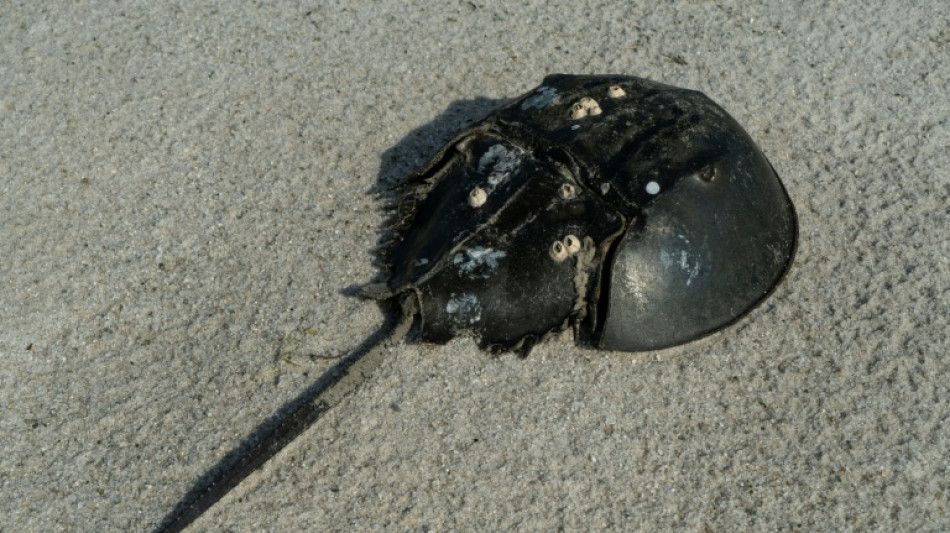
Conservationists sue Trump admin over inaction on horseshoe crabs / Photo: © AFP/File

Conservationists sue Trump admin over inaction on horseshoe crabs

A conservation group sued President Donald Trump's administration on Monday over its failure to act on protecting American horseshoe crabs, which are increasingly threatened by the harvesting of their blood for drug safety testing.

Text size:

Sometimes called "living fossils," horseshoe crabs have patrolled the world's shallow coastal waters for more than 450 million years, outlasting the dinosaurs.

But their population has cratered more than 70 percent since 2000 as a result of over-harvesting and habitat loss.

Their bright blue blood is used for testing the safety of biomedical products, despite synthetic alternatives now approved and widely used in Europe and Asia.

"Harvesting horseshoe crabs for blood is now the number one threat to horseshoe crabs," Will Harlan, a scientist at the Center for Biological Diversity, which brought the legal case against the National Marine Fisheries Service (NMFS), told AFP.

"We think because horseshoe crabs are so depleted overseas -- the other three species of horseshoe crabs are all even more endangered than the American horseshoe crab -- and so demand globally has shifted to the United States," he added, with biomedical harvests doubling over the past seven years.

The Center for Biological Diversity, along with 25 other organizations, petitioned the federal government in February 2024 -- when former president Joe Biden was in office -- to list the American horseshoe crab (Limulus polyphemus) as threatened or endangered, and to designate areas as critical habitats.

Under the Endangered Species Act, such a petition triggers a 90-day deadline to issue an initial finding. While the law allows some flexibility, it requires that a scientifically justified decision be reached within a year. Rejection can pave the way for appeal.

"Unfortunately, under both administrations, we've been waiting for a decision that, by law, was supposed to come much sooner," said Harlan. "But these horseshoe crabs can't wait any longer."

Since the 1970s, horseshoe crabs have been caught, bled alive, and returned to the sea to harvest a protein called "Factor C," which detects endotoxins that can contaminate drugs.

Some companies, including Eli Lilly -- known for its weight-loss drugs -- have earned praise for converting most of their operations to synthetic alternatives.

With helmet-like shells, spike-like tails and five pairs of legs connected to their mouths, horseshoe crabs crawl ashore along the Atlantic and Gulf coasts each spring to lay their eggs on beaches in massive spawning events.

As their numbers have declined, so too have the species that depend on them, including sea turtles, fish and birds.

The Trump administration has sought to weaken the landmark Endangered Species Act -- proposing, for example, to allow economic considerations to factor into what were previously science-based decisions.

Y.Parker--ThChM