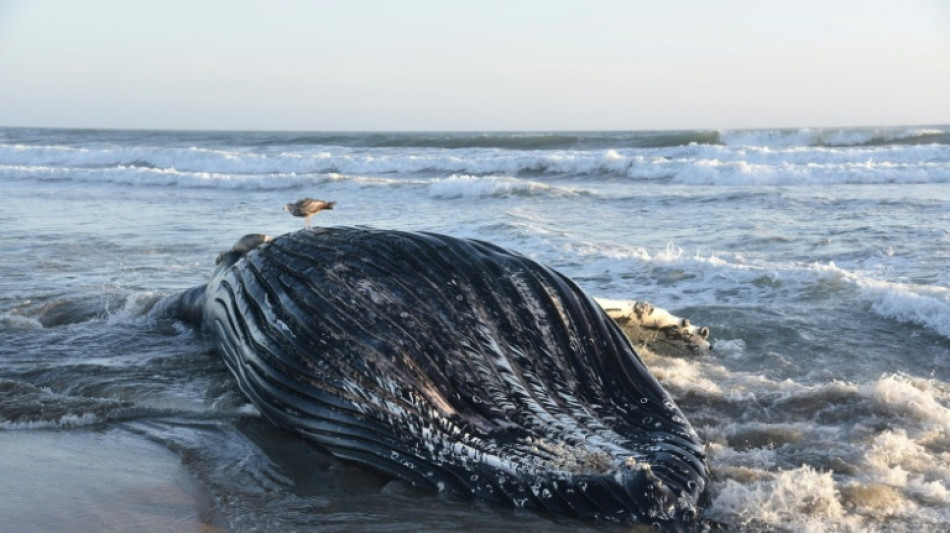
Whales at risk, hungry pelicans: Marine heat wave hits California / Photo: © Marine Mammal Stranding Network, UC Santa Cruz/AFP

On a boat off the coast of California, Sara Lesser gazes wistfully at dozens of dolphins playing in the vessel's wake. This summer, extreme heat is making such a scene increasingly rare.
On daily tourist boat trips, "the number of whales and dolphins we're seeing is less than we would on a normal year," Lesser, a 39-year-old naturalist at the Aquarium of the Pacific in Long Beach, told AFP.
The warming of the ocean surface is forcing anchovies and sardines -- which the mammals eat -- to seek cooler waters, either at deeper levels or farther north.
Dolphins and whales "are going to follow their food, and so we're seeing less sightings," Lesser explained.
The educator aims to raise awareness among visitors about the plight of the animals, as fewer whale sightings is just a harbinger of larger negative changes to come to the marine ecosystem.
Surface water temperatures along the California coast are now three to four degrees C above normal, according to the US National Oceanic and Atmospheric Administration (NOAA).
The current heat wave has been ongoing for "about six months," said Andrew Leising, a research oceanographer at NOAA.
What makes it more worrying is that it coincides with the return of El Nino, the weather pattern that warms surface temperatures in the central and eastern equatorial Pacific Ocean -- and periodically disrupts global climate.
This year, scientists are predicting that El Nino could rank among the largest ever recorded.
- Sea lions at risk -
"Chances are this El Nino is going to be stronger than the 2015-2016 one," Leising said, noting that a decade ago, the oceanic heat wave was devastating for the Golden State.
At that time, conditions were much the same as they are now: El Nino aggravated a heat wave that had begun in 2014.
Ocean waters became so hot that thousands of birds died because they could not reliably get fish on the surface. The carcasses of malnourished sea lions and whales washed up on beaches.
In recent months, dozens of pelicans and cormorants were found dead near San Diego.
Leising fears the sea lions -- one of California's signature animals -- could soon suffer.
When temperatures rise, the females abandon their pups to hunt for food, he explained.
Heat also fuels toxic algae blooms containing domoic acid, which contaminate the anchovy and sardine populations. This makes the sea lions sick, and eventually they could wash up dead.
In Monterey Bay, south of San Francisco, harmful algae are so prevalent that two humpback whales were found dead ashore in early June.
Elliott Hazen, an adjunct professor in the ecology and evolutionary biology department at the University of California, Santa Cruz, says that hasn't happened in a decade.
"These are such large predators, it just highlights how much domoic acid there has to be in the ecosystem for it to affect them," Hazen told AFP.
- Great white sharks near shore -
The marine heat wave is also pushing great white sharks nearer to the shore -- a rare sight.
During the whale watching sail from the Aquarium of the Pacific, a shark briefly surfaced, its fin visible.
"It's not common for us to see them," said Lesser, the aquarium guide. "But younger sharks like to be in warmer waters, and so we're seeing sharks closer to shore."
That has frayed nerves more than once in the area.
This week, a Malibu resident posted a video of a white shark swimming just a few yards (meters) from children, who were totally unaware of its presence.
This past spring, swimming was banned three times at Huntington Beach due to sharks deemed to be aggressive.
All these anomalies could become more and more regular -- California has seen marine heat waves every year since 2019.
"We know that climate change is adding more fuel to the fire," Hazen said.
"If we have these marine heat waves over and over again, and we lose the ability to sustain the ecosystem the way we have in the past, we're going to lose some of the fish species that we rely on for food. So that's the big concern."
O.Yip--ThChM