The China Mail - China Targets Dollar at US Critical Moment

USD -
AED 3.672499
AFN 62.503781
ALL 81.659303
AMD 376.771283
ANG 1.789731
AOA 916.999937
ARS 1397.006098
AUD 1.41209
AWG 1.795
AZN 1.699248
BAM 1.65854
BBD 2.015365
BDT 122.283185
BGN 1.647646
BHD 0.377265
BIF 2968.971278
BMD 1
BND 1.266737
BOB 6.914711
BRL 5.136699
BSD 1.000602
BTN 91.051788
BWP 13.169789
BYN 2.896658
BYR 19600
BZD 2.012482
CAD 1.365485
CDF 2210.000349
CHF 0.77192
CLF 0.022134
CLP 873.990477
CNY 6.85815
CNH 6.88068
COP 3775.17
CRC 472.1525
CUC 1
CUP 26.5
CVE 93.505932
CZK 20.6587
DJF 178.183483
DKK 6.366605
DOP 60.401006
DZD 130.318984
EGP 49.368503
ERN 15
ETB 155.205569
EUR 0.85215
FJD 2.22375
FKP 0.741651
GBP 0.748545
GEL 2.680157
GGP 0.741651
GHS 10.667175
GIP 0.741651
GMD 72.506669
GNF 8776.065738
GTQ 7.675347
GYD 209.357841
HKD 7.82214
HNL 26.479604
HRK 6.428798
HTG 131.172565
HUF 322.65903
IDR 16863
ILS 3.0869
IMP 0.741651
INR 91.41505
IQD 1310.805368
IRR 1314314.999878
ISK 122.280076
JEP 0.741651
JMD 156.010447
JOD 0.708967
JPY 156.882497
KES 129.102218
KGS 87.449444
KHR 4011.957006
KMF 417.00028
KPW 900.000007
KRW 1459.870344
KWD 0.307171
KYD 0.833902
KZT 498.390961
LAK 21417.123863
LBP 89605.779749
LKR 309.44305
LRD 183.615927
LSL 15.922716
LTL 2.95274
LVL 0.604889
LYD 6.319904
MAD 9.1639
MDL 17.125559
MGA 4244.079065
MKD 52.631804
MMK 2099.892679
MNT 3568.336801
MOP 8.064277
MRU 39.937927
MUR 46.769907
MVR 15.450139
MWK 1735.196601
MXN 17.28535
MYR 3.928019
MZN 63.905008
NAD 15.922919
NGN 1361.719814
NIO 36.829117
NOK 9.521555
NPR 145.676406
NZD 1.67919
OMR 0.384482
PAB 1.000657
PEN 3.357445
PGK 4.36722
PHP 58.289805
PKR 279.674211
PLN 3.60182
PYG 6445.40359
QAR 3.637458
RON 4.344602
RSD 99.995037
RUB 77.751674
RWF 1461.902763
SAR 3.753988
SBD 8.045182
SCR 14.208689
SDG 601.49971
SEK 9.135715
SGD 1.271105
SHP 0.750259
SLE 24.549973
SLL 20969.49935
SOS 570.856794
SRD 37.722031
STD 20697.981008
STN 20.776093
SVC 8.755379
SYP 110.524979
SZL 15.919748
THB 31.427504
TJS 9.521181
TMT 3.5
TND 2.900452
TOP 2.40776
TRY 43.9629
TTD 6.79228
TWD 31.542701
TZS 2555.000032
UAH 43.14189
UGX 3607.454048
UYU 38.439197
UZS 12157.675821
VES 416.8362
VND 26200
VUV 118.983872
WST 2.715907
XAF 556.230444
XAG 0.010489
XAU 0.000185
XCD 2.70255
XCG 1.803396
XDR 0.691772
XOF 556.230444
XPF 101.131647
YER 238.549779
ZAR 16.05749
ZMK 9001.201522
ZMW 18.907139
ZWL 321.999592
  • RBGPF

    0.1000

    82.5

    +0.12%

  • CMSC

    -0.4299

    23.45

    -1.83%

  • BCE

    0.6400

    26.31

    +2.43%

  • NGG

    0.0500

    93.77

    +0.05%

  • RYCEF

    -0.0600

    18.4

    -0.33%

  • RIO

    0.2500

    99.34

    +0.25%

  • AZN

    4.4700

    208.45

    +2.14%

  • CMSD

    -0.3100

    23.28

    -1.33%

  • VOD

    -0.0400

    15.36

    -0.26%

  • RELX

    0.7300

    34.79

    +2.1%

  • BTI

    -0.0200

    62.65

    -0.03%

  • GSK

    1.0600

    59.13

    +1.79%

  • BCC

    -0.9000

    82.74

    -1.09%

  • JRI

    0.1200

    13.29

    +0.9%

  • BP

    0.8700

    38.86

    +2.24%


China Targets Dollar at US Critical Moment


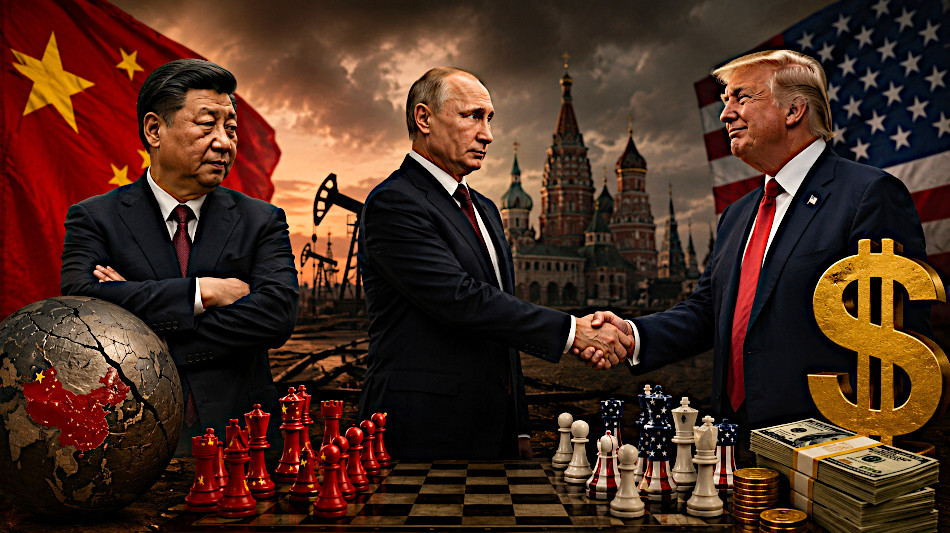
China has intensified its financial offensive against the United States, deploying significant measures to undermine the dominance of the US dollar at a time when America faces mounting economic and geopolitical challenges. Reports indicate that the People’s Bank of China (PBOC) has directed major state-owned banks to prepare for large-scale interventions in offshore markets, selling dollars to bolster the yuan. This move, seen as a direct challenge to the dollar’s status as the world’s reserve currency, coincides with heightened US vulnerabilities, including domestic political instability and a ballooning national debt nearing $35 trillion.

The strategy builds on years of Chinese efforts to internationalise the yuan and reduce reliance on the dollar. Since 2022, China has accelerated dollar sell-offs, with Reuters noting similar directives from the PBOC in October of that year amid a weakening yuan. More recently, Beijing has leveraged its position as a key holder of US Treasury securities—still over $800 billion despite gradual reductions—to exert pressure. Analysts suggest that China aims to exploit the US’s current economic fragility, exacerbated by inflation and supply chain disruptions, to advance its long-term goal of reshaping global financial power.

Russia’s alignment with China has further amplified this campaign, with both nations increasing trade in non-dollar currencies. In 2023, yuan transactions surpassed dollar-based exchanges in Sino-Russian trade, a trend that has only deepened. Meanwhile, whispers of more aggressive tactics persist, including unverified claims of plans to confiscate US assets within China, encompassing government, corporate, and individual investments. While such measures remain speculative, they reflect the growing audacity of Beijing’s financial warfare.

The timing is critical. The US faces a contentious election cycle and a Federal Reserve grappling with interest rate dilemmas, leaving the dollar exposed. China’s actions also resonate within the BRICS bloc (Brazil, Russia, India, China, South Africa), which has openly discussed de-dollarisation, with proposals for a unified currency gaining traction at recent summits. If successful, this could erode the dollar’s global hegemony, a cornerstone of American economic influence since the Bretton Woods agreement of 1944.

Yet, China’s gambit carries risks. Flooding markets with dollars could destabilise its own economy, heavily reliant on export surpluses tied to dollar-based trade. Moreover, the US retains significant retaliatory tools, including sanctions and control over the SWIFT financial system. For now, Beijing’s “big guns” signal intent more than immediate triumph, but the message is clear: China sees this as America’s moment of weakness—and its opportunity to strike.