The China Mail - Wild weather leaves mass blackouts in Australia

USD -
AED 3.672499
AFN 65.490979
ALL 82.012423
AMD 377.773158
ANG 1.79008
AOA 917.000329
ARS 1442.213897
AUD 1.435884
AWG 1.8
AZN 1.692558
BAM 1.659595
BBD 2.015639
BDT 122.394949
BGN 1.67937
BHD 0.37701
BIF 2965.596535
BMD 1
BND 1.27457
BOB 6.91481
BRL 5.276499
BSD 1.000776
BTN 90.44239
BWP 13.24927
BYN 2.866659
BYR 19600
BZD 2.012669
CAD 1.368225
CDF 2229.999794
CHF 0.778325
CLF 0.021932
CLP 865.999845
CNY 6.93805
CNH 6.93844
COP 3698
CRC 496.14758
CUC 1
CUP 26.5
CVE 93.565043
CZK 20.554984
DJF 178.211857
DKK 6.330925
DOP 63.157627
DZD 129.884887
EGP 46.851204
ERN 15
ETB 155.932472
EUR 0.84786
FJD 2.209499
FKP 0.732184
GBP 0.736898
GEL 2.694989
GGP 0.732184
GHS 10.987836
GIP 0.732184
GMD 73.000178
GNF 8783.310776
GTQ 7.675957
GYD 209.370505
HKD 7.813455
HNL 26.434899
HRK 6.389298
HTG 131.283861
HUF 321.370498
IDR 16891.2
ILS 3.12817
IMP 0.732184
INR 90.731986
IQD 1311.010794
IRR 42125.000158
ISK 122.77009
JEP 0.732184
JMD 156.523658
JOD 0.708973
JPY 157.065499
KES 129.000177
KGS 87.449784
KHR 4038.98126
KMF 419.000399
KPW 900.030004
KRW 1467.765017
KWD 0.30738
KYD 0.833956
KZT 493.576471
LAK 21509.911072
LBP 89638.030929
LKR 309.69554
LRD 186.137286
LSL 16.167606
LTL 2.95274
LVL 0.60489
LYD 6.339495
MAD 9.185352
MDL 17.007501
MGA 4427.737424
MKD 52.265163
MMK 2099.783213
MNT 3569.156954
MOP 8.05317
MRU 39.920067
MUR 46.060025
MVR 15.449954
MWK 1735.286131
MXN 17.37897
MYR 3.949497
MZN 63.749856
NAD 16.167606
NGN 1368.289941
NIO 36.826006
NOK 9.751415
NPR 144.708438
NZD 1.67184
OMR 0.38449
PAB 1.000776
PEN 3.36398
PGK 4.350519
PHP 58.483981
PKR 280.209677
PLN 3.574565
PYG 6608.484622
QAR 3.647395
RON 4.318595
RSD 99.537972
RUB 76.871084
RWF 1460.610278
SAR 3.750053
SBD 8.058149
SCR 13.88989
SDG 601.496786
SEK 9.07764
SGD 1.273885
SHP 0.750259
SLE 24.450177
SLL 20969.499267
SOS 570.904894
SRD 37.869768
STD 20697.981008
STN 20.789492
SVC 8.756194
SYP 11059.574895
SZL 16.159799
THB 31.694017
TJS 9.366941
TMT 3.505
TND 2.899825
TOP 2.40776
TRY 43.61475
TTD 6.776526
TWD 31.688005
TZS 2585.000435
UAH 43.184356
UGX 3572.383187
UYU 38.617377
UZS 12275.134071
VES 377.985125
VND 25965.5
VUV 119.687673
WST 2.726344
XAF 556.612755
XAG 0.013612
XAU 0.000206
XCD 2.70255
XCG 1.803594
XDR 0.692248
XOF 556.610394
XPF 101.198154
YER 238.40389
ZAR 16.17445
ZMK 9001.203421
ZMW 18.589121
ZWL 321.999592
  • SCS

    0.0200

    16.14

    +0.12%

  • RIO

    -5.3600

    91.12

    -5.88%

  • CMSC

    0.0300

    23.55

    +0.13%

  • GSK

    1.9400

    59.17

    +3.28%

  • BCE

    -0.7700

    25.57

    -3.01%

  • RBGPF

    0.1000

    82.5

    +0.12%

  • BCC

    -1.0700

    89.16

    -1.2%

  • BP

    -1.0300

    38.17

    -2.7%

  • BTI

    0.3300

    61.96

    +0.53%

  • AZN

    -0.2900

    187.16

    -0.15%

  • NGG

    -0.9000

    86.89

    -1.04%

  • RYCEF

    -0.2000

    16.42

    -1.22%

  • CMSD

    0.0200

    23.89

    +0.08%

  • JRI

    -0.1500

    13

    -1.15%

  • RELX

    0.3100

    30.09

    +1.03%

  • VOD

    -1.0900

    14.62

    -7.46%

Wild weather leaves mass blackouts in Australia
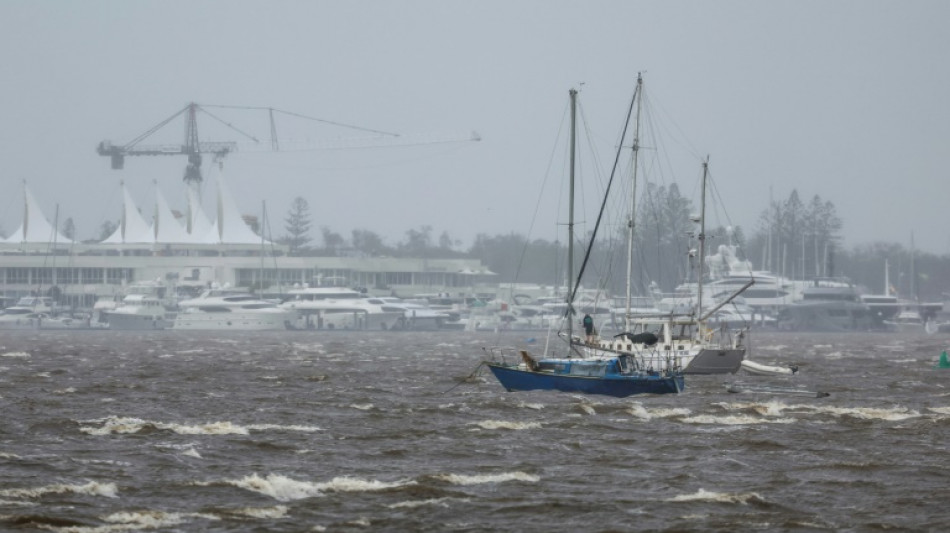
Wild weather leaves mass blackouts in Australia / Photo: © AFP

Wild weather leaves mass blackouts in Australia

Wild weather has blacked out more than 300,000 homes and businesses on Australia's east coast, officials said Sunday, with one driver confirmed dead and a dozen troops injured.

Text size:

After days hovering off the coast as a category 2 tropical cyclone generating heavy weather across the region, Alfred weakened into a tropical depression before making landfall on Saturday evening.

Strong gusts and heavy rain have brought down power lines and sparked flood warnings on swollen rivers along a 400-kilometre (250-mile) stretch of the coast straddling southeast Queensland and northeast New South Wales.

Utility companies said about 310,000 properties in southeast Queensland and at least another 16,000 in northeast New South Wales were still without power on Sunday.

"Customers need to be prepared to be without power for several days," Queensland's Essential Energy said.

"The biggest challenges to getting power back on will be rising flood waters and swollen creek beds, fallen vegetation and mud slides impacting access roads," it said in a statement.

About 14,600 people are under emergency warnings related to the weather system in New South Wales, the state's emergency services said.

"In the last 24 hours, 17 incidents have occurred as a result of people driving into flood waters," said emergency services deputy commissioner Damien Johnson.

"Not only is it a danger to yourself and your family, it is also dangerous as well for the volunteers, the emergency services workers that need to rescue you."

A 61-year-old man's body was found Saturday after his four-wheel-drive pickup truck was swept off a bridge into a river in northern New South Wales.

He had escaped from the pickup and tried in vain to cling to a tree branch in the river before disappearing into the rapid waters on Friday, police said.

- Perilous weather -

In a separate incident Saturday, police said 13 troops were injured and taken to hospital when two army trucks rolled over during a deployment to clear roads near the flood-prone New South Wales city of Lismore.

Twelve soldiers were still in hospital Sunday, two of them in a serious condition, New South Wales Premier Chris Minns told a news conference.

"We wish a speedy recovery for all of those young soldiers," he said.

Prime Minister Anthony Albanese warned that the weather was still perilous.

"The situation in Queensland and northern New South Wales remains very serious due to flash flooding and heavy winds," Albanese said.

"Heavy rainfall, damaging wind gusts and coastal surf impacts are expected to continue over coming days."

Warnings for floods, severe weather and hazardous surf have been issued for parts of Queensland and New South Wales, the government's bureau of meteorology said.

"The heavy rain, and the risk of flash flooding and major riverine flooding, will continue into next week," it warned Queensland residents, though the system was expected to weaken as it moved inland.

K.Lam--ThChM