The China Mail - Beijing lifts rain alert after evacuating over 80,000

USD -
AED 3.673042
AFN 63.503991
ALL 82.403989
AMD 368.150403
ANG 1.790403
AOA 918.000367
ARS 1465.449815
AUD 1.427684
AWG 1.8025
AZN 1.70397
BAM 1.705709
BBD 2.013483
BDT 122.708482
BGN 1.69088
BHD 0.37702
BIF 2985
BMD 1
BND 1.290663
BOB 6.90816
BRL 5.152304
BSD 0.999721
BTN 94.239742
BWP 13.585663
BYN 2.777729
BYR 19600
BZD 2.010527
CAD 1.417515
CDF 2280.000362
CHF 0.807865
CLF 0.02293
CLP 902.460396
CNY 6.769604
CNH 6.78349
COP 3452.68
CRC 453.506829
CUC 1
CUP 26.5
CVE 96.403894
CZK 21.091104
DJF 177.720393
DKK 6.516504
DOP 58.403884
DZD 133.34504
EGP 49.986489
ERN 15
ETB 158.37504
EUR 0.872353
FJD 2.235504
FKP 0.755711
GBP 0.757022
GEL 2.650391
GGP 0.755711
GHS 11.22504
GIP 0.755711
GMD 73.503851
GNF 8775.000355
GTQ 7.625892
GYD 209.119888
HKD 7.83688
HNL 26.68504
HRK 6.573199
HTG 130.583803
HUF 306.820388
IDR 17826.3
ILS 2.96854
IMP 0.755711
INR 94.330504
IQD 1310
IRR 1375000.000352
ISK 125.530386
JEP 0.755711
JMD 157.959917
JOD 0.70904
JPY 161.30504
KES 129.403801
KGS 87.450384
KHR 4010.00035
KMF 429.503794
KPW 900.00035
KRW 1527.650383
KWD 0.30793
KYD 0.833035
KZT 487.855928
LAK 22055.000349
LBP 89550.000349
LKR 333.641485
LRD 182.150382
LSL 16.405039
LTL 2.95274
LVL 0.60489
LYD 6.375039
MAD 9.225039
MDL 17.654036
MGA 4200.000347
MKD 53.732839
MMK 2099.479867
MNT 3580.422334
MOP 8.070939
MRU 40.060379
MUR 47.850378
MVR 15.450378
MWK 1737.000345
MXN 17.34565
MYR 4.137904
MZN 63.910377
NAD 16.403727
NGN 1360.440377
NIO 36.610377
NOK 9.70261
NPR 150.787532
NZD 1.743816
OMR 0.384983
PAB 0.999725
PEN 3.384039
PGK 4.38775
PHP 60.716504
PKR 278.325038
PLN 3.71375
PYG 6138.96617
QAR 3.640504
RON 4.568104
RSD 102.170373
RUB 73.103247
RWF 1464
SAR 3.74824
SBD 8.061424
SCR 13.683262
SDG 600.503676
SEK 9.589325
SGD 1.292404
SHP 0.746601
SLE 24.750371
SLL 20969.503664
SOS 571.503662
SRD 37.402504
STD 20697.981008
STN 21.4
SVC 8.747449
SYP 110.532098
SZL 16.403649
THB 32.890369
TJS 9.272075
TMT 3.5
TND 2.91175
TOP 2.40776
TRY 46.45903
TTD 6.779085
TWD 31.715038
TZS 2630.985038
UAH 44.909735
UGX 3638.520172
UYU 39.96965
UZS 12005.000334
VES 606.63266
VND 26310
VUV 118.132932
WST 2.751795
XAF 572.078806
XAG 0.015428
XAU 0.000241
XCD 2.70255
XCG 1.801643
XDR 0.703697
XOF 565.000332
XPF 104.250363
YER 238.603589
ZAR 16.454065
ZMK 9001.205044
ZMW 17.919703
ZWL 321.999592
  • CMSC

    0.0500

    22.37

    +0.22%

  • BCC

    3.8500

    74.66

    +5.16%

  • RBGPF

    -0.5300

    60.61

    -0.87%

  • RYCEF

    -0.0300

    18.4

    -0.16%

  • NGG

    -1.2400

    79.44

    -1.56%

  • BTI

    -0.5800

    58.91

    -0.98%

  • GSK

    -1.4800

    50.67

    -2.92%

  • RIO

    -2.5900

    100.08

    -2.59%

  • BCE

    0.0000

    23.28

    0%

  • CMSD

    0.0000

    22.29

    0%

  • JRI

    0.0500

    12.67

    +0.39%

  • BP

    -1.0400

    39.1

    -2.66%

  • VOD

    -0.2300

    14.3

    -1.61%

  • RELX

    -0.8300

    31.18

    -2.66%

  • AZN

    -2.9600

    174.93

    -1.69%

Beijing lifts rain alert after evacuating over 80,000
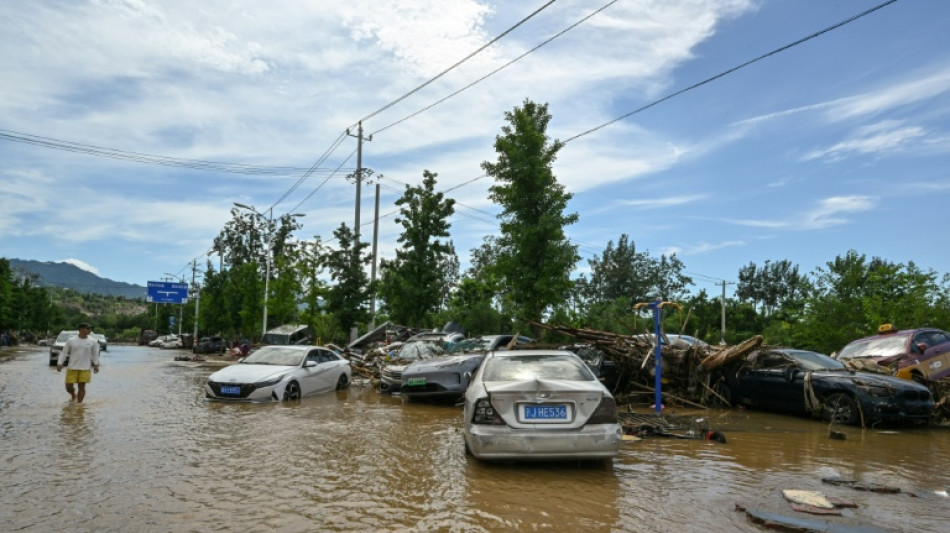
Beijing lifts rain alert after evacuating over 80,000 / Photo: © AFP

Beijing lifts rain alert after evacuating over 80,000

Beijing lifted a severe weather alert on Tuesday but warned residents to stay vigilant against natural disasters after authorities evacuated more than 82,000 people over fears of more deadly floods in the Chinese capital.

Text size:

The municipal weather office had imposed a red rainstorm warning -- the highest in a four-tier system -- on Monday, forecasting heavy downpours until Tuesday morning.

The office lifted the alert early Tuesday morning, saying in a social media statement the weather system had weakened as it drifted eastwards.

But it continued to warn of isolated downpours across outlying parts of the city, adding that people "must not let up after strong rains have passed" as landslides or other disasters may follow.

Authorities evacuated over 82,000 people at risk from heavy rainfall as of Monday evening, state news agency Xinhua said, citing the city's flood control headquarters.

Officials warned of flooding risks in the northeastern suburb of Miyun -- the hardest hit by the recent deluge -- as well as southwestern Fangshan, western Mentougou and northern Huairou.

Last week, floods in Beijing's northern suburbs killed at least 44 people and left nine missing, according to official figures.

Some 31 fatalities occurred at an elderly care centre in Miyun -- prompting a local official to admit "gaps" in disaster readiness.

"Our knowledge of extreme weather was lacking. This tragic lesson has warned us that putting the people first, putting human life first, is more than a slogan," Yu Weiguo, Miyun's ruling Communist Party boss, said at the time.

Residents of flood-hit areas told AFP journalists that they had been surprised at the speed with which the rushing water had inundated homes and devastated villages.

- Restoring order -

At a meeting on Monday, the municipal government stressed the need to "restore the normal order of life and production in post-disaster areas as quickly as possible".

Urgent tasks included road repairs, electricity and water resumption and the refurbishment of schools, hospitals and elderly care homes, officials said, according to a statement on a city social media account.

China's public security ministry has also warned people to be on guard against "rumours", including exaggerating the extent of natural disasters to create panic, state broadcaster CCTV reported on Tuesday.

China has been lashed by heavy rains in recent weeks, with heavy flooding in the north followed by intense precipiation along the southern coast.

Parts of Hong Kong were brought to a standstill on Tuesday by flooding caused by heavy rains, after the highest-tier rainstorm warning was issued for the fourth time in eight days.

Natural disasters are common across China, particularly in the summer, when some regions experience heavy rain while others bake in searing heat.

China is the world's biggest emitter of the greenhouse gases that drive climate change and contribute to making extreme weather more frequent and intense.

But it is also a global renewable energy powerhouse that aims to make its massive economy carbon-neutral by 2060.

W.Cheng--ThChM