The China Mail - 'Extreme cold': Winter storm forecast to slam huge expanse of US

USD -
AED 3.673031
AFN 65.494684
ALL 82.249984
AMD 379.139818
ANG 1.79008
AOA 917.00029
ARS 1429.981701
AUD 1.48039
AWG 1.8
AZN 1.70221
BAM 1.668657
BBD 2.012917
BDT 122.251183
BGN 1.67937
BHD 0.377012
BIF 2950
BMD 1
BND 1.282506
BOB 6.905967
BRL 5.327972
BSD 0.99942
BTN 91.533638
BWP 13.338396
BYN 2.875572
BYR 19600
BZD 2.010102
CAD 1.382405
CDF 2155.000017
CHF 0.793496
CLF 0.022276
CLP 879.729779
CNY 6.963898
CNH 6.96032
COP 3671.53
CRC 489.471708
CUC 1
CUP 26.5
CVE 94.805413
CZK 20.798902
DJF 177.719906
DKK 6.385255
DOP 62.950349
DZD 129.85104
EGP 47.330502
ERN 15
ETB 155.397456
EUR 0.854797
FJD 2.267045
FKP 0.742423
GBP 0.745155
GEL 2.694948
GGP 0.742423
GHS 10.845035
GIP 0.742423
GMD 73.500812
GNF 8750.000433
GTQ 7.671831
GYD 209.107275
HKD 7.797405
HNL 26.450108
HRK 6.441201
HTG 130.861933
HUF 328.955496
IDR 16907.6
ILS 3.15195
IMP 0.742423
INR 91.61135
IQD 1310
IRR 42125.000158
ISK 124.970295
JEP 0.742423
JMD 157.122381
JOD 0.709051
JPY 158.177501
KES 128.94988
KGS 87.450259
KHR 4075.999726
KMF 420.000116
KPW 900.031287
KRW 1466.350045
KWD 0.30724
KYD 0.832914
KZT 506.573952
LAK 21605.000137
LBP 85549.999909
LKR 309.475462
LRD 184.925007
LSL 16.430012
LTL 2.95274
LVL 0.60489
LYD 6.364971
MAD 9.182498
MDL 16.940548
MGA 4535.00019
MKD 52.573203
MMK 2099.691634
MNT 3565.807821
MOP 8.027525
MRU 39.759781
MUR 46.101325
MVR 15.449843
MWK 1733.504982
MXN 17.48895
MYR 4.047021
MZN 63.910276
NAD 16.430366
NGN 1418.580178
NIO 36.699903
NOK 9.959565
NPR 146.454899
NZD 1.71202
OMR 0.384425
PAB 0.999458
PEN 3.357501
PGK 4.18875
PHP 59.141026
PKR 279.974994
PLN 3.60584
PYG 6693.229131
QAR 3.641013
RON 4.3534
RSD 100.362981
RUB 76.996077
RWF 1452
SAR 3.750256
SBD 8.130216
SCR 15.106561
SDG 601.500423
SEK 9.10718
SGD 1.284098
SHP 0.750259
SLE 24.650087
SLL 20969.499267
SOS 571.49826
SRD 38.209809
STD 20697.981008
STN 21.2
SVC 8.745025
SYP 11059.574895
SZL 16.430334
THB 31.197034
TJS 9.320069
TMT 3.5
TND 2.871503
TOP 2.40776
TRY 43.293703
TTD 6.784809
TWD 31.611503
TZS 2549.999502
UAH 43.131999
UGX 3457.955088
UYU 38.341438
UZS 12075.000009
VES 346.83002
VND 26265
VUV 120.830431
WST 2.782376
XAF 559.675947
XAG 0.010769
XAU 0.000207
XCD 2.70255
XCG 1.801288
XDR 0.695535
XOF 560.503506
XPF 102.224999
YER 238.349963
ZAR 16.29281
ZMK 9001.198512
ZMW 20.114673
ZWL 321.999592
  • RBGPF

    0.0000

    84.04

    0%

  • SCS

    0.0200

    16.14

    +0.12%

  • CMSC

    0.1500

    23.61

    +0.64%

  • CMSD

    -0.0200

    24

    -0.08%

  • RYCEF

    -0.2000

    16.9

    -1.18%

  • VOD

    0.1000

    13.6

    +0.74%

  • RELX

    0.0300

    40.32

    +0.07%

  • NGG

    0.8500

    80.85

    +1.05%

  • BCC

    1.1900

    85.01

    +1.4%

  • JRI

    0.0500

    13.72

    +0.36%

  • RIO

    3.1600

    88.84

    +3.56%

  • BCE

    0.1200

    24.51

    +0.49%

  • BTI

    1.3900

    57.71

    +2.41%

  • GSK

    0.4200

    48.07

    +0.87%

  • AZN

    0.6000

    90.54

    +0.66%

  • BP

    0.7700

    35.92

    +2.14%

'Extreme cold': Winter storm forecast to slam huge expanse of US
'Extreme cold': Winter storm forecast to slam huge expanse of US / Photo: © AFP/File

'Extreme cold': Winter storm forecast to slam huge expanse of US

A winter storm bringing very cold temperatures is expected to slam a massive stretch of the United States this week with more than 175 million people facing the prospect of power outages and travel disruptions.

Text size:

Winter Storm Fern is forecast to engulf an area stretching from Texas and the Great Plains region to the mid-Atlantic and northeastern states. Forecasts warned it could be 2,000 miles (3,219 kilometers) long -- well over half the length of the continental US.

The storm's peak is expected to come Thursday and Friday, with Texas already having declared an emergency.

More than a foot of snow could be seen across the mid-Atlantic region, forecasters warned, with Virginia and Maryland likely to bear the brunt as arctic air locks in.

US weather channels were running apocalyptic predictions of "crippling ice," and a 1,500-mile (2,414-kilometer) "snow zone" liable to see record-breaking snowfall, while warning that freezing rain could damage power infrastructure and trees.

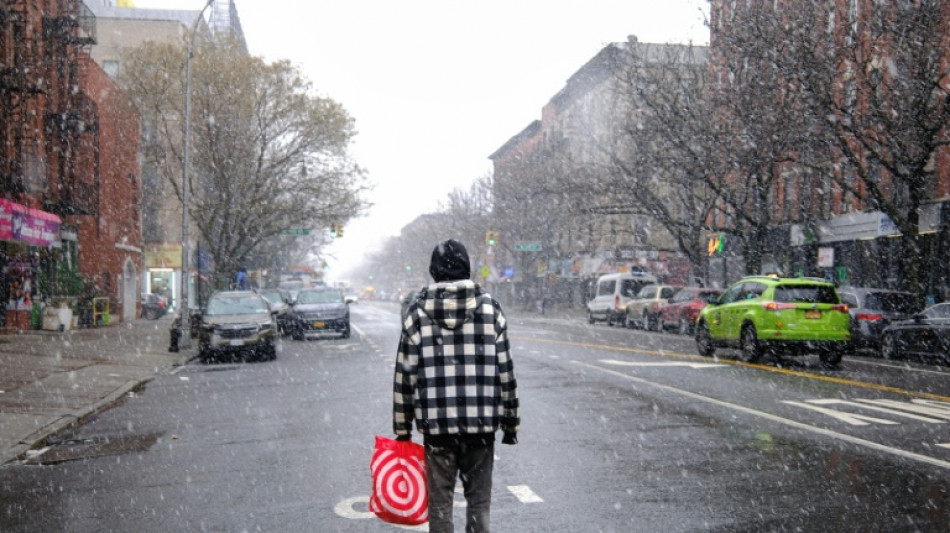
New York City, the US financial capital and the country's most populous urban area, could see as much as 12 inches of snow, the Weather Channel warned.

"Frigid temperatures will expand across the eastern two-thirds of the country behind an Arctic cold front," the National Weather Service said in an advisory.

"Frigid sub-zero and single digit temperatures will expand from the Northern Plains Thursday into the Mid-Mississippi Valley, Ohio Valley and Northeast by Sunday.

"This Arctic blast will be accompanied by gusty winds, leading to dangerous wind chills. The coldest wind chills may fall below minus 50 Fahrenheit (minus 46C) across the Northern Plains.

"Extreme cold warnings, extreme cold watches and cold weather advisories are in effect for parts of the Northern Plains and Upper Midwest beginning (Wednesday)."

An extremely cold air mass, combined with a frontal zone to its south will produce a major winter storm from the Central-Southern Plains region to the East Coast starting Friday and lasting into the weekend, the advisory added.

Some areas likely to be affected were bracing for the arrival of severe weather conditions.

In Texas, Governor Greg Abbott on Tuesday declared a state of emergency and activated emergency resources including the state's national guard and transport department assets to help ease the pressure on roads.

A combination of snow, rain and sleet could make travel almost impossible, local media warned.

The Monroe County Road Commission, which covers a large area outside Detroit, Michigan, warned "there is a shortage of salt."

"This year we've used more than we have the last four Decembers combined," David Leach, the commission's managing director, told CBS News.

In past years, rural areas in the northeast have been entirely cut off while snowplows attempted to clear roads.

R.Yeung--ThChM