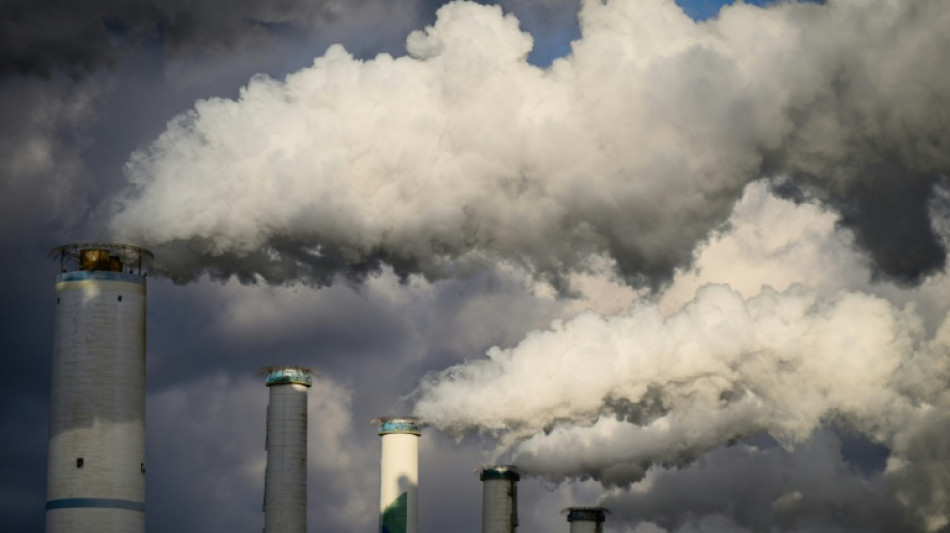
Lost in Trump's climate boast: best-case scenario abandoned / Photo: © AFP/File

As US President Donald Trump gloated over climate experts downgrading their worst-case emissions scenario, a key point was overshadowed: the most optimistic outcome has also been abandoned.
An international committee of climate experts published a paper last month that will overhaul the scenarios that have been used by researchers and included in the UN's major climate reports for years.
The little-publicised paper gained renewed attention when Trump, who has called global warming a hoax, seized on it on Saturday to claim that the worst-case projections from climate experts had been "wrong".
Detlef Van Vuuren, the paper's lead author and senior researcher at PBL Netherlands Environmental Assessment Agency, told AFP that Trump's social media post was a "completely incorrect interpretation" of the conclusions.
- Worst case scenario -
Experts previously established six scenarios more than 15 years ago.
The most extreme outcome -- sometimes called the "business-as-usual" scenario -- depicts a future in which humans continue the unabated burning of oil, gas and coal, which are responsible for most planet-heating emissions.
Previously known by the technical term RCP8.5, the worst-case outcome was replaced by SSP5-8.5 in the latest report of the UN's climate science body -- the Intergovernmental Panel on Climate Change (IPCC).
The IPCC's latest report, finalised in 2023, estimates global temperatures rising by between 3.3C and 5.7C by 2100 compared to pre-industrial levels, with a "best estimate" of 4.4C.
The most optimistic scenario sees warming kept close to 1.5C, with a brief "overshoot" slightly above that level, in a world where emissions are cut aggressively.
- New scenarios -
Last month's paper said the high emissions levels foreseen in the worst-case scenario "have become implausible" thanks to renewable energy, climate policies and recent emission trends.
Under their updated worst-case projection, temperatures could rise by almost 3.5C in 2100 over a preindustrial period defined as 1850-1900.
Replacing the old worst-case scenario "doesn't mean at all that we have made a lot of progress with respect to climate change", Van Vuuren said.
"The new high emissions would still lead to enormous climate damage," he added.
But the paper also rethinks the lowest emissions scenario, saying the "trajectories have become inconsistent with observed trends during the 2020–2030 period".
The new best-case scenario sees temperatures "overshooting" to at least 1.7C or even 1.8C before returning to 1.5C, Van Vuuren said.
"We don't find it plausible anymore to stay at 1.5 with only limited overshoot," Van Vuuren said. "Because emissions have increased so much. That scenario is not relevant anymore."
"I think the big change now is that they've pretty much completely abandoned the idea of non-overshoot scenarios," US climate expert Zeke Hausfather told AFP.
The old most optimistic scenario "assumed that we had started reducing emissions in 2020 and cut them rapidly by this point. And obviously, that didn't happen", Hausfather said.
IPCC chief Jim Skea said in October that breaching 1.5C was "almost inevitable", at least temporarily.
- 'WRONG!' -
But Trump focused on the rethink of the worst-case scenario.
"GOOD RIDDANCE!" he wrote on his Truth Social platform, taking a dig at Democrats with a deliberate typo.
"After 15 years of Dumocrats promising that 'Climate Change' is going to destroy the Planet, the United Nations TOP Climate Committee just admitted that its own projections (RCP8.5) were WRONG! WRONG! WRONG!""
French climate expert Christophe Cassou, who is among hundreds drafting the next IPCC report, said scientists "haven't been alarmist at all".
The world is not heading towards the worst-case scenario "because we've actually taken political measures allowing us to move away from that", he told AFP.
Cassou noted that both the old scenarios will appear in the next IPCC report, along with the new ones, as they were still cited in research.
Van Vuuren said the old scenario was "absolutely a legitimate choice".
"RCP8.5 has always been this low probability, high-risk scenario," he said, stressing that it is important for governments to explore "what could happen if things go wrong".
"Yes, there is some good news in the fact that we didn't follow the worst possible case," he said. "But that doesn't mean at all that climate change doesn't exist. It doesn't mean that people have overexaggerated climate change."
E.Lau--ThChM