As climate shifts, malaria gains ground in southern Africa / Photo: © AFP

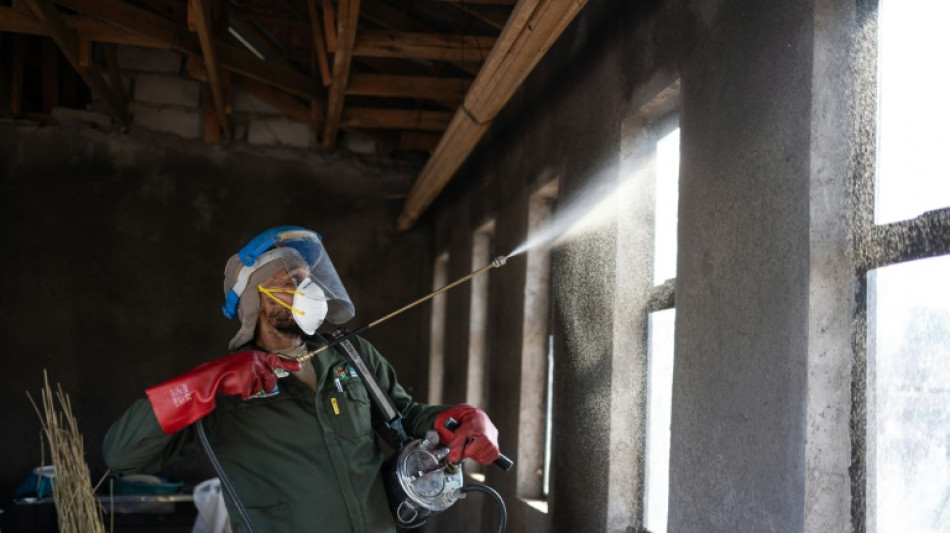
In a remote South African village, Paulina Mhlongo sits in the yard as health workers in green protective gear move briskly through her home, soaking the walls with anti-mosquito insecticide.
Her teenage grandson fell critically ill last year from malaria, the disease that kills more than a quarter of a million people annually and is surging in southern Africa as the climate shifts.
Before this spraying, the family's "only defence" against malaria-carrying mosquitoes was a rattling fan, said Mhlongo, a 63-year-old retiree.
Her village of Calcutta is in Mpumalanga, one of three provinces in South Africa's malaria belt experiencing changing rain patterns and rising temperatures that favour mosquito breeding.
Heavy rains leave pools for eggs, while warmer temperatures speed up mosquito development and shorten the malaria parasite's incubation period.
Malaria cases in Mpumalanga jumped fourfold in January compared with a year earlier, according to the National Institute for Communicable Diseases (NICD).
The upsurge jeopardises South Africa's goal of eliminating the disease by 2029.
Gauteng -- the powerhouse province home to Johannesburg and Pretoria, and where malaria is not endemic -- logged more than 400 cases and 11 deaths in the first three months of 2026, according to the NICD.
While most infections were imported into the province from known hotspots, these figures are "concerning" even if the disease is not being transmitted between people, the public health body said.
- Supercharging hotspots -
Human‑driven climate change has increased the likelihood and intensity of extreme weather, while the naturally occurring La Nina weather phenomenon brought above‑average rains to parts of southern Africa in early 2026, causing flooding that created more mosquito breeding sites, the group said.
Namibia reported 8,760 cases in the first four weeks of 2026, a 68-percent increase from a year earlier.
Flood-hit Mozambique recorded more than 1.35 million cases in the first six weeks of the year, up 55 percent alongside dozens of deaths.
The outlook offers little reassurance as climate volatility deepens.
The increase in malaria cases does not mean the disease is migrating, said Professor Jantjie Taljaard, head of infectious diseases at Stellenbosch University.
Instead, climate change is supercharging existing hotspots and lengthening transmission windows, fuelling far more intense outbreaks.
"Rural environments and areas on the margins of established malaria risk areas are at highest risk," Taljaard said.
The effects are being felt on the frontline at Cunningmoore Clinic, where technicians Nicholas Skhumbane and Armstrong Mgiba swiftly process a steady stream of blood samples from surrounding villages.
Working out of a threadbare laboratory, the two men, clad in white coats and latex gloves, move systematically from slide to slide.
They add a drop of Giemsa stain -- a purplish-blue dye that reveals malaria parasites -- before placing each sample under a microscope.
The results are returned just as quickly as at Tintswalo Hospital, a modern facility some 50 kilometres (30 miles) away.
- 'Even in winter' -
For health officials, the shifting weather patterns are forcing a rethink of malaria planning beyond traditional hotspots and seasons.
"Climate change is a complex thing to deal with," said Sharon Lindiwe Nyoni, malaria programme manager at the Mpumalanga department of health.
"When you plan as a department, you need to anticipate what is coming your way, but with climate change everything is just unfolding."
The old assumption that malaria is confined to summer no longer holds, she warned. "Even in winter, we continue to see transmission."
It is not only local health systems that are coming under strain, experts say, but also intervention efforts.
"Flooding can mean we simply cannot reach communities to deliver control measures," virologist Edina Amponsah-Dacosta told AFP.
Apart from heavy rains, extreme heat is a challenge as it can break the strict cold chain required before vaccines, which need refrigeration, ever reach remote clinics, she said.
Despite the rising case numbers, health workers say that some locals remain sceptical about the safety of the insecticide spray and refuse to let health workers inside their homes.
"It is very painful to see someone dying of something that is preventable and again curable," Nyoni said.
Back in Calcutta, Mhlongo waited outside as the sharp scent of insecticide drifted from her freshly sprayed nine-room house, which she shares with eight relatives.
Empty beer cans littered the back of a nearby pickup truck propped on rocks -- a place the sprayers warned could harbour mosquitoes.
"I am happy because mosquitoes are a problem," Mhlongo said, serving the spray team a homemade snack of maize meal, sugar and groundnuts as a neighbour's music drifted across the farming village.
A.Kwok--ThChM