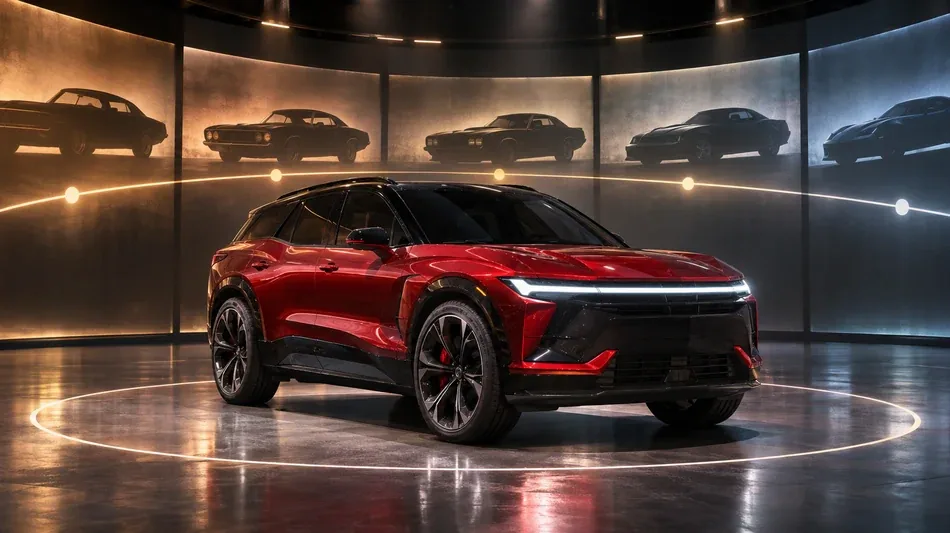
Chevrolet Blazer EV SS tested against decades of Super Sport models

A test of the 615-horsepower Chevrolet Blazer EV SS compares the electric SUV with successful and unsuccessful uses of the Super Sport badge.
A recent test of a 2026 Chevy Blazer EV SS prompted a review of where Chevy’s electric family hot rod fits in the history of SS-badged machines. Chevy established the Super Sport trim in the 1960s with some legendary cars (Impala, Chevelle, Camaro, Nova) and then applied it scattershot over the decades, with some latter-day SS models worthy of the heritage and others an exercise in credibility dilution.
I am a self-appointed expert on which SS models rocked, and which ones should have been an RS at best (in high school, we all knew RS stood for Really Slow). So here are my SS rankings, grouped by Worthy of the Name and Should Have Been an RS. Fun fact: One SS was both.
I drove a Camaro SS 1LE at Carolina Motorsports Park for our How Fast Does Your Car Have to Be to Outrun a Cop? story. Our cop-evading candidates also included a Ferrari 488 GTB, and while the Ferrari was the quickest car of the day, the Camaro wasn’t as far behind as you might expect. It’s also possible that I just felt more comfortable pushing a Camaro than I did a Ferrari, but the SS 1LE remains the track-rat bargain of this century. I still want one.
One of my high school hobbies was cadging test drives at car dealerships. Maybe I should have felt bad about wasting dealers’ time, but on some level I believed that I might actually buy whatever car I was begging for a drive. And I was arriving in my IROC, which was presentable enough to imply at least some trade-in value. I drove plenty of cars—the second-generation Ford Probe GT with its frisky V-6 was a pleasant surprise—but I did get shut down whenever I exceeded the threshold of deal-signing plausibility that was assigned when I rolled onto a given lot. That’s what happened when I asked to drive a 1994 Impala SS that was in the showroom of a local car dealer. I vividly remember what the salesman told me: “If everyone drives it, nobody buys it.” Instead, he gave me the keys to a Monte Carlo SS. I was amazed that a car with a similar engine to mine (the ubiquitous Chevy 5.0) could be so much slower. “Someday, I’ll write a story about how not all Chevys deserve an SS badge,” I probably didn’t say. But let’s imagine I did. What a perceptive lad!
I still haven’t driven a bubble-Caprice Impala SS. But I continue to revere them. They’re like a cop car, but cooler!
Speaking of cop-cars-but-cooler, the Chevy SS was the civilian version of the contemporary Caprice, and it was like Chevy’s version of an E39 BMW M5, complete with 415 horsepower and an available manual transmission. Of course, just right is never enough, so we had Lingenfelter Performance Engineering bolt on a supercharger before I took an SS on a multi-state investigation of the history of bootlegging. Sliding that car around on dirt roads out in moonshine country was so much fun I almost forgot I had a job to do. Which may or may not have involved bringing some things in the trunk back to Michigan. I get amnesia when I try to recall any details about that, but the SS—that I remember, and fondly. If you want one, maybe don’t wait too long, because the SS secret is out, based on what I see lurking on Bring a Trailer.
I’ve never driven a Chevelle SS, but when we had one in a comparison test, it sounded like it was a royal handful. A 13.81-second quarter-mile at 102 mph isn’t super quick now, but consider that the first 500 feet of that run was probably devoted to wheelspin management as the 7.4-liter, 450-hp (gross-rated) V-8 abused the primitive tires of the day.
Of the Chevelle’s brakes, Sam Posey stated, “While they’re working, they are predictable.”
2005–2010 Cobalt SS (the Forced-Induction Ones)
The Cobalt SS was a sneaky performance car when it debuted with a supercharged, 205-hp four-cylinder in 2005, and later got a 260-hp turbocharged upgrade. Chevy also built it in naturally aspirated form (hold that thought). This was around the time when GM started to figure out the concept of handling, and the Cobalt SS’s excellent all-around performance prompted me to conjure an unlikely contest in 2006. The premise: I race against Dale Earnhardt, Jr., around a tight road course at the Charlotte Motor Speedway infield. He’d get a Cobalt SS. And I’d get a 505-hp Corvette Z06. I beat him, but not for his lack of trying—he pushed that Cobalt so hard he pitted in with gravel falling out of the left-rear wheel because his track-out lines were starting to include real estate beyond the actual track.
Then we went Corvette to Corvette, and that went how you’d expect, as evidenced by his note in my Z06 press kit: “Good luck next time. Dale Jr., 30.8 (you 32.2).”
Dropping a dang Corvette engine in a family SUV is usually the sort of procedure that requires an engine hoist, a wrecked C4, and a long weekend. But in 2006 Chevy did that deed at the factory, giving us the Trailblazer SS, a 395-hp SUV that hit 60 mph in 5.5 seconds and conjured the casual menace of the ‘90s Impala SS. It also had upgraded brakes and suspension, modifications that our John Phillips described as “comprehensively testosteronated”. If you like the whole Trailblazer SS deal but wish it were weirder, GM also built a Saab version, the 9-7X Aero. It was about as Swedish as apple pie at a baseball game on the Fourth of July, and remains the most powerful Saab I can think of at the moment.
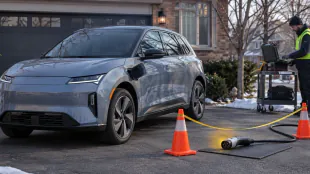
OK, the stopwatch doesn’t lie: the Blazer EV SS destroys its predecessors at the drag strip. The trip to 60 mph is over in 3.3 seconds, and the quarter-mile requires just 11.8 seconds. That beats an automatic 2019 Camaro SS (3.9 and 12.2 seconds for those respective runs), which itself was slightly quicker than the manual Camaro SSs we tested. On power alone—615 horsepower and 650 pound-feet of torque—the electric Blazer deserves entry to the SS club.
In other ways, it’s merely casually sporty, but that’s been the SS mien in a lot of cases. I appreciate that you can get it in habanero orange, an extroverted hue that caused one of my kids to mistake it for a Lamborghini Urus for about 50 milliseconds. And, in this age of inflation, the $395 performance package is a huge bargain for the upgrades it brings: 22-inch summer tires and high-friction brake pads and rotors. Those front rotors are 15.3 inches and are grabbed by six-piston Brembo calipers. That’s legit hardware, as evidenced by its 157-foot stop from 60 mph.
The Blazer EV SS interior gives you some SS branding on the seats and steering wheel but otherwise looks mostly like any other Blazer EV, which is to say mostly like any other Chevy SUV. Which is fine. If I were the person at GM in charge of cost-benefit analysis, I too would opt for cruddy lower door plastic as long as I got to keep Super Cruise.
The Blazer EV SS is worthy of the SS badge. Whether it’s worthy of the Blazer one is a different discussion that you can continue on your forum, K5 Freaks 4EVR.
The “Should Have Been An RS” Crowd
The positive news here was that Chevy brought back a V-8-powered Impala SS that was good at doing burnouts. The bad news was that it could barely avoid doing burnouts at all times because it was front-wheel-drive. Yes, Chevy dropped a dang 303-hp LS engine in the front-drive Impala of the day, resulting in torque steer that made every ditch a possibility. Our own Tony Quiroga described that Impala SS as a car that “gives the feeling that it’s waging war with itself”. Other observations from that review:
-“Keeping an 18-year-old platform competitive is not an insubstantial task.”
-“Dive, squat, and roll control could be described as nautical.”
-On the skidpad, “The Impala leaned over far enough to be included in Who's Who in Body Roll.”
-“Impressed by the 154-mph top speed? Driving the SS at that speed is scary enough to be a stunt on NBC's Fear Factor.”
-“The front-strut suspension crashes over pavement imperfections as if someone had overlooked the advantages of bushings.”
At the time, my wife had an Impala as a company car. She was a pharma sales rep for Johnson & Johnson, and her trunk was always full of Tylenol PM and K-Y Jelly. It would have been funny if she ever got pulled over and searched. Also, the second “A” of the trunk badge fell off, so we fondly referred to her car as the Impal. That was the right assignment for that era of Impala.
During the early-2000s hot-truck heyday, there were some wicked creations. Ford stated, “Let’s put a 380-hp supercharged V-8 in a regular-cab two-wheel-drive F-150, call it the Lightning and do some huge burnouts.” Over at Dodge, they stated, “Let’s drop a 500-hp Viper V-10 in a regular-cab, two-wheel-drive Ram, call it the SRT-10 and do some even huger burnouts.” When Chevy got in on the game, it stated, “Let’s build a Silverado with an extended cab, all-wheel-drive, and 345 hp. We’ll call it the SS, and it won’t do burnouts.” Eventually Chevy built a rear-drive version, but the Silverado SS still got noogies and purple nurples at recess from the Dodge and Ford.
We stated the Maxx itself was “a runty-looking cross between a family sedan and an ice chest,” and the SS treatment didn’t do a whole lot to energize that off-putting shape. The Maxx SS was powered by an iron-block pushrod V-6 that made all of 240 horsepower, sloshed to the front wheels by a four-speed automatic. It hit 60 mph in 6.9 seconds and topped out at a governed 115 mph. This Malibu Maxx didn’t need to be called an SS. In fact, this Malibu Maxx didn’t need to be at all. It reminded me of when I bought reflective mailbox lettering decals and made my parents’ rusty 1989 Subaru DL wagon the DL SS.
How is the Cobalt SS on both the worthy list and the SS trash pile? Because for two years, Chevy offered a naturally aspirated version that wheezed out just 170 horsepower. (The good version was formally named the Cobalt SS Supercharged.) Chevy itself got embarrassed by this SS’s half-heartedness and renamed it the Cobalt Sport after two years, proving that even pre-bankruptcy GM had limits to its cynicism. Happily, no subsequent SS stooped to that level, and hopefully none ever will.
C.Fong--ThChM